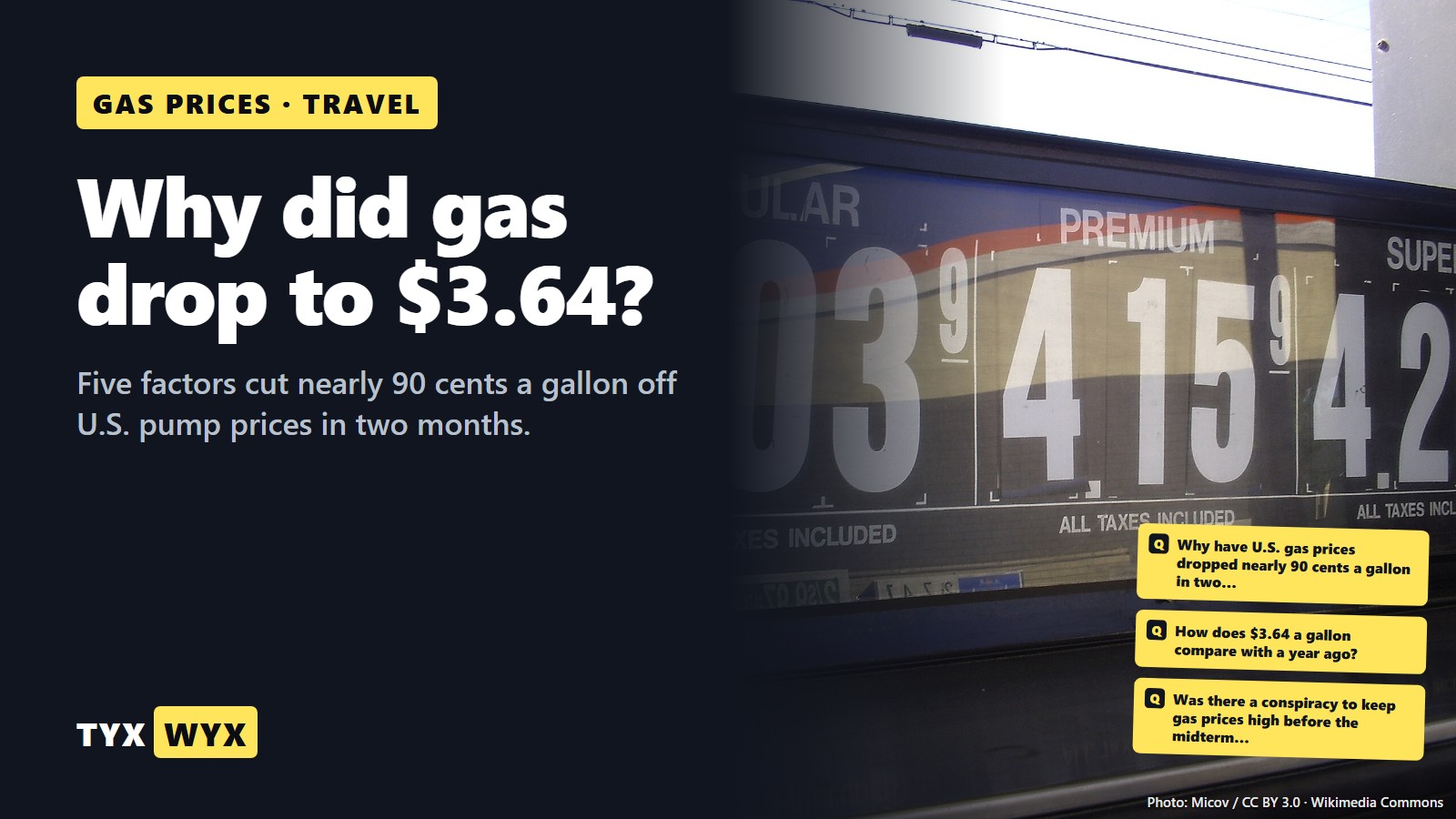
- Average U.S. regular unleaded gasoline fell nearly 90 cents a gallon over two months to $3.64 on Monday, its lowest level since the early days of the Iran war.
- The national average remains 57 cents a gallon higher than a year ago, according to AAA, and nearly 20% of Thanksgiving travelers told GasBuddy they will cut other holiday spending to pay for fuel.
- If Middle East energy flows avoid fresh disruptions, GasBuddy’s Patrick De Haan says the national average could bottom out as low as $3.35 a gallon over the next few weeks.
What happened
Just as 72.9 million Americans prepare to drive for Thanksgiving, according to AAA projections cited by Fortune, U.S. regular gasoline has dropped nearly 90 cents a gallon in two months to hit a national average of $3.64 on Monday — its lowest level since the early days of the Iran war, Fortune reported.
Think of a refinery like a commercial bakery oven that bakes bread and rolls on the same tray: when refiners crank up the heat to meet surging autumn diesel demand and delay maintenance into next year, extra gasoline comes out of the pipe right alongside it. Combined with global crude dipping slightly below $90 a barrel and winter-grade fuel replacing pricier summer blends, consumers are getting a holiday reprieve at the pump — even if prices remain 57 cents above last year’s level.
FIVE QUESTIONS
U.S. Thanksgiving fuel prices · $3.64 a gallon national average, Nov 23–24, 2026
Why have U.S. gas prices dropped nearly 90 cents a gallon in two months?
Fortune reported that five converging forces pushed gasoline down since late September: rebounding Middle East oil exports, reduced fears of immediate U.S. military escalation after the midterm elections, the annual shift to cheaper winter-grade fuel and slower cold-weather driving, resolved Midwest refinery outages alongside rising Chinese fuel exports, and U.S. refineries running full tilt to produce diesel. As Fortune explained, refining complexes cannot operate like light switches for a single product, so running at maximum utilization for fall diesel demand automatically pumps out extra gasoline.
Patrick De Haan, head of petroleum analysis at GasBuddy, told Fortune: “The scale of decline has been a little bit surprising,” adding, “But, given how things have developed, it’s not really a shock.” On the refinery rebound, De Haan told Fortune: “Refineries are operating at their highest November rate since 1998,” and “This may be the highest utilization year for refineries ever. It’s going to be really close.”
How does $3.64 a gallon compare with a year ago?
Even after plunging nearly 90 cents in two months, Monday’s $3.64 national average for regular unleaded is still 57 cents higher than it was a year ago, according to AAA data cited by Fortune. Over the weekend, drivers in some parts of the country saw pump prices hovering at — or occasionally below — the $3 mark.
By our math, the national average needs to fall just 6 cents more to match the $3.58 level where it stood on Thanksgiving Day 2022, based on the figures reported by Fortune. AAA projects 72.9 million Americans will travel by road this Thanksgiving, down only slightly from 73.1 million last year, while GasBuddy survey data cited by Fortune showed almost two-thirds of Americans plan to hit the road this week and close to 20% will cut back on other holiday spending to cover fuel costs.
Was there a conspiracy to keep gas prices high before the midterm elections?
No — Fortune explicitly reported that “there wasn’t any conspiracy to keep prices higher ahead of the midterm elections,” while noting that President Donald Trump’s actions were key contributors to the swing. Prior to the midterms, Trump openly said he was delaying any major ramp-up in attacks until after the elections, a warning that kept oil prices inflated as markets priced in potential November supply disruptions.
Since the midterm elections and the blue wave of Democratic wins, Trump has downplayed any large military escalation, helping crude prices cool even without a peace deal on the horizon. At the same time, non-political refinery bottlenecks had inflated September and October pump prices, including weather and mechanical outages at ExxonMobil’s Joliet and Phillips 66’s Wood River refineries in Illinois. “The refining issues were boosting prices ahead of the election,” De Haan told Fortune. “As these issues have been getting resolved, they’ve been pushing prices down, coupled with the seasonality, coupled with oil markets.”
How much Middle East oil has returned to global markets?
Despite ongoing conflict and depleted strategic oil reserves worldwide, the Middle East has returned to nearly 90% of its pre-war oil exports, including shipments exiting the Strait of Hormuz, Fortune reported. That recovery has relied on a combination of U.S. naval escorts, complicated oil tanker transfers, and pipeline bypass routes.
High tanker contracting and insurance costs are still keeping crude elevated, and nearly 10% of global refineries remain offline largely in the Middle East and Russia because of wars, according to Fortune. Even so, the rebound in Middle East exports — combined with China ramping up refinery output and fuel exports after drawing down its own reserves during the Iran war — helped push the global oil benchmark slightly below $90 per barrel on Monday.
Could gas prices fall even further after Thanksgiving?
Yes, if geopolitical tensions stay contained. De Haan told Fortune that if there are no more major energy disruptions in the Middle East, the U.S. national average for regular gasoline could bottom out as low as $3.35 per gallon over the next few weeks.
Seasonal physics also favor drivers heading into December: driving demand typically bottoms out in winter, and winter-grade gasoline is cheaper and less complex to refine than summer-grade fuel, which requires extra additives to prevent evaporation in the heat, Fortune noted. Still, De Haan cautioned in Fortune that one big variable hangs over the market: “The biggest thing now is this looming uncertainty over whether there will be something concrete and long-lasting.”
What we still don’t know
- Whether the post-midterm pause in major Middle East military escalation will hold long enough for the national average to reach De Haan’s projected $3.35-a-gallon floor.
- How quickly deferred U.S. refinery maintenance scheduled for next year — alongside the roughly 10% of global refining capacity still offline due to wars in the Middle East and Russia — will tighten fuel supplies again in 2027.