- The U.S. Commerce Department added 7 entities across Malaysia, Singapore, and Thailand — including Megaspeed — to its trade blacklist on November 23, 2026.
- Any company wanting to ship U.S.-origin tech or advanced chips to those seven firms now needs a federal license reviewed under a presumption of denial.
- With the Justice Department and Singapore authorities still probing alleged chip diversion to China, how much overseas AI hardware demand gets cut off next?
What happened
On Monday afternoon, November 23, 2026 — the exact day Nvidia’s board reinstated Jensen Huang as chief executive — the U.S. Department of Commerce placed Megaspeed, the Singapore-based cloud and AI infrastructure provider at the center of Nvidia’s recent turmoil, onto the federal Entity List.
According to the final rule filed with the Federal Register at 4:15 p.m. by the Bureau of Industry and Security (BIS), the U.S. government added 7 entities under the destinations of Malaysia, Singapore, and Thailand. The filing states that the seven firms were determined to be acting contrary to the national security or foreign policy interests of the United States.
Megaspeed was one of Nvidia’s biggest chip customers during the period when Jensen Huang had a self-admitted affair with Alice Huang, an executive who led Megaspeed for over two years and was suspected of links to Chinese espionage, TechCrunch and Semafor reported. Last week, the Commerce Department announced a criminal probe into Megaspeed, and authorities in both the U.S. and Singapore are investigating whether the firm illegally smuggled Nvidia chips to China, according to TechCrunch.
Semafor first reported the plans to blacklist the company on Monday. Hours later, the formal regulatory text landed on public inspection, scheduled for official publication on November 25, 2026.
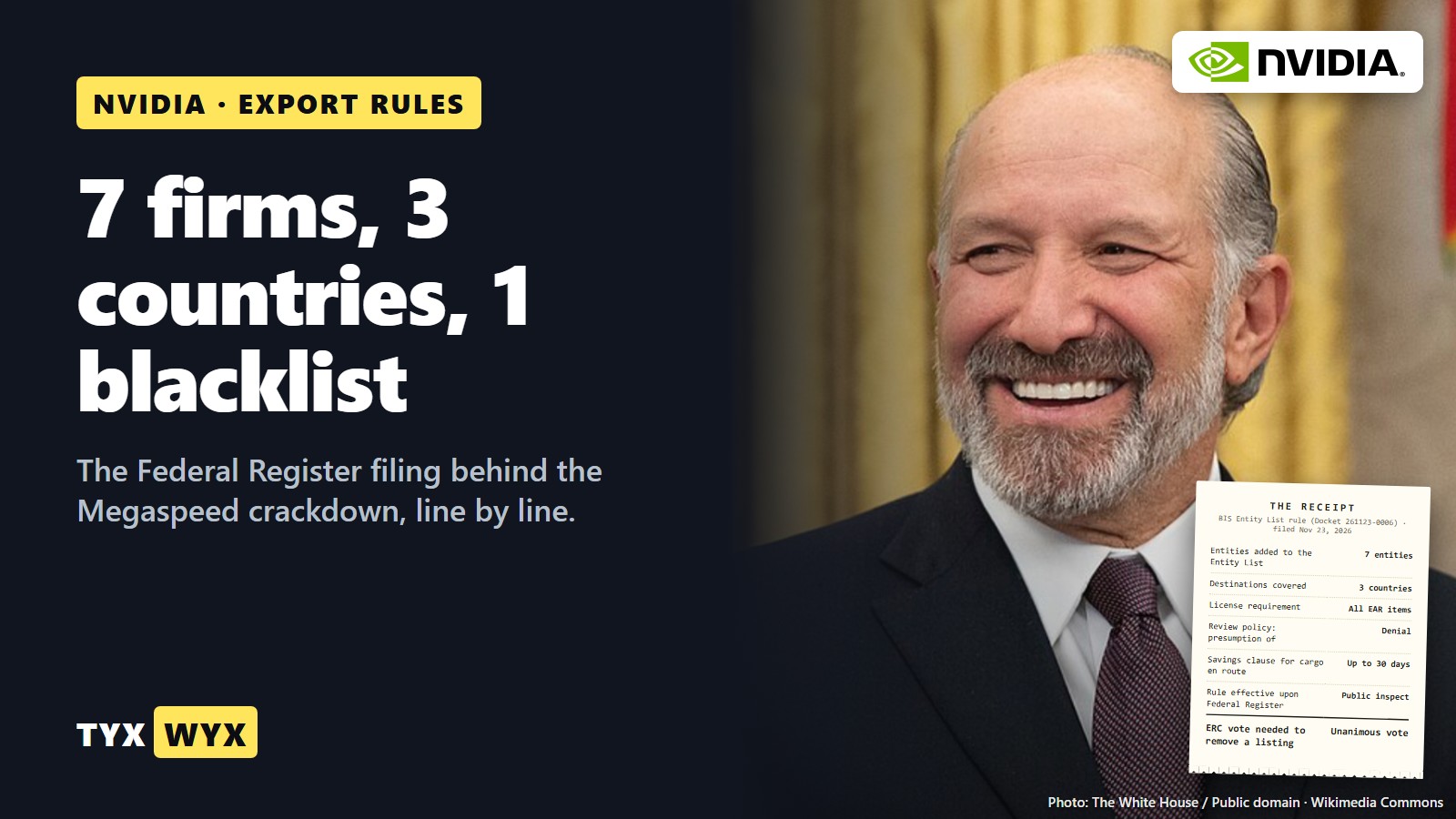
THE RECEIPT
BIS Entity List rule (Docket 261123-0006) · filed Nov 23, 2026
| Entities added to the Entity List | 7 entities |
| Destinations covered | 3 countries |
| License requirement | All EAR items |
| Review policy: presumption of | Denial |
| Savings clause for cargo en route | Up to 30 days |
| Rule effective upon Federal Register | Public inspect |
| ERC vote needed to remove a listing | Unanimous vote |
All regulatory terms come directly from Commerce Department Bureau of Industry and Security Docket No. 261123-0006, filed Nov 23, 2026 at 4:15 p.m.
Seven names in three countries: what the Federal Register actually says
In Washington headlines, the Entity List is often called a trade ban. Technically, the rule does not use the word ban. Instead, it imposes a license requirement for all items subject to the Export Administration Regulations (EAR) whenever a listed firm is a party to the transaction — and sets the license review policy to a presumption of denial.
Think of it like a guarded checkpoint that leaves an application window open on paper, while handing the guard a stamp that says “No” by default. You are allowed to ask for permission, but the rule instructs reviewers to turn you down unless you overcome that presumption.
The BIS filing names all seven targets across three countries:
- Malaysia: MSFusion Sdn. Bhd.; PT Megaspeed International; and Speedmatrix Sdn Bhd (also known as Speedmatrix).
- Singapore: Apex Enterprise Solutions (Singapore) Private Limited (also known as Apex); Megaspeed International Pte. Ltd. (also listed under four aliases, including 7Road International); and Swiftdata Pte. Ltd.
- Thailand: Megaspeed (Thailand) Co., Ltd. (also listed under the 7Road International aliases).
The Federal Register text explains the trigger in one sentence:
“These additions are being made because of the significant risk of these entities being or becoming involved in the diversion of advanced computing commodities to unauthorized end uses or end users.”Bureau of Industry and Security, 15 CFR Part 744 Final Rule
BIS spokesman Thomas Wackman told Semafor that the rule makes it unlawful to export any U.S.-origin goods, software, or technology to Megaspeed — and makes it unlawful to export advanced AI chips to the company even if those chips are produced outside the United States.
Who pushed Commerce to move — and the 30-day escape hatch
Why did the crackdown arrive on the same Monday that Huang returned to Nvidia’s corner office? Semafor reported that Commerce Secretary Howard Lutnick had been under mounting pressure from others inside the Trump administration and from bipartisan lawmakers to put Megaspeed on the Entity List and explain his decisions around chip export controls.
Earlier this month, Treasury Secretary Scott Bessent said his department — along with the Pentagon, the State Department, and the U.S. Trade Representative — had backed putting Megaspeed on the list “for months,” adding that “Commerce holds the pen,” Semafor reported. Under EAR rules cited in the filing, the interagency End-User Review Committee (ERC), chaired by Commerce and including State, Defense, Energy, and Treasury, adds entries by a majority vote. Getting off the list is much harder: removal requires a unanimous vote.
The Federal Register document also contains a standard “Savings Clause.” Shipments that were already en route aboard a carrier to a port of export, reexport, or in-country transfer on the date of public inspection, pursuant to actual orders, may still proceed without a new license — provided the delivery is completed no later than 30 days after public inspection.
The other side
Megaspeed has denied wrongdoing regarding allegations that it defied export restrictions or smuggled Nvidia chips to China, TechCrunch reported. Meanwhile, the political signal from Washington on Monday cut in two directions at once: while Commerce locked down Megaspeed and its affiliates, Semafor and TechCrunch reported that President Donald Trump lobbied for Nvidia’s board to reinstate Jensen Huang as CEO on the very same day. Furthermore, the rule’s 30-day Savings Clause means equipment already loaded onto ships or planes before the filing was posted is not seized mid-transit.
What it means for your wallet
If you hold semiconductor stocks or broad U.S. index funds, the Entity List filing shows how Washington is separating Nvidia’s executive leadership from its overseas customer map. Huang is back at the helm, which cheered equity traders on Monday, yet federal export enforcement is tightening at the exact same moment.
Because the BIS rule applies to advanced chips even when manufactured abroad, foreign cloud buyers in Southeast Asia face immediate compliance hurdles if federal officials suspect diversion risks. For long-term investors, the lesson is that white-house support for a domestic chip champion does not mean a free pass for the overseas data centers buying its hardware.
What we still don’t know
- How much revenue or backlog Nvidia and its server partners had tied to the seven newly listed entities in Malaysia, Singapore, and Thailand.
- Whether any shipments were already en route on November 23 and will cross the finish line under the 30-day Savings Clause.
- What the ongoing Justice Department criminal investigation and Singapore probe into Megaspeed will conclude.
- Federal Register Public Inspection — BIS Final Rule: Additions to the Entity List, Docket No. 261123-0006 (filed Nov 23, 2026)
- Semafor — Commerce adds Megaspeed to trade blacklist (Nov 23, 2026)
- TechCrunch — Megaspeed, the company at the center of the Jensen Huang scandal, appears headed for a US blacklist (Nov 23, 2026)