- CNBC reported that Nvidia gained nearly $1 trillion and rose 31% on Monday after its board reversed course and reinstated Huang as CEO, before trading around 5% lower in Tuesday’s premarket.
- Four tracks of scrutiny remain open: California’s Department of Justice, the U.S. Securities and Exchange Commission (as Reuters reported), Nvidia’s own board probe, and two appearances before Congress in December.
- Five market voices quoted by CNBC split between those who think U.S. government assurances lower the odds of stock damage and those who warn that governance questions and scrutiny could slow deal-making.
What happened
CNBC reported that Nvidia gained nearly $1 trillion after an abrupt board reversal reinstated Huang as CEO, just days after Nvidia’s new board chair, Harvey Jones, rejected calls to reinstate Huang on Nov. 17. Shares rose 31% Monday and were around 5% lower in Tuesday’s premarket trading. Nvidia had not responded to a CNBC request for comment as the story went live.
Four inquiries still hang over the chipmaker:
- California’s Department of Justice is probing whether Nvidia’s advanced chips or confidential information may have gone to China and whether Nvidia misled investors and the public.
- Reuters reported on Friday that the U.S. Securities and Exchange Commission is looking into the company’s accounting practices; the SEC declined to comment.
- Nvidia is investigating reports that Huang had been the target of a foreign intelligence effort, which the company said on Monday would continue as it restored him to the top job.
- Congress expects Huang to appear twice in December on China’s access to advanced Nvidia chips and U.S. export controls, as lawmakers from both parties expressed anger and doubled down on calls for investigations.
IN THEIR OWN WORDS
Five analysts and investors on Nvidia’s open investigations · notes and CNBC, Nov 23–24, 2026
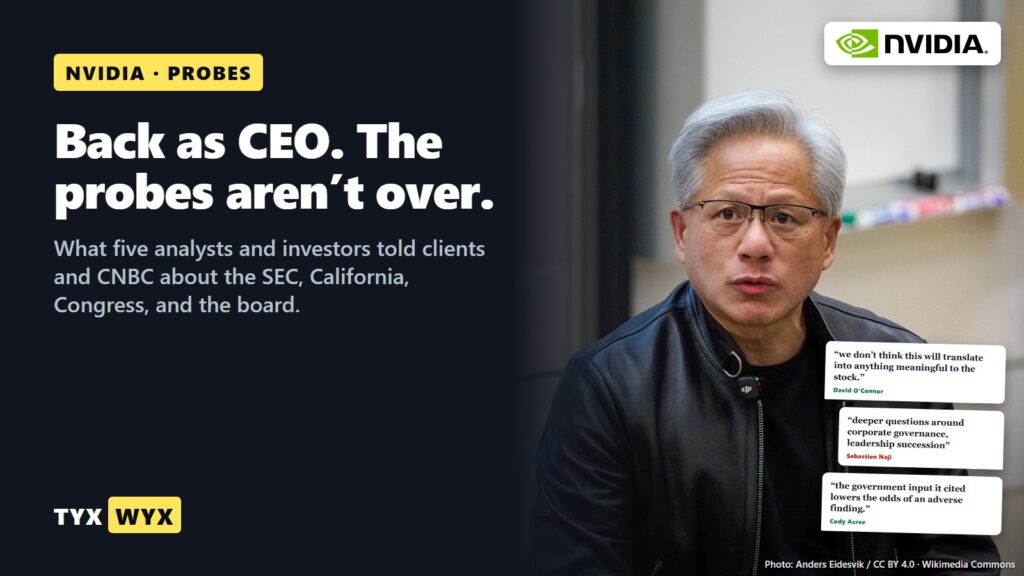
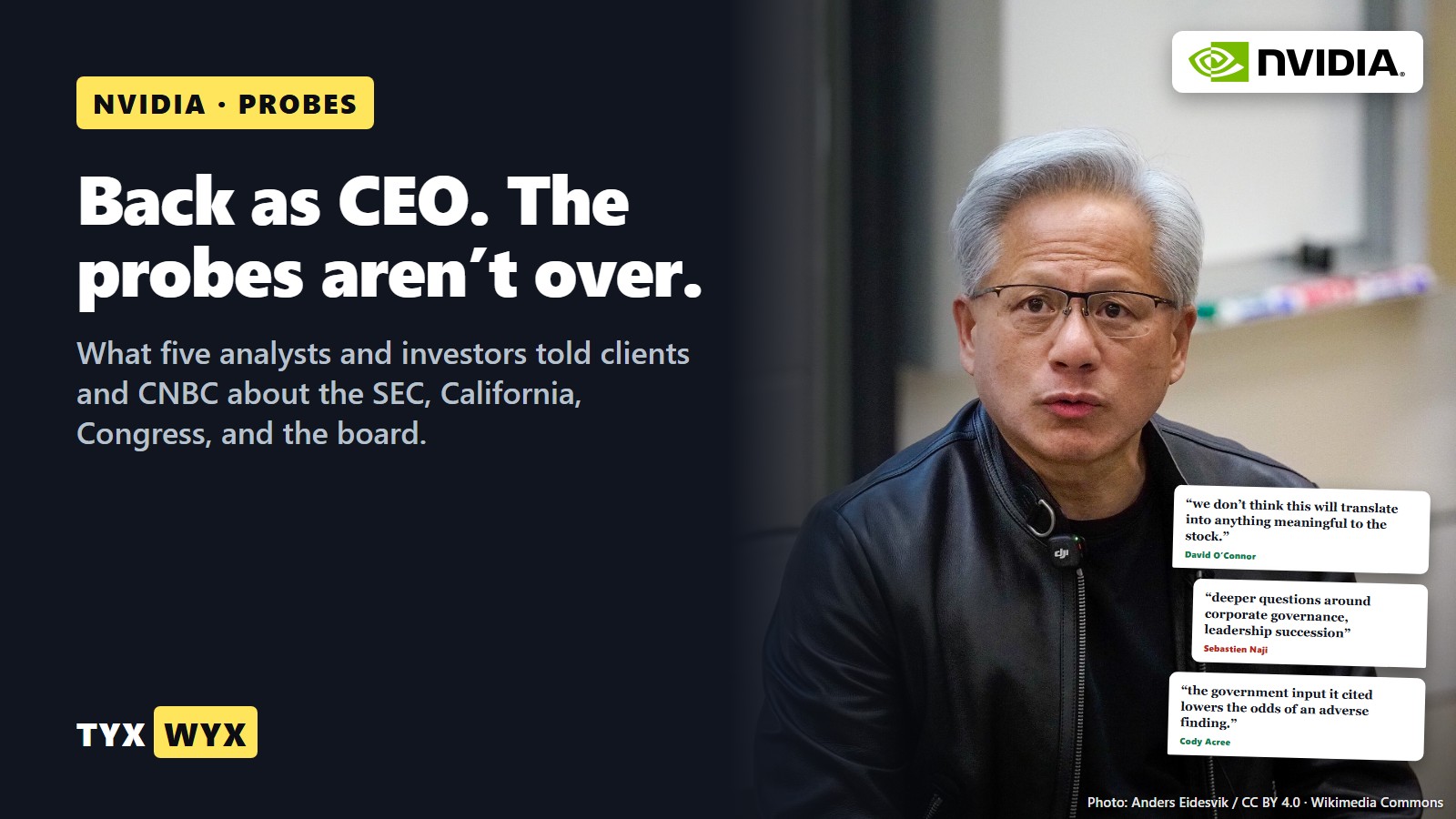
“we don’t think this will translate into anything meaningful to the stock.”
in a note on Monday (reported by CNBC)
“confidence in where the investigation is heading, and the government input it cited lowers the odds of an adverse finding.”
in a note on Monday (reported by CNBC)
“events of recent weeks have exposed deeper questions around corporate governance, leadership succession, and regulatory oversight that could have lasting implications for the company’s competitive position”
in a note on Monday (reported by CNBC)
“With all the scrutiny they’re going to be under, it’s going to be very difficult for them to have the same level of deal-making capacity out there in the marketplace.”
on CNBC’s “Access Middle East” on Tuesday
“legitimate questions as to their judgment and process, which has to make one wonder how they come to their other important decisions.”
in a note on Monday (reported by CNBC)
Quotes are taken verbatim from each analyst’s Monday research note or Tuesday broadcast appearance as reported by CNBC.
Who thinks the risk is fading — and who still worries
Trump told CNBC Monday that he personally intervened to speak with the board about reinstating Huang. The president posted on Truth Social on Monday that the U.S. government has “no reason to believe” Huang’s return poses a risk to national security and “does not possess evidence that he has engaged in any unlawful conduct.”
By our math, two of the five market voices quoted by CNBC leaned on those assurances, while three flagged governance and deal-making risks. David O’Connor, senior research analyst at Piper Sandler, said in a Monday note that Congress will “likely want their answers” from Huang, but given U.S. government assurances on national security, “we don’t think this will translate into anything meaningful to the stock.” Cody Acree, analyst at StoneX, wrote in a Monday note that the board’s investigation is the “key risk” remaining — and any conclusion that “confidential information was shared” or compliance was compromised would “reopen the leadership question” — yet Huang’s reinstatement showed “confidence in where the investigation is heading, and the government input it cited lowers the odds of an adverse finding.”
The cautious camp views the rebound like a plane cleared to fly while inspectors still hold the flight recorder. Sebastien Naji, analyst at William Blair, wrote in a Monday note that Huang’s return “clears some of the uncertainty,” but “events of recent weeks have exposed deeper questions around corporate governance, leadership succession, and regulatory oversight that could have lasting implications for the company’s competitive position.” Stacy A. Rasgon, managing director at Bernstein, said in a Monday note that the board faced “legitimate questions as to their judgment and process, which has to make one wonder how they come to their other important decisions,” adding that Democrats taking over Congress in January could keep Huang and Nvidia in the “crosshairs.” On Tuesday, Richard Reyle, chief investment officer at Questar Capital Partners, told CNBC’s “Access Middle East” that Nvidia is “kind of the central bank of the AI trade,” warning: “With all the scrutiny they’re going to be under, it’s going to be very difficult for them to have the same level of deal-making capacity out there in the marketplace.”
What we still don’t know
- What Nvidia’s board investigation, California’s Department of Justice, and the U.S. Securities and Exchange Commission will conclude.
- What emerges when Huang appears before Congress twice in December, and when Nvidia will comment publicly.