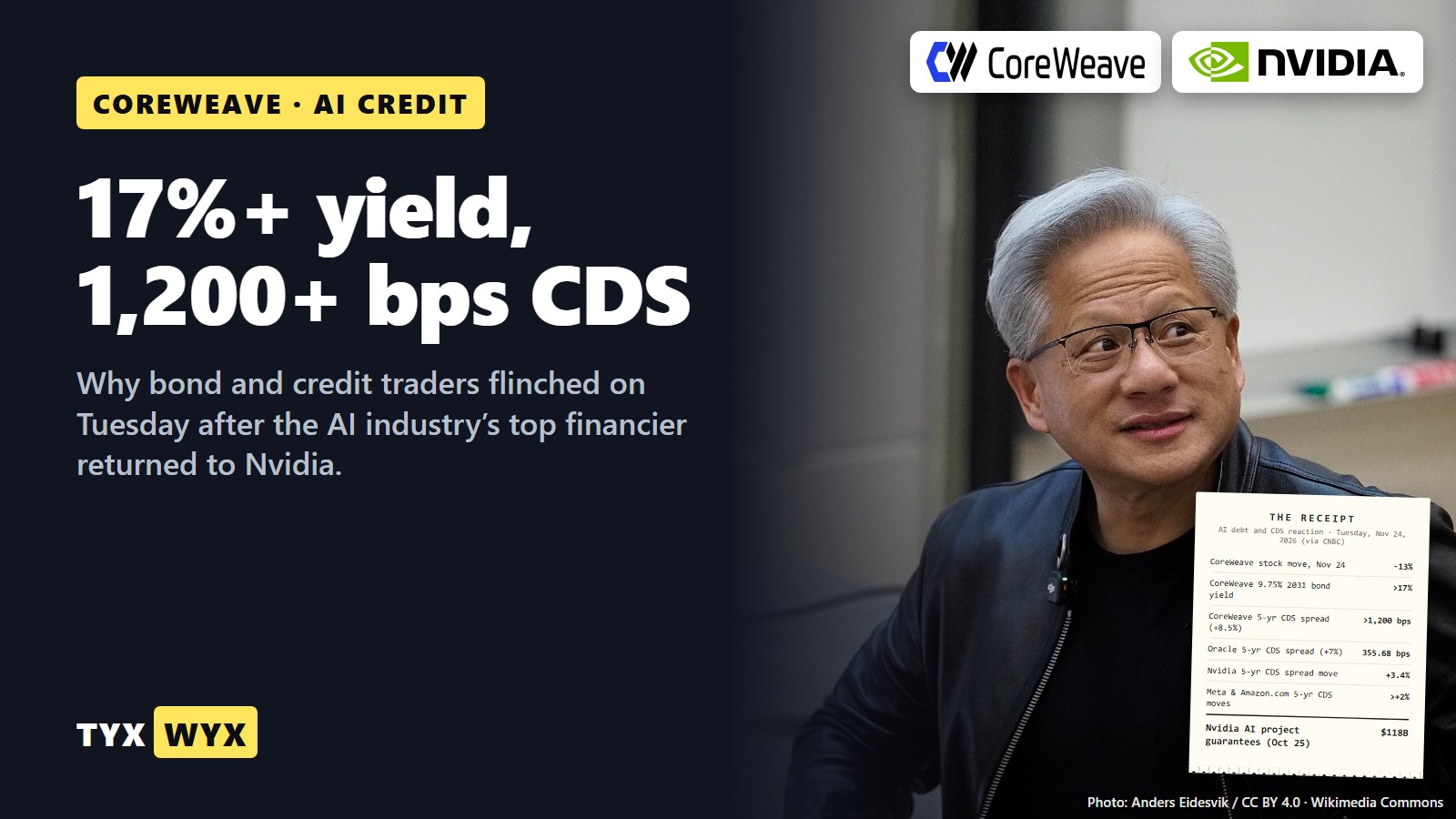
- On Tuesday — one day after Jensen Huang returned as Nvidia CEO — CoreWeave’s stock sank 13%, the yield on its 9.75% bond due in 2031 topped 17%, and its five-year CDS spread jumped 8.5% to over 1,200 basis points, CNBC reported.
- Credit default swap spreads also widened for Oracle (+7% to 355.68), Nvidia (+3.4%), and hyperscalers Meta Platforms and Amazon.com (more than +2% each).
- Wall Street is split on whether Huang will double down on Nvidia’s circular financing — backed by $118 billion in AI project guarantees as of October 25 — or face lingering scrutiny from credit investors and ongoing investigations.
What happened
AI credit markets shuddered on Tuesday, November 24, 2026 — just one day after Jensen Huang returned as CEO of Nvidia, CNBC reported. While investors cheered Huang’s Monday reinstatement by pushing stocks higher, bond yields lower, and credit spreads tighter, all three moves reversed on Tuesday as debt traders weighed what his return means for the massive borrowing funding the artificial intelligence buildout.
CoreWeave, a neocloud company that rents out AI computing power and has become the poster child of AI debt concerns, saw its stock sink 13% on Tuesday. The yield on its 9.75% bond due in 2031 topped 17% — bond yields move inversely to prices — while the spread on its five-year credit default swaps jumped 8.5% to over 1,200 basis points.
THE RECEIPT
AI debt and CDS reaction · Tuesday, Nov 24, 2026 (via CNBC)
| CoreWeave stock move, Nov 24 | -13% |
| CoreWeave 9.75% 2031 bond yield | >17% |
| CoreWeave 5-yr CDS spread (+8.5%) | >1,200 bps |
| Oracle 5-yr CDS spread (+7%) | 355.68 bps |
| Nvidia 5-yr CDS spread move | +3.4% |
| Meta & Amazon.com 5-yr CDS moves | >+2% |
| Nvidia AI project guarantees (Oct 25) | $118B |
Figures as reported by CNBC on Nov. 24, 2026. CoreWeave’s 17%+ bond yield sits more than 7.25 percentage points above its 9.75% coupon (17% minus 9.75%), and its 1,200+ bps CDS spread is over 3.37 times Oracle’s 355.68 (1,200 divided by 355.68).
Circular financing, $118 billion in guarantees, and the ‘Jensen effect’
As CNBC explained, credit default swaps (CDS) act as insurance against nonpayment; rising spreads mean investors see the debt as riskier. On Tuesday, CDS spreads widened across the AI ecosystem: Oracle’s five-year CDS spread jumped 7% to 355.68, Nvidia’s CDS added 3.4%, and highly rated hyperscalers Meta Platforms and Amazon.com saw spreads widen by more than 2%. By our math, CoreWeave’s bond yield above 17% is more than 7.25 percentage points higher than its original 9.75% coupon.
Why did bondholders flinch at Huang’s return? Huang is viewed as one of the AI industry’s top financiers, spearheading deals with highly leveraged neoclouds like CoreWeave to buy chips backed in some cases by Nvidia guarantees — a loop known as circular financing. Nvidia said on its earnings call that it had $118 billion in guarantees as of October 25 to back AI projects. It is like an appliance maker co-signing a customer’s loan to buy more of its own machines: equity traders celebrate the sales, while lenders worry about how much debt is piling up on both balance sheets.
After President Donald Trump told CNBC on Monday that he “convinced” Nvidia’s board to bring Huang back, Ben Emons, founder and chief investment officer at FedWatch Advisors, called Tuesday’s sell-off a waning of the “Jensen effect.”
“markets see government intervention as ‘moral suasion’ that carries credit and interest-rate risks,”Ben Emons, founder and CIO at FedWatch Advisors, via CNBC
The other side
Market participants disagree on whether Nvidia will keep bankrolling customers at the same pace, CNBC reported. During Huang’s brief absence after stepping down on November 12, CFO Colette Kress said on Nvidia’s earnings call that the firm would be “rigorously evaluating future investments” and remain disciplined with capital. Paul Meeks of Freedom Capital Markets said that concern “should be put to rest with Jensen [Huang] back,” and investor Steve Eisman predicted on CNBC’s Squawk Box that Huang will “double down on the circular financing.”
Stifel analyst Ruben Roy disagreed in a Monday note: “Given scrutiny of disclosure around financing and guarantees … we do not expect Mr. Huang’s return to bring a quick reversion to broader customer financing.” Meanwhile, John Lloyd, global head of multi-sector and corporate credit at Janus Henderson Investors — who owns CoreWeave in portfolios he manages — told CNBC he is cautiously positive, pointing to strong GPU residual values and spot compute rates: “The company is doing everything in its power to execute. They don’t need the high yield market at this time.”
What it means for your wallet
Larry Holzenthaler of Catalyst Funds told CNBC that fixed-income investors may tiptoe away from the uncertainty around administration involvement, while economist David Rosenberg warned that AI debt concerns have not disappeared. Investigations also continue: Huang is expected before three House committees next week, Nvidia is conducting an independent investigation, and California Attorney General Rob Bonta has launched a probe, even after Trump said Monday that U.S. Attorney General Todd Blanche confirmed the federal government does not possess evidence of unlawful conduct.
What we still don’t know
- Whether Huang will expand Nvidia’s $118 billion in AI project guarantees or maintain the tighter capital discipline outlined during his absence.
- What next week’s appearances before three House committees and the probes by Nvidia and California Attorney General Rob Bonta will mean for Nvidia’s financing strategy.