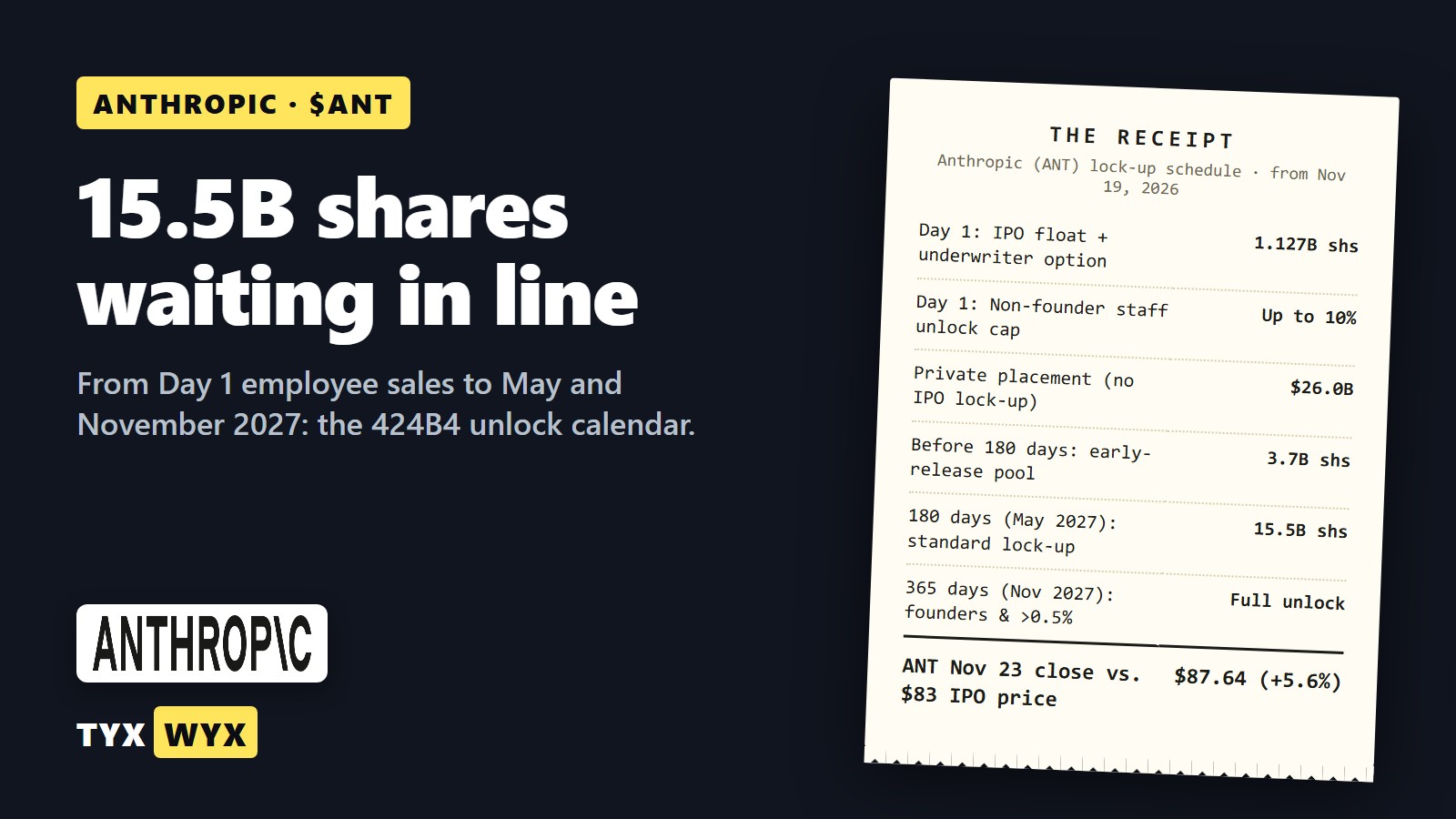
- Anthropic sold 980 million shares at $83.00 in its November 19 IPO (plus 147 million underwriter option shares), while about 15.5 billion insider shares remain under lock-up.
- Non-founder employees could sell up to 10% on Day 1, $26 billion in private Class N shares sit outside the underwriter lock-up, and up to 3.7 billion shares can unlock before 180 days.
- With ANT closing at $87.64 on November 23 — just 5.6% above its $83.00 IPO price — how much new supply can the market absorb when May 2027 arrives?
What happened
When Anthropic began trading on Nasdaq under the ticker ANT on November 19, 2026, the public bought 980 million Class A shares priced at $83.00 each — plus another 147 million shares after underwriters exercised their full option on November 20. According to Anthropic’s Form 424B4 final prospectus, however, the public float is only a fraction of the roughly 15.5 billion shares held by insiders waiting behind lock-up agreements.
A lock-up agreement is a contract that stops company insiders and early backers from dumping their stock right after an IPO. Think of it like stadium exit doors after a concert: if every gate opens at once, the hallway jams, so the venue opens one section at a time on a schedule printed on your ticket.
In Anthropic’s case, the schedule in the prospectus has four distinct gates — and the first one opened on the very first morning of trading. Meanwhile, across its first three sessions on Nasdaq, daily closing prices show ANT sliding from $97.17 on November 19 to $88.91 on November 20, and then to $87.64 on November 23.
At $87.64, the stock sits 5.6% above its $83.00 offering price, and 23.9% below its November 19 intraday peak of $115.10. For anyone holding or watching the stock, the calendar on page 22 of the prospectus matters as much as the income statement.
THE RECEIPT
Anthropic (ANT) lock-up schedule · from Nov 19, 2026
| Day 1: IPO float + underwriter option | 1.127B shs |
| Day 1: Non-founder staff unlock cap | Up to 10% |
| Private placement (no IPO lock-up) | $26.0B |
| Before 180 days: early-release pool | 3.7B shs |
| 180 days (May 2027): standard lock-up | 15.5B shs |
| 365 days (Nov 2027): founders & >0.5% | Full unlock |
| ANT Nov 23 close vs. $83 IPO price | $87.64 (+5.6%) |
Day 1 float adds 980M base IPO shares and 147M option shares; +5.6% is ($87.64 − $83.00) ÷ $83.00.
Gate 1 and Gate 2: Day 1 sellers and the 3.7 billion early-release pool
Even before the opening bell on November 19, not every dollar in the offering went to the company. According to Anthropic’s November 18 pricing announcement and the prospectus, 956,351,354 of the initial 980 million IPO shares were newly issued by Anthropic, while 23,648,646 shares — worth about $1.96 billion at the $83.00 IPO price — were sold by existing stockholders. Anthropic received no proceeds from those selling stockholders.
Once trading started, two more groups had special terms disclosed in the Form 424B4 prospectus:
- Non-founder employees on Day 1: Unlike co-founders and major holders, non-founder employees were allowed to sell up to 10% of their locked-up holdings starting on the first day of trading, November 19.
- The $26 billion private placement: Concurrent with the IPO, seven chip and cloud partners — Google ($10B), Nvidia ($10B), AMD ($2.5B), Broadcom ($1B), Micron ($1B), Microsoft ($1B) and TSMC ($500M) — bought $26 billion of non-voting Class N stock at $83.00. Those shares are not covered by the underwriters’ lock-up agreements, though they remain restricted securities under federal rules.
Then comes Gate 2. According to the prospectus, out of the roughly 15.5 billion shares under 180-day lock-ups, up to 3.7 billion shares can be released early before the 180-day clock runs out. That early-release pool alone is more than three times the entire 1.127 billion-share public IPO including the underwriter option.
Gate 3 and Gate 4: May 2027, November 2027, and who keeps the votes
The standard lock-up expires at 180 days — May 2027. That is the date when the main body of the 15.5 billion locked-up shares becomes eligible to enter the market, excluding the portion held by the largest insiders.
Under the prospectus rules, co-founders and stockholders who hold more than 0.5% of the company face a longer lock-up of up to 365 days, pushing their final unlock to November 2027. For scale, Amazon holds 14.6% (or up to 23.6% if all its convertible notes convert) and Google holds 13.4% in non-voting Class N stock.
Importantly, even as billions of shares unlock over the next twelve months, voting control will not shift to public buyers. According to page 22 of the prospectus, Anthropic is a Nasdaq “controlled company”:
- Public Class A shares carry one vote per share, while strategic partners’ Class N shares carry zero votes.
- A single Class F share held by the co-founders’ entity carries 50.1% of the total voting power and no economic rights.
- A single Class T share held by the Long-Term Benefit Trust elects a majority of the board of directors.
Insiders can gradually sell economic shares over the next year while the Class F and Class T structure keeps board and voting control locked in place.
The other side
A lock-up expiration allows shares to be sold, but it does not force anyone to sell. In the Form 424B4 prospectus, Anthropic also disclosed that certain current directors and insiders indicated an interest in buying up to $305 million of Class A shares at the $83.00 IPO price — moving money in the opposite direction on Day 1. Furthermore, stagger rules — splitting Day 1 employee sales, the 180-day window, and the 365-day window for co-founders and holders above 0.5% — are specifically designed to prevent a single one-day flood of insider stock. And through three turbulent market sessions, ANT has held above its $83.00 IPO floor, bouncing off an intraday low of $83.05 on November 20.
What it means for your wallet
When you buy a newly listed stock, you are buying into its supply schedule as well as its business. Right now, daily trading in ANT reflects roughly 1.127 billion IPO shares plus whatever portion of the 10% Day 1 employee allowance has come to market — against the roughly 15.5 billion shares the prospectus lists under lock-up.
In its first three days, ANT dropped 8.50% on November 20 and another 1.43% on November 23 to finish at $87.64, even on a Monday when the Nasdaq-100 ETF jumped 7.00%. That leaves a $4.64 cushion above the $83.00 IPO price as the market looks ahead to the 3.7 billion-share early-release window and the May 2027 expiration.
What we still don’t know
- How many shares non-founder employees actually sold during the first three trading days under their 10% Day 1 allowance.
- What specific price or date conditions will trigger the early release of up to 3.7 billion shares before the 180-day mark, and how much of that pool holders will sell.
- Whether strategic partners holding non-voting Class N shares will seek to convert or sell once securities-law holding periods expire in 2027.