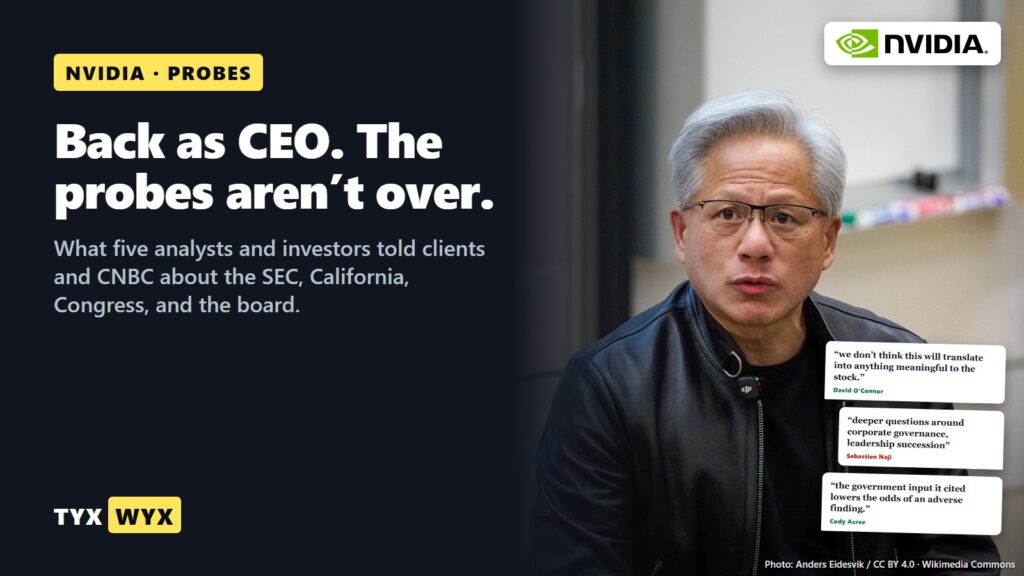
- Nvidia’s board accepted CEO Jensen Huang’s resignation on November 11 and reinstated him 11 days later on November 22.
- By our math on daily closing prices, $10,000 put into NVDA, QQQ or SPY on November 11 ended November 23 within a $76 band: $9,500, $9,430 and $9,506.
- With an independent board investigation and government inquiries still open, index investors face a sharp question: how diversified is a passive fund when one stock drives the boat?
What happened
If you put $10,000 into an S&P 500 ETF (SPY), a Nasdaq-100 ETF (QQQ), or Nvidia stock (NVDA) at the market close on November 11, 2026, you took three wildly different rides over the next eleven days — only to end up in almost the exact same place on November 23: between $9,430 and $9,506.
According to Nvidia’s Form 8-K filed on November 12, the company’s board accepted the resignation of President and Chief Executive Officer Jen-Hsun Huang on November 11, effective immediately. Chief Financial Officer Colette M. Kress, 59, stepped in as interim CEO while the board launched a search, and director Harvey C. Jones, 73, a board member since 1993, became first-ever Chair of the Board. The company’s release gave no reason for the departure, stating only that “Jensen’s contributions to NVIDIA are profound.”
Across the next seven trading sessions, daily closing prices showed NVDA falling 27.7%, from $173.73 on November 11 to $125.53 on November 20, after touching $148.80 intraday on November 12 and $124.50 intraday on November 20.
Then, on Sunday, November 22, the board reversed course. According to a Form 8-K and press release filed on November 23, directors voted unanimously to reinstate Huang as President, CEO, and director, effective immediately. On Monday, November 23, NVDA surged 31.48% to close at $165.05 on volume of 783 million shares.
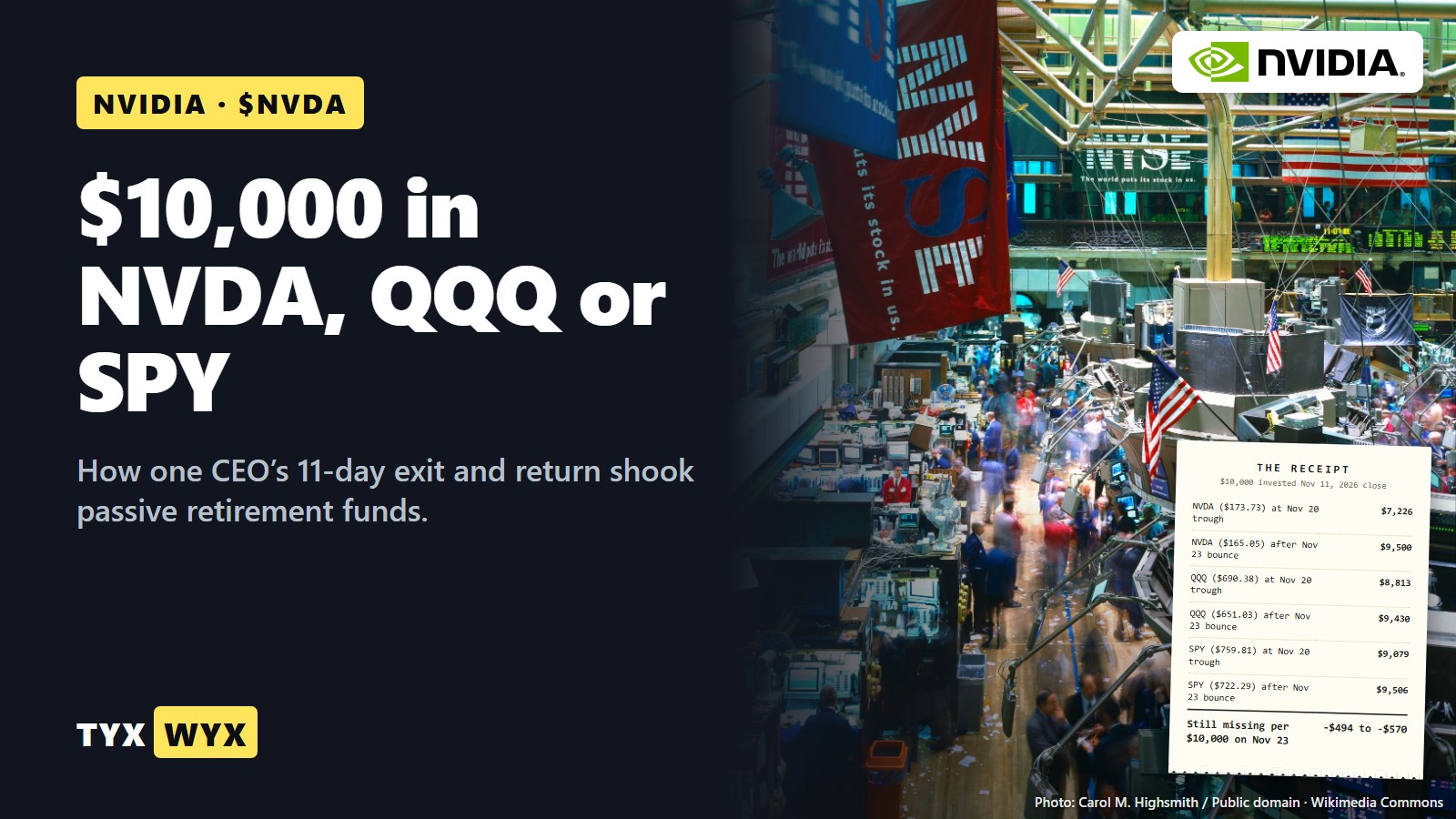
THE RECEIPT
$10,000 invested Nov 11, 2026 close
| NVDA ($173.73) at Nov 20 trough | $7,226 |
| NVDA ($165.05) after Nov 23 bounce | $9,500 |
| QQQ ($690.38) at Nov 20 trough | $8,813 |
| QQQ ($651.03) after Nov 23 bounce | $9,430 |
| SPY ($759.81) at Nov 20 trough | $9,079 |
| SPY ($722.29) after Nov 23 bounce | $9,506 |
| Still missing per $10,000 on Nov 23 | -$494 to -$570 |
Values multiply $10,000 by each ticker's Nov 20 or Nov 23 closing price divided by its Nov 11 closing price.
The $7,226 crater and the index shockwave
Most retirement savers buy broad index funds — baskets that hold hundreds of companies weighted by total market value — to avoid single-company drama. Buying a market-cap-weighted index fund today is like sharing a rowboat with an elephant: you own every plank in the boat, but when the elephant shifts its weight, everyone gets wet.
We tracked a $10,000 investment using daily closing prices from November 11, the last session before Huang’s exit was disclosed, through the Friday, November 20 trough:
- Nvidia (NVDA) slid from $173.73 to $125.53, including a 14.01% drop on November 20 alone. By our math, $10,000 shrank to $7,226 — a paper loss of $2,774 in seven sessions.
- Nasdaq-100 ETF (QQQ) dropped from $690.38 to $608.45, falling 5.67% on November 20 and 10.51% for the week from November 13 to November 20. A $10,000 stake fell to $8,813.
- S&P 500 ETF (SPY) fell from $759.81 to $689.81, down 3.64% on November 20 and 8.56% for the week from November 13 to November 20. A $10,000 stake dropped to $9,079.
Even passive savers who never placed an individual stock order watched roughly 9% to 12% of their index balance evaporate during the eleven-day leadership vacuum.
Why a 31.48% rebound still left $500 missing
Monday, November 23, looked like a full rescue on trading screens. NVDA jumped 31.48% to $165.05, trading between $156.93 and $171.50 during the day. QQQ climbed 7.00% to $651.03, and SPY gained 4.71% to $722.29.
Yet basic percentage math explains why none of the three returned to even. When a stock drops 27.7% from $173.73 to $125.53, its rebound is multiplied against a smaller number. A 31.48% gain on $125.53 adds $39.52 a share — leaving NVDA at $165.05, still 5.0% below its November 11 close.
Put all three November 23 balances side by side on a $10,000 starting ticket:
- SPY finished at $9,506 (down 4.94% from November 11, and 7.3% below its October 6 high close of $779.09).
- NVDA finished at $9,500 (down 5.00% from November 11).
- QQQ finished at $9,430 (down 5.70% from November 11, and 14.3% below its October 6 close of $759.66).
Notice the surprise at the bottom of the receipt: over the full eleven-day round trip, the diversified Nasdaq-100 ETF actually lagged Nvidia itself by $70 per $10,000 invested.
The company’s side
In the press release attached to its November 23 Form 8-K, Nvidia’s board said it voted unanimously to reinstate Huang after discussions left directors satisfied with his candor and ability to lead. The board stated that it received input from “senior levels of the United States government” and, based on that input, is confident that Huang’s return “poses no national security risk.” Directors also highlighted new governance checks: an independent board committee investigating reports that Huang was the target of a foreign intelligence effort, a new National Security and Export Control Committee of independent directors, and a search for a new Chief Compliance Officer. In the filing, Huang said he returned “with the greatest humility and renewed commitment.”
What it means for your wallet
If you hold an S&P 500 or Nasdaq-100 fund in a retirement account, the November 11–23 round trip showed both edges of index concentration. On the way down, broad funds cushioned the blow: while NVDA holders saw $2,774 of every $10,000 vanish by November 20, SPY and QQQ holders saw smaller drawdowns of $921 and $1,187.
On the way back up, however, selling at the bottom locked in the damage. Anyone who exited SPY or QQQ at the November 20 close missed a one-day jump of 4.71% to 7.00% on November 23 — even though both indexes still sit 7.3% and 14.3% below their October 6 closes.
What we still don’t know
- What the independent directors’ committee will conclude in its investigation into reporting that Huang was the target of a foreign intelligence effort.
- Which senior U.S. government officials gave input to Nvidia’s board, and how ongoing government investigations and inquiries will be resolved.
- Who Nvidia will appoint as its new Chief Compliance Officer, and whether the new National Security and Export Control Committee will tighten sales practices.