- On November 22, OpenAI Chief Scientist Jakub Pachocki published internal log-perplexity scores showing pretraining loss dropping from ~0.99 on GPT-3.5 to ~0.76 on a recent model.
- Pachocki proposed that frontier AI developers commit to common development limits based on perplexity until safety monitoring reaches concrete new milestones.
- He warned that AI-driven pretraining breakthroughs could arrive as soon as 2027, raising questions over whether rival labs will ever agree on a single yardstick.
What happened
AI labs almost never publish the internal scoreboard that shows how fast their foundational models are improving. On Sunday, November 22, 2026, OpenAI Chief Scientist Jakub Pachocki broke that habit in a post titled “Perplexity and Intelligence,” releasing OpenAI’s internal pretraining measurements and calling for industry-wide development caps.
Pachocki argued that beneath all the fine-tuning and prompting tricks, modern AI comes down to a simpler process: “first, one builds a large computer, then uses it to pretrain a model (compressor) on a large unstructured dataset.” OpenAI tracks that base intelligence using perplexity — or more precisely, the logarithm of perplexity, called cross-entropy loss — which measures how accurately a model predicts the next token on a held-out snapshot of OpenAI’s internal codebase. Lower numbers mean sharper predictions.
On that internal yardstick, GPT-3.5 scored roughly 0.99 (unlocking fluent conversation), GPT-4 reached roughly 0.91 (productive chain-of-thought reasoning), and dropping below 0.8 brought transformative capabilities in cybersecurity and mathematics. Once OpenAI upgraded to a model at ~0.76, it began solving open mathematics problems one after another in a single Slack thread.
Pachocki acknowledged that sharing these figures gives competitors a clearer picture of where OpenAI stands, but wrote that competitive secrecy was outweighed by the urgency of establishing shared safety standards across frontier model developers — without naming specific rival labs.
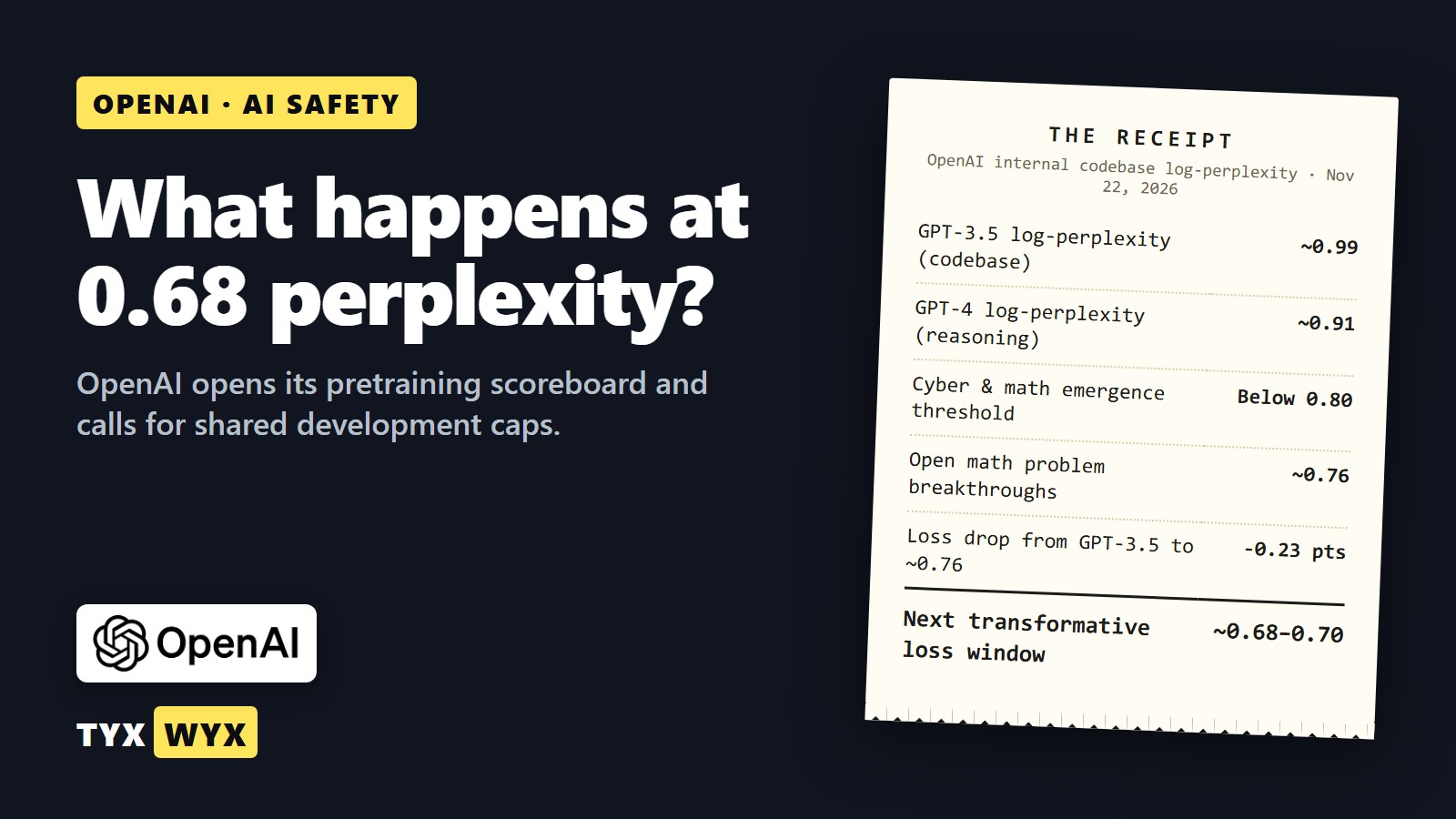
THE RECEIPT
OpenAI internal codebase log-perplexity · Nov 22, 2026
| GPT-3.5 log-perplexity (codebase) | ~0.99 |
| GPT-4 log-perplexity (reasoning) | ~0.91 |
| Cyber & math emergence threshold | Below 0.80 |
| Open math problem breakthroughs | ~0.76 |
| Loss drop from GPT-3.5 to ~0.76 | -0.23 pts |
| Next transformative loss window | ~0.68–0.70 |
The -0.23 log-perplexity change subtracts ~0.99 (GPT-3.5) from ~0.76 (the math-breakthrough model) in OpenAI’s November 22 research post.
Why OpenAI wants a speed limit before the ~0.68–0.70 window
By our math on Pachocki’s numbers, moving from GPT-3.5 (~0.99) to the math-breakthrough model (~0.76) took a reduction of 0.23 log-perplexity points. Now OpenAI is looking just 0.06 to 0.08 points lower, warning that the next threshold could outrun existing safety tools.
Extrapolating from recent gains, Pachocki wrote that entering the ~0.68–0.7 log-perplexity window should bring further transformative capabilities alongside “further degradation in currently dominant forms of alignment auditing and further increases in evaluation and training awareness.” Even more striking, he warned that AI is starting to help design better pretraining algorithms, meaning “as soon as 2027 we could conceivably see a similar avalanche of fundamental pretraining advancements.”
To keep that acceleration under human control, Pachocki put forward a concrete proposal for all frontier labs:
“I further propose common limits, based on perplexity and other measurements, that developers are committed to not crossing until our ability to understand and monitor AI behavior achieves a certain concrete milestone (such as the development of a successor to CoT monitors).”Jakub Pachocki, Chief Scientist at OpenAI, Nov 22, 2026
It is like an automaker publishing its test-track telemetry and asking rival teams to bolt a shared speed limiter onto their engines until someone invents stronger brakes.
The other side
Pachocki himself laid out four major obstacles to using perplexity as an industry standard. First, labs train on different data mixtures and test on different private datasets — OpenAI’s numbers come from its own internal codebase, which is a poor proxy for older text models like GPT-2 and GPT-3. Second, perplexity is detached from specific real-world tasks. Third, it completely misses breakthroughs outside pretraining, since chain-of-thought reasoning boosts capability without lowering perplexity at all. Fourth, nobody knows the true mathematical floor (inherent entropy) of the data.
What it means for your wallet
Pachocki’s essay is a scientific proposal rather than a financial filing, so what follows is our interpretation of why it matters for technology investors. In Footnote 5, Pachocki notes that OpenAI’s steep 2026 acceleration came mostly from “long term research and compute investments,” with meaningful design contributions now starting to come from AI itself.
In our reading, that creates two very different financial paths for the chipmakers, cloud providers, and newly public AI labs sitting inside major index funds. If rival developers actually adopt Pachocki’s “common framework for setting successive limits and pacing further development,” industry-wide pretraining pauses could slow the pace at which labs deploy new multi-billion-dollar supercomputers. Conversely, if an “avalanche” of AI-discovered pretraining algorithms arrives in 2027 without an industry pact, labs could squeeze dramatically higher intelligence out of every server rack they already rent.
What we still don’t know
- Whether any competing frontier AI developers will agree to share internal perplexity scores or sign onto OpenAI’s proposed pretraining limits.
- What specific benchmark dataset labs could share to compare base models fairly without leaking proprietary training mixtures or internal codebases.
- Which exact OpenAI model corresponds to the ~0.76 log-perplexity score and how close current training runs are to the ~0.68–0.70 window.