- Elon Musk’s SpaceX is using a $43 billion financing deal called Project Saturn to acquire Nvidia AI chips, using the GPUs themselves as collateral.
- Structured as a five-year triple-net, hell-or-high-water lease through Saturn Funding Trust, the deal keeps the debt off SpaceX’s books while requiring quarterly payments.
- SpaceX says the collateralized chips will stay on Earth, but is that promise actually written into the signed debt contract?
What happened
Even one of the richest people on Earth borrows money when the hardware tab hits eleven figures — and his bankers have a unique question about where the collateral is parked. According to Tom’s Hardware on November 22, 2026, citing reporting from Ars Technica, Elon Musk is borrowing $43 billion to finance SpaceX’s acquisition of Nvidia AI chips, using those semiconductors as collateral for the deal.
The wrinkle is that SpaceX is building giant AI data centers both on the ground and in orbit. Lenders backing the deal are worried that SpaceX could put the pledged Nvidia GPUs aboard its planned orbital data center, making the chips virtually impossible for creditors to reclaim and resell if SpaceX ever defaults, Ars Technica reported, as cited by Tom’s Hardware.
SpaceX has said it will deploy the collateralized chips only on Earth, and credit rating agency Moody’s stated in a report that the processors will go into SpaceX’s U.S. data centers. However, Tom’s Hardware noted that it remains unclear whether an Earth-only provision is included in the signed debt instrument.
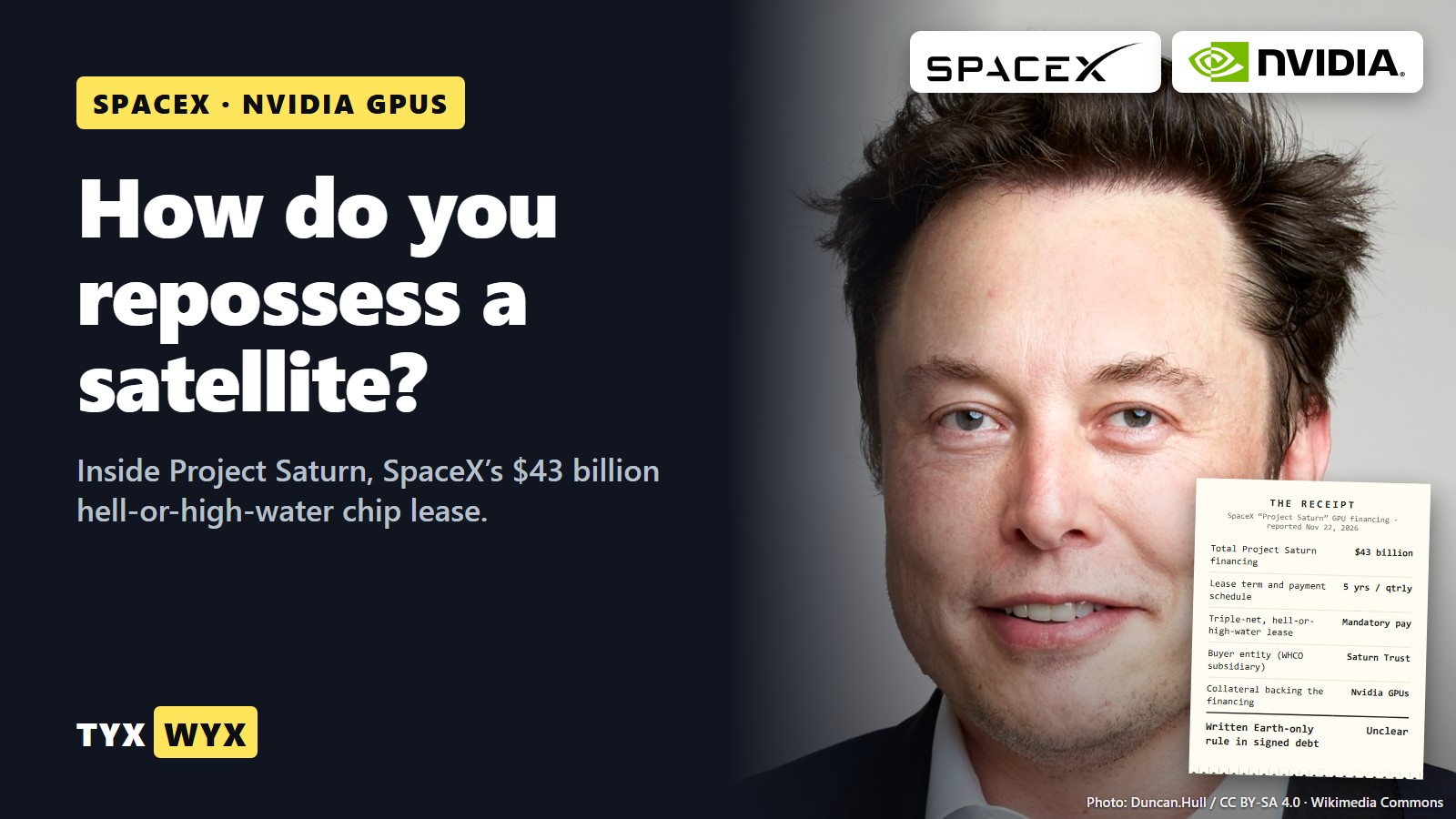
THE RECEIPT
SpaceX “Project Saturn” GPU financing · reported Nov 22, 2026
| Total Project Saturn financing | $43 billion |
| Lease term and payment schedule | 5 yrs / qtrly |
| Triple-net, hell-or-high-water lease | Mandatory pay |
| Buyer entity (WHCO subsidiary) | Saturn Trust |
| Collateral backing the financing | Nvidia GPUs |
| Written Earth-only rule in signed debt | Unclear |
Deal figures, vehicle names, and contract terms are as reported by Tom’s Hardware on Nov 22, 2026, citing Ars Technica and Moody’s.
Project Saturn: how a five-year hell-or-high-water lease works
According to Tom’s Hardware, the $43 billion package — code-named “Project Saturn” — is not set up like a standard corporate bank loan. Instead, it mirrors aircraft leasing agreements, where a specialized financing vehicle buys the hardware up front and leases it to the operator, keeping the obligation off the borrower’s balance sheet and leaving its investment-grade rating untouched.
Here is how the money flows under Project Saturn:
- The buyer: Saturn Funding Trust, a wholly owned subsidiary of asset-backed lending company WHCO, acquires the Nvidia GPUs on SpaceX’s behalf.
- The payments: SpaceX pays Saturn Funding Trust quarterly for the right to use the AI chips over a five-year term.
- The ironclad clause: The agreement is structured as a “five-year triple-net, hell-or-high-water finance lease arrangement.”
In plain English, a triple-net, hell-or-high-water lease means the renter assumes all operational expenses and must keep making quarterly payments for all five years no matter what happens — even if the Nvidia chips break, become technologically obsolete, or the AI project loses money.
A satellite larger than a Boeing 747 — and the repo problem
If the lease contract forces SpaceX to pay no matter what, why are lenders still nervous about outer space? Because in asset-backed lending, your ultimate safety net is seizing the physical equipment and selling it to someone else if the borrower stops paying. Imagine financing a fleet of exotic sports cars for a client who casually mentions he owns a rocket and plans to park a few of them on the moon. If a payment ever bounces, no tow truck on Earth can reach your collateral.
SpaceX’s orbital ambitions are not just sci-fi sketches. Tom’s Hardware reported that Musk has already revealed the company’s first-generation AI1 satellite, designed with a 120-kilowatt payload and a wingspan larger than a Boeing 747, all aimed at building an AI large language model to “assist in the pursuit of understanding.”
On the ground, SpaceX has plenty of places to plug in those GPUs as well. According to Tom’s Hardware, Musk is planning a $24 billion gas-powered AI supercomputer in Starbase, Texas, on top of the existing Colossus 1 and Colossus 2 sites near the Tennessee-Mississippi border.
The other side
From a credit perspective, the terms of Project Saturn are already heavily tilted in the lenders’ favor, Tom’s Hardware observed. Because the five-year hell-or-high-water lease shifts every operational, obsolescence, and profitability risk onto SpaceX, creditors only face a repossession problem if SpaceX outright defaults. Furthermore, both SpaceX’s public assurances and Moody’s credit report state that the financed Nvidia chips are headed for U.S. data centers on solid ground.
What it means for your wallet
For everyday investors who own Nvidia or broad index funds, Project Saturn highlights two huge trends driving the 2026 AI boom. First, demand for Nvidia silicon remains so intense that a single private company is arranging $43 billion in GPU financing on top of a planned $24 billion Texas supercomputer.
Second, the AI build-out is increasingly funded through off-balance-sheet leasing trusts like WHCO’s Saturn Funding Trust. Wall Street’s credit markets are now deeply intertwined with AI hardware values — meaning bond investors care right down to the physical ZIP code (or altitude) where those GPUs sit.
What we still don’t know
- Whether the final signed debt instrument for Project Saturn includes an explicit legal covenant barring SpaceX from launching the collateralized GPUs into orbit.
- Which specific Nvidia GPU generations and quarterly lease rates are locked into the five-year Saturn Funding Trust schedule.
- How much of SpaceX’s compute capacity will ultimately sit in Starbase and the Colossus sites versus its 120-kilowatt AI1 satellites.