- On November 19, 2026, investigative outlet Hunterbrook Media published a report tying AMD startup firmware to blacklisted Chinese server maker IEIT Systems and three related vendors.
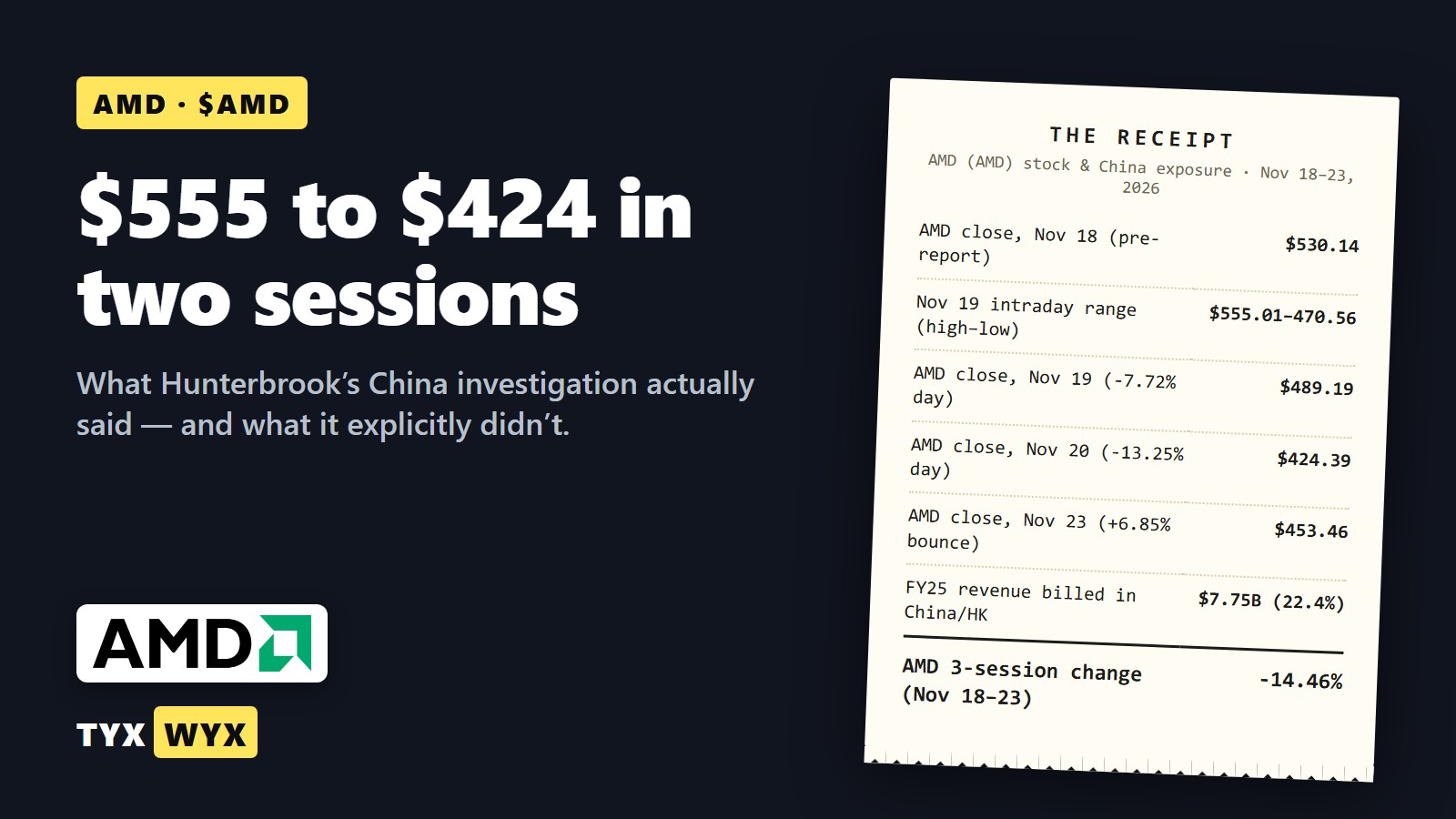
- AMD shares swung from $555.01 to $470.56 intraday on November 19 before closing down 7.72% at $489.19, then fell another 13.25% on November 20 to $424.39.
- The report itself states that its findings concern software updates rather than processor shipments and do not establish a violation of U.S. export laws — so what is the real risk to AMD’s $7.75 billion China business?
What happened
On the morning of November 19, 2026, investigative outlet Hunterbrook Media published a report titled “AMD Has Its Own China Problem.” Within hours, social media posts summarized the story as proof of illegal chip sales to China. According to daily closing prices, AMD stock plunged from an intraday high of $555.01 to a low of $470.56 before closing at $489.19, down 7.72%.
The selling accelerated on Friday, November 20, when AMD dropped another 13.25% to close at $424.39. Even after a 6.85% rebound to $453.46 on Monday, November 23, the stock sat 14.46% below its November 18 close of $530.14.
Right under the headline, Hunterbrook printed an explicit disclosure about its affiliated investment fund:
“Based on Hunterbrook Media’s reporting, at the time of publication Hunterbrook Capital is short $AMD and long a basket of comparable securities. Positions may change at any time. This article is not investment advice or any recommendation.”Hunterbrook Media, Nov 19, 2026
Reading a short-seller report through online rumors is like playing telephone down a crowded hallway: by the third person, a building code warning turns into an arson charge. We read the full text to separate what it documented from what it did not claim.
THE RECEIPT
AMD (AMD) stock & China exposure · Nov 18–23, 2026
| AMD close, Nov 18 (pre-report) | $530.14 |
| Nov 19 intraday range (high–low) | $555.01–470.56 |
| AMD close, Nov 19 (-7.72% day) | $489.19 |
| AMD close, Nov 20 (-13.25% day) | $424.39 |
| AMD close, Nov 23 (+6.85% bounce) | $453.46 |
| FY25 revenue billed in China/HK | $7.75B (22.4%) |
| AMD 3-session change (Nov 18–23) | -14.46% |
Three-session change is ($453.46 − $530.14) ÷ $530.14; intraday drop on Nov 19 was $84.45 (-15.22%) from high to low.
What the report documented: firmware, three affiliates, and $12 billion in sales
Hunterbrook’s investigation starts with IEIT Systems, a Chinese server maker that the U.S. Commerce Department placed on its Entity List — an export blacklist requiring a federal license reviewed under a policy of denial — in March 2025. Hunterbrook downloaded IEIT’s server BIOS updates (startup firmware that prepares a server to run processors) and found at least six newer versions of AMD startup code posted after the blacklisting, including TurinPI 1.0.0.B code posted on October 19, 2026.
Hunterbrook also found firmware files 99.94% identical to IEIT’s on the websites of three non-blacklisted server vendors:
- Maginfra in Jinan, China, registered in February 2025, one month before IEIT was blacklisted.
- Kaytus Systems in Singapore, which booked $1.57 billion in 2024–2025 revenue, paid IEIT $164 million in 2025 referral fees, and stated in its 2025 audited accounts: “The ultimate holding company of the Company is IEIT SYSTEMS Co., Ltd.”
- Aivres Systems in Fremont, California — called Inspur Systems Inc. until May 2023 — which AMD names as a sponsor of its Advancing AI 2026 conference, and which received 209 ocean shipments (more than 2,000 metric tons of server parts) from China after IEIT’s blacklisting.
The report connected those ties to two tightening U.S. rules: a November 19 interim final rule requiring licenses for advanced AI chips shipped to Singapore and four other nations, and a suspended rule scheduled to take effect January 10, 2027 extending Entity List restrictions to foreign companies at least 50% owned by blacklisted entities. In fiscal 2025, AMD billed $7.75 billion (22.4% of revenue) to China and Hong Kong, plus $4.28 billion (12.4%) to Singapore. Two ventures 85% owned by China’s Tongfu Microelectronics (and 15% by AMD, with a $100 million loan from AMD still outstanding as of September) also handle the majority of AMD’s chip assembly, testing, and packaging ($2 billion in 2025 services), while AMD reported $67 million in 2025 licensing income ($263 million over five years) that Hunterbrook matched to blacklisted Hygon ventures.
What the report explicitly did NOT claim
Contrary to viral posts claiming AMD was caught shipping physical AI chips to blacklisted buyers, Hunterbrook stated four separate times that its findings did not prove illegal processor shipments or an export-law violation:
- On the six IEIT BIOS packages: “These dates concern software, not shipments of processors.”
- On how the firmware reached IEIT: “Hunterbrook does not know how IEIT obtained AMD’s code, or whether AMD or anyone else held a license to supply it. AMD did not say.”
- On the $67 million in 2025 licensing income ($263 million over 2021–2025) matched to Hygon: “The payments do not establish that AMD violated U.S. export controls. They could reflect royalties and other payments for technology AMD licensed before the listing; the Entity List restricts exports to listed companies, not payments from them.”
- On the overall paper trail, including a Cancon server (an alias of blacklisted Suma Technology) in AMD’s February 2026 catalog: “And records Hunterbrook found don’t establish on their own a violation of export laws.”
According to Hunterbrook, AMD asked for more time to answer questions, was given until the next day, and did not respond before publication.
The other side
Inside Hunterbrook’s own article, former Commerce Department undersecretary William Reinsch noted that license records are non-public and cautioned against assuming AMD lacked approval: “The fact that you have to get a license does not mean automatically that the license will be denied.” The report also noted that Aivres, Kaytus, and Maginfra were not on the U.S. Consolidated Screening List as of November 15, 2026, and that selling most standard AMD processors in China is legal. Rather than alleging a crime, the report makes a valuation and policy argument: AMD trades at a price-to-earnings ratio three to four times higher than Nvidia’s and carries $48.8 billion in purchase and service commitments (plus up to $8.5 billion in guarantees against $15.8 billion in cash and short-term investments, as The Bear Cave reported the same day) while billing over a third of its revenue in China, Hong Kong, and Singapore.
What it means for your wallet
For investors who rotated out of Nvidia and into AMD assuming AMD was free of China export risk, the two-day drop from $530.14 to $424.39 — before Monday’s bounce to $453.46 — showed why reading the primary text matters. A short report does not need to prove a crime to reprice a high-multiple stock; it only has to highlight that new licensing rules for Singapore and affiliates on January 10, 2027, could slow AI accelerator sales. When Washington restricted AMD’s China-specific MI308 chip in April 2025, AMD took about $800 million in inventory and related charges.
What we still don’t know
- Whether AMD or a partner holds a Commerce Department license allowing firmware updates or technical support to reach IEIT Systems.
- Whether the Commerce Department will let its 50%-ownership Entity List rule take effect on January 10, 2027, or extend the suspension again.
- How much of AMD’s $4.28 billion in annual Singapore billings will face new licensing delays under the November 19 interim final rule.