- On November 23, 2026 — Anthropic’s third trading day on Nasdaq — GraniteShares launched AIL, the GraniteShares 2x Long Anthropic Daily ETF.
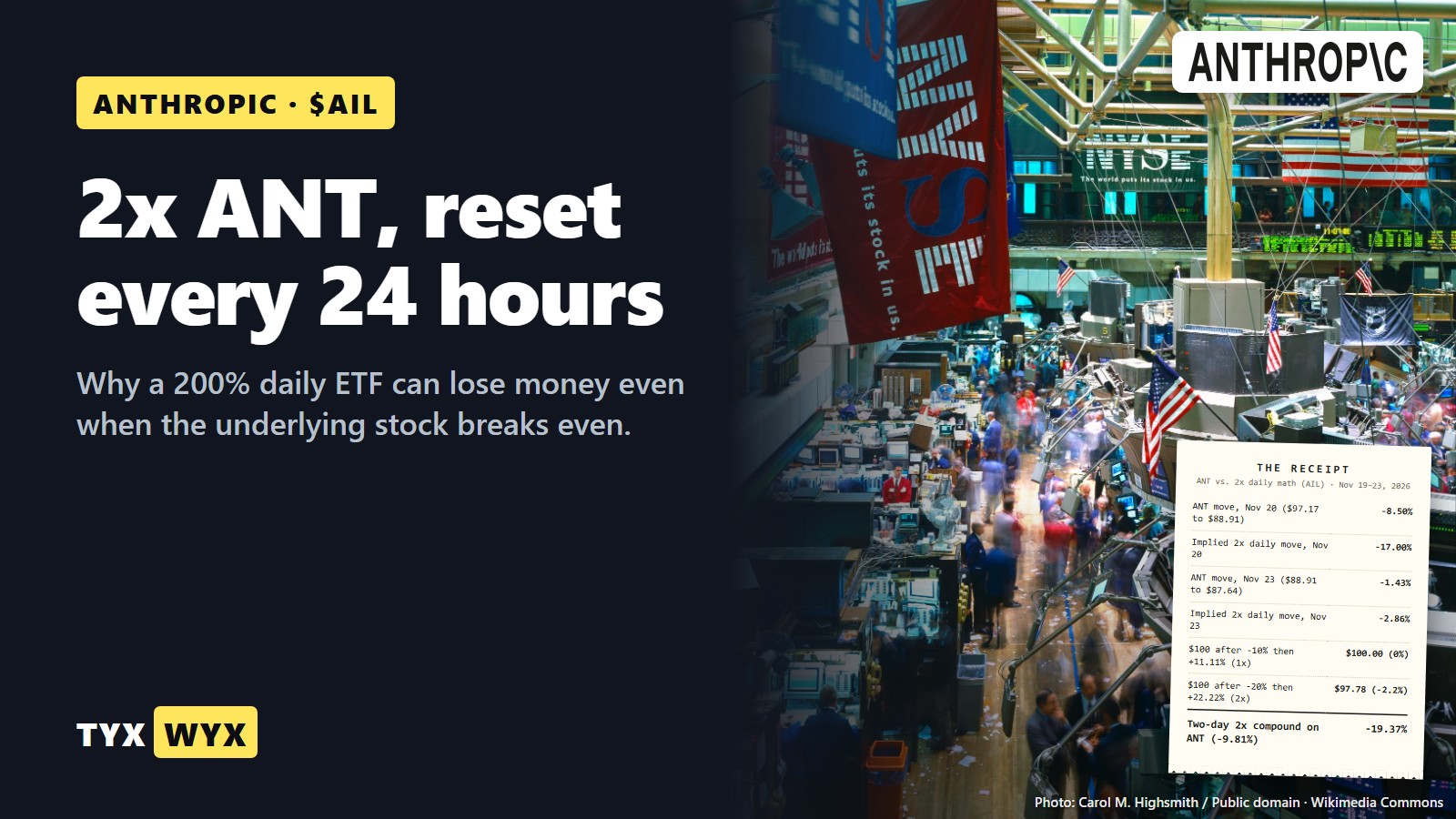
- As ANT fell 8.50% on November 20 and 1.43% on November 23, 2x daily math turns those drops into roughly -17.00% and -2.86% before fees.
- With the expense ratio still listed as a blank dash on the launch-day product page, how much will daily rebalancing and swap costs eat over time?
What happened
Anthropic’s stock had barely finished its first two sessions on Nasdaq before Wall Street built a double-speed version of it. On November 23, 2026 — the third day of trading for Anthropic (ANT) — GraniteShares launched AIL, the GraniteShares 2x Long Anthropic Daily ETF, alongside an inverse companion, ANS.
According to GraniteShares’ product page, AIL does not own a single share of Anthropic directly. Instead, it uses total-return swaps — private financial contracts with banking counterparties that pay double the stock’s daily percentage move — backed by cash and short-term U.S. Treasury bills totaling 200% notional exposure.
The goal on the product page is specific to a single clock cycle:
“The fund seeks daily investment results, before fees and expenses, of 2 times (200%) the daily percentage change of the common stock of Anthropic, PBC, (Ticker: ANT). There is no guarantee that the fund will meet its stated objective. The fund should not be expected to provide 2 times the cumulative return of ANT for periods greater than a day.”GraniteShares AIL Product Page
Curiously, on launch day, the product page still showed blank dashes for Management Fee, Total Expense Ratio, and Net Expense Ratio, and its FAQ line read verbatim: “AIL has a net expense ratio of .” A footnote stated that GraniteShares Advisors LLC contractually agreed to cap operating expenses, leaving both the percentage cap and expiration date blank on the page.
THE RECEIPT
ANT vs. 2x daily math (AIL) · Nov 19–23, 2026
| ANT move, Nov 20 ($97.17 to $88.91) | -8.50% |
| Implied 2x daily move, Nov 20 | -17.00% |
| ANT move, Nov 23 ($88.91 to $87.64) | -1.43% |
| Implied 2x daily move, Nov 23 | -2.86% |
| $100 after -10% then +11.11% (1x) | $100.00 (0%) |
| $100 after -20% then +22.22% (2x) | $97.78 (-2.2%) |
| Two-day 2x compound on ANT (-9.81%) | -19.37% |
Implied 2x moves multiply ANT's daily change by 2; the two-day compound is (1 − 0.17) × (1 − 0.0286) − 1.
What 2x daily math looks like on ANT’s first drops
Look at how Anthropic’s stock actually traded across its first three closes. On November 19, ANT closed its debut at $97.17. On Friday, November 20, it fell 8.50% to close at $88.91 (after dipping to $83.05 intraday). On Monday, November 23 — AIL’s inception date — ANT slipped another 1.43% to close at $87.64.
Apply a 2x daily multiplier before fees to those two sessions, and the numbers move fast. (AIL itself only began trading on November 23, so the first day is a what-if.) On a day when ANT drops 8.50%, a 2x daily vehicle is built to drop 17.00%, turning $100.00 into $83.00. On November 23, when ANT fell 1.43%, a 2x daily move equals -2.86%.
By our math, if you compound those two sessions back to back, $100.00 drops to $83.00 on the first day and then loses 2.86% of $83.00 ($2.37) on the second, landing at $80.63 — a 19.37% loss while the underlying stock fell 9.81% from $97.17 to $87.64.
Why a zigzag market quietly eats your principal
The real trap in a leveraged daily ETF appears when a stock bounces up and down. Because the fund resets its 200% target every trading day, it has to add exposure after a winning day and cut exposure after a losing day. It is like walking up and down a sandy dune carrying double your body weight: every step down sinks deeper into the sand, so taking the same number of steps back up leaves you lower than where you started.
Run a clean two-day example on a $100 investment:
- Day 1: Suppose ANT falls 10.00%, from $100.00 to $90.00. A 2x daily ETF falls 20.00%, from $100.00 to $80.00.
- Day 2: Suppose ANT rebounds 11.11%, climbing from $90.00 right back to $100.00. The regular stock holder is completely flat at 0.00%.
- The 2x result: On Day 2, the 2x fund gains 22.22% (two times 11.11%). But 22.22% of $80.00 is only $17.78 — leaving the 2x holder at $97.78, down 2.22% before fees.
GraniteShares spells out this exact hazard in the risk disclosures at the bottom of the AIL page:
“For periods longer than a single day, the Fund will lose money if the Underlying Stock’s performance is flat, and it is possible that the Fund will lose money even if the Underlying Stock’s performance increases over a period longer than a single day. An investor could lose the full principal value of his/her investment within a single day.”GraniteShares AIL Risk Factors
The other side
In its product FAQ, GraniteShares makes clear who the fund is built for: “It is intended for active traders, not buy-and-hold investors.” For a short-term trader who wants amplified one-day exposure around an earnings release or a scheduled news catalyst without borrowing on margin in a brokerage account, a 2x ETF packages that trade into a ticker that can be bought and sold on an exchange. Furthermore, when a stock trends upward several days in a row without pullbacks, daily compounding works in the holder’s favor, producing more than 200% of the multi-day gain.
What it means for your wallet
If you are a long-term investor saving for retirement, the fine print on AIL’s own page says the quiet part out loud: “The volatility of the underlying security may affect a Funds return as much as, or more than, the return of the underlying security.” In its first three days on Nasdaq, ANT swung between $115.10 and $83.05 — a wide range that maximizes daily rebalancing drag.
There are also structural costs that regular stock owners never pay. Because AIL holds total-return swaps rather than shares, investors bear annual fund operating expenses, swap financing costs, and any gap between the ETF’s market price and its net asset value (NAV) during fast-moving sessions.
What we still don’t know
- What AIL’s actual management fee, net expense ratio, and fee-waiver cap are, since those figures were still blank on the product page on November 23.
- Which swap counterparties GraniteShares is using for AIL’s 200% notional exposure and how much financing those swaps will cost in a volatile first month.
- How wide AIL’s bid-ask spread and premium or discount to NAV will run when Anthropic experiences sharp intraday swings.