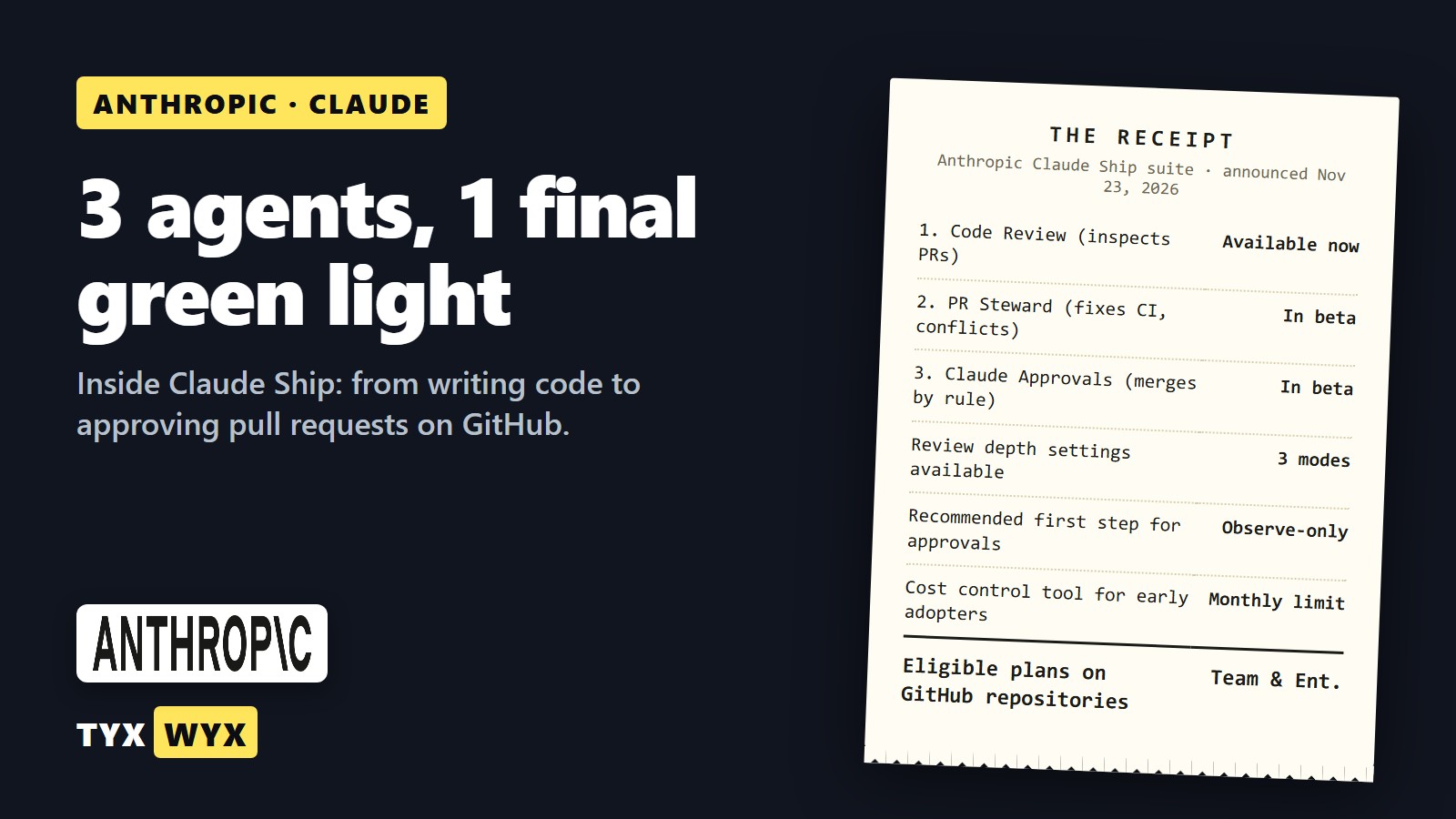
- Anthropic launched Claude Ship on November 23, 2026, bundling three AI agents that review, fix, and automatically approve routine code changes on GitHub.
- Rolling out to Claude Team and Enterprise subscribers, the beta tools come with monthly spending limits and three review settings (Quick, Standard, and Deep).
- Will software engineering leaders actually trust an AI agent to sign off on production code, or keep Claude Approvals locked in observe-only mode?
What happened
On Monday, November 23, 2026, newly public Anthropic announced the launch of Claude Ship, a suite of AI agents designed not only to review and repair software code, but also to automatically approve routine code changes for production, TechCrunch and SiliconANGLE reported.
AI coding tools that write software or scan for bugs are already common across the tech industry. What makes Claude Ship different, both outlets noted, is that it delegates final approval authority on pull requests (PRs) to an AI agent governed by policies that a development team writes in advance.
According to TechCrunch and SiliconANGLE, the launch targets a growing bottleneck inside engineering organizations: AI coding agents now generate fresh code so quickly that human engineers struggle to review and sign off on every change before it goes live. As Anthropic explained in a company blog post quoted by both publications:
“Most teams want a person to approve every change, and that’s easy to keep up with when people write every line. But a lot of developers build with agents now. On the Claude Code team, Claude writes most of our code, and we wanted everything after the PR to move that fast too.”Anthropic blog post, cited by TechCrunch and SiliconANGLE
Claude Ship is rolling out to Claude Team and Enterprise plans for repositories hosted on GitHub.
THE RECEIPT
Anthropic Claude Ship suite · announced Nov 23, 2026
| 1. Code Review (inspects PRs) | Available now |
| 2. PR Steward (fixes CI, conflicts) | In beta |
| 3. Claude Approvals (merges by rule) | In beta |
| Review depth settings available | 3 modes |
| Recommended first step for approvals | Observe-only |
| Cost control tool for early adopters | Monthly limit |
| Eligible plans on GitHub repositories | Team & Ent. |
Product components, availability status, and safety controls are as reported by TechCrunch and SiliconANGLE on Nov 23, 2026.
Inside the three-agent assembly line: who fixes and who approves?
Think of a modern software team like a factory where robotic arms suddenly doubled the speed of the assembly line, piling up finished boxes in front of a single human inspector at the loading dock. With Claude Ship, Anthropic is putting a second robot at the end of the conveyor belt — one armed with the inspector’s rulebook and a rubber stamp.
According to TechCrunch and SiliconANGLE, the suite breaks that post-writing workflow into three distinct parts:
- Code Review (generally available): An existing tool that inspects proposed pull requests and flags problems.
- PR Steward (in beta): A new agent that steps in to fix failing continuous integration (CI) checks, resolve merge conflicts, and address feedback generated by Code Review. After every push, PR Steward leaves a comment explaining what it changed and how a human can roll the change back if needed.
- Claude Approvals (in beta): A second new agent that reads an approval policy saved as a file inside the team’s repository. Written in natural language, that policy can weigh Code Review findings and an organization’s own classifiers to automatically approve routine changes.
Even with automated sign-off, Anthropic says human managers keep the steering wheel. Teams choose which repositories run Claude Ship, pick among Quick, Standard, or Deep review settings, and define which code changes must be escalated to a person for a final decision, TechCrunch reported.
Why automated approvals are a revenue story for a newly public company
Neither TechCrunch nor SiliconANGLE reported per-seat or per-token dollar prices for Claude Ship. However, both reports highlighted a telling detail: Anthropic advises early adopters to set monthly spending limits when turning the beta on.
In our view as market watchers, that detail explains why Claude Ship matters to investors just days after Anthropic’s debut on public markets. Having an AI agent write a block of code is a one-time prompt; having three agents continuously scan every pull request, re-run failing CI checks, fix merge conflicts, and evaluate Deep review classifiers turns software maintenance into round-the-clock background compute consumption. Every automated loop after the pull request gives enterprise customers another reason to keep usage meters spinning.
The other side
Letting an AI agent approve code written by another AI agent carries obvious operational risk, and Anthropic itself is urging early adopters to be cautious, SiliconANGLE reported. Because PR Steward and Claude Approvals are still in beta, the company recommends that engineering teams run the approval tool in observe-only mode first, start with just a single repository, and cap their exposure with monthly spending limits before letting the agent merge code on its own.
What it means for your wallet
If you hold Anthropic stock or follow enterprise software companies inside a tech ETF, Claude Ship shows where the AI arms race is moving next. Coding assistants were the first enterprise hit; now vendors are competing to own the entire software development pipeline on GitHub from initial draft to final merge.
For investors, the key metric to watch in future quarterly reports won’t just be how many developers use Claude to write code, but whether Team and Enterprise customers upgrade from observe-only experiments to paid, high-volume automated reviews across their repositories.
What we still don’t know
- How much Anthropic charges for Quick, Standard, and Deep runs inside Claude Ship, or how fast an active GitHub repository burns through a monthly spending limit.
- When PR Steward and Claude Approvals will graduate from beta to general availability, or expand beyond GitHub repositories.
- How many enterprise security teams will permit automated code approvals in production without a human signature.