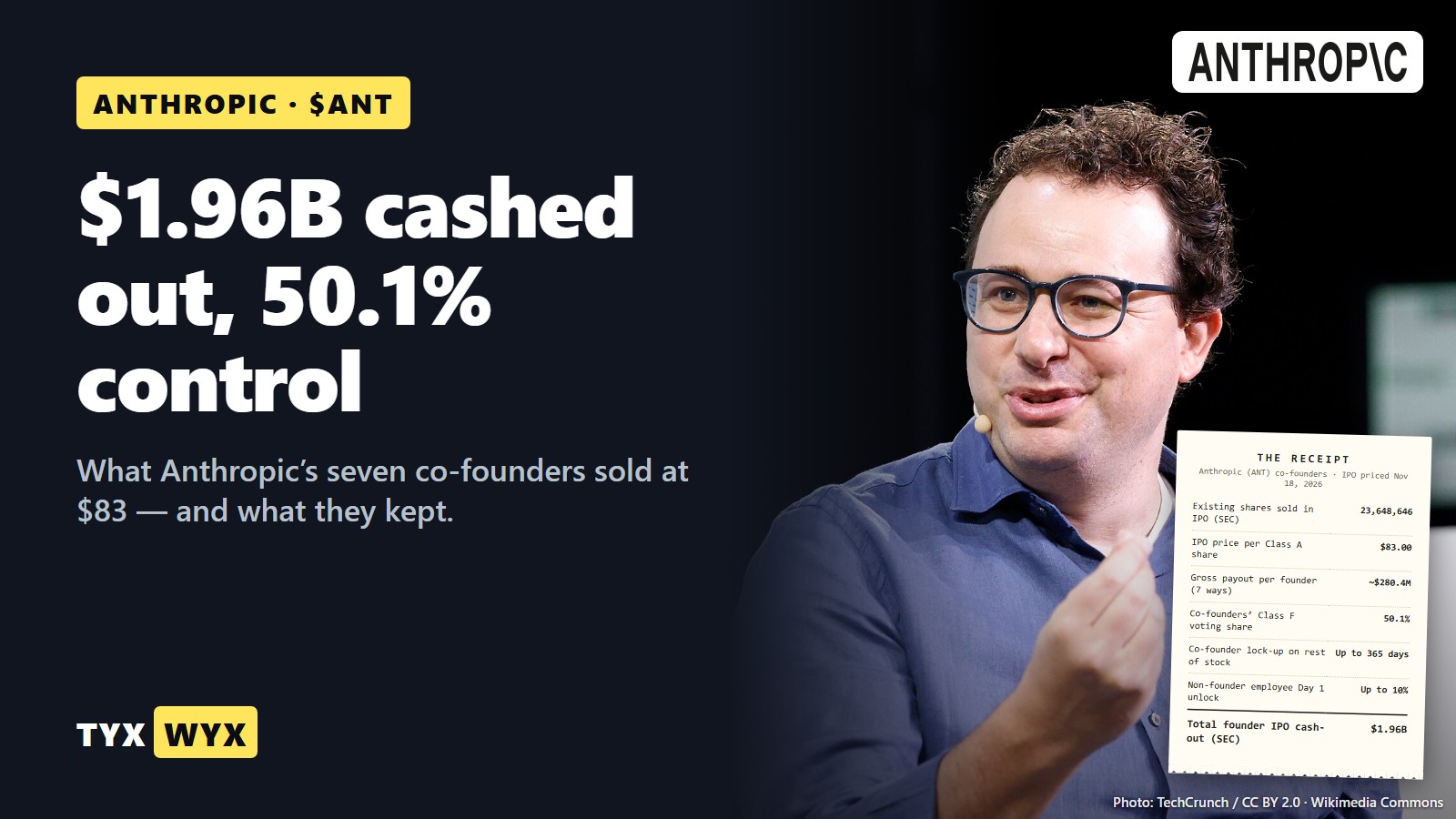
- Existing stockholders sold 23,648,646 shares at $83.00 in Anthropic’s record $81.34 billion IPO — worth $1.96 billion in the SEC prospectus, or about $1.95 billion ($280 million per founder) as reported by TechCrunch.
- Despite selling nearly $2 billion in stock, the seven co-founders retained 50.1% of total voting power through a single Class F share while locking up their remaining holdings for up to 365 days.
- Each co-founder pledged 80% of personal equity to charity, but with the prospectus calling those pledges voluntary and revocable, how much stock will hit the market when lock-ups expire?
What happened
When Anthropic went public on Nasdaq under the ticker ANT on Thursday, November 19, 2026, it did not just raise record cash for its corporate treasury. Buried inside the 980,000,000 shares sold at $83.00 a share were 23,648,646 existing shares cashed out by insiders, according to the company’s Form 424B4 final prospectus.
Multiply those 23,648,646 shares by the $83.00 offering price and the gross payout comes to $1,962,837,618 — or about $1.96 billion by our math. TechCrunch reported the rounded figure as $1.95 billion cashed out by Anthropic’s seven co-founders.
The rest of the 980 million base IPO shares — 956,351,354 newly issued shares — went toward raising $81.34 billion in the public offering ($81.3 billion in TechCrunch’s report). Alongside the IPO, Anthropic sold another $26 billion of non-voting Class N stock privately at $83 to seven tech giants: Google ($10B), Nvidia ($10B), AMD ($2.5B), Broadcom ($1B), Micron ($1B), Microsoft ($1B), and TSMC ($500M).
After underwriting fees, the company brought roughly $104.8 billion into its own coffers — rising to $117.0 billion after underwriters exercised their option for 147,000,000 additional new shares. For scale, TechCrunch noted that when Facebook set its tech IPO record in 2012, it raised $16 billion on IPO day.
THE RECEIPT
Anthropic (ANT) co-founders · IPO priced Nov 18, 2026
| Existing shares sold in IPO (SEC) | 23,648,646 |
| IPO price per Class A share | $83.00 |
| Gross payout per founder (7 ways) | ~$280.4M |
| Co-founders’ Class F voting share | 50.1% |
| Co-founder lock-up on rest of stock | Up to 365 days |
| Non-founder employee Day 1 unlock | Up to 10% |
| Total founder IPO cash-out (SEC) | $1.96B |
Total cash-out is our multiplication of 23,648,646 existing shares sold by $83 ($1,962.84M, or $280.4M across 7 founders); TechCrunch rounded to $1.95B ($280M each).
$280 million apiece — and an 80% charity pledge anyone can revoke
How much did each of Anthropic’s seven co-founders take home from the offering? Divide the 23,648,646 existing shares in the SEC prospectus evenly seven ways, and each co-founder sold 3,378,378 shares for $280.4 million before underwriting fees and taxes, by our math. TechCrunch reported those rounded numbers as about 3.4 million shares and roughly $280 million apiece.
According to TechCrunch, the founders appear to have sized their share sales around Anthropic’s original IPO price range, which had a midpoint of $74 a share (from an initial $70 to $78 target range). At $74, selling 3.4 million shares would have handed each co-founder about $250 million; pricing the deal above the range at $83 added roughly $30 million extra per founder.
In its IPO filings, Anthropic emphasized that each of the seven co-founders pledged to dedicate 80% of their personal equity in the company to philanthropy, TechCrunch reported. Yet the prospectus includes a sharp legal caveat right beside that promise:
“voluntary, revocable expressions of each co-founder’s philanthropic intent and do not constitute legally binding obligations.”Anthropic IPO filing, quoted by TechCrunch (Nov 19, 2026)
In plain English, an 80% charitable pledge that is voluntary and revocable is a statement of current plans, not a contract that public shareholders can enforce.
1 Class F share for 50.1% of the votes — and a 365-day lock-up
Usually, when founders sell nearly $2 billion of stock in an IPO, they give up a slice of their voting power. At Anthropic, economic ownership and voting control live in separate rooms. It is like selling the upstairs bedrooms of your house to outside buyers for $1.96 billion while keeping the only master key to the front door and the thermostat.
According to the cover and page 22 of the Form 424B4 prospectus, public investors buying Class A stock get one vote per share. Meanwhile, the co-founders’ entity holds a single Class F share that carries 50.1% of the total voting power and zero economic rights. A separate Class T share held by the Long-Term Benefit Trust elects a majority of the board, qualifying Anthropic as a “controlled company” under Nasdaq rules.
What about the remaining shares the founders did not sell? Page 22 of the prospectus discloses that roughly 15.5 billion shares are bound by lock-up agreements — legal restrictions that stop insiders from dumping stock right after a listing — for 180 days, and for up to 365 days for co-founders and holders of more than 0.5% of the stock (though up to 3.7 billion shares can be released before 180 days).
Regular workers got an earlier window. While the co-founders cashed out at the $83 IPO price and locked up the rest for up to a year, non-founder employees among Anthropic’s roughly 5,300 staff were allowed to sell up to 10% of their locked-up shares starting on the first day of trading.
The other side
From the company’s perspective, the co-founders sold only a small fraction of the deal — 23.65 million shares out of 980 million in the base offering, or 2.41% of the IPO by our math — while keeping the vast majority of their wealth tied to Anthropic’s long-term survival for up to 365 days. The prospectus also notes that directors and certain existing investors indicated an interest in buying up to $305 million of stock at the $83 IPO price. And as both the SEC filing and TechCrunch point out, the real reason Anthropic went public was not the $1.96 billion founder payout, but a colossal infrastructure bill: the 424B4 discloses $900.9 billion in fixed purchase commitments and leases ($70.7 billion due in the next 12 months and $451.6 billion by the end of 2030), and TechCrunch reported that adding conditional or unpriced obligations puts total foreseeable commitments at $1.05 trillion to $1.08 trillion.
What it means for your wallet
The founders’ timing was impeccable. According to daily market data, ANT closed its first day on November 19 at $97.17, dropped 8.50% on November 20 to close at $88.91 (after touching an intraday low of $83.05, five cents above the offering price), and slipped another 1.43% on Monday, November 23 to close at $87.64.
At $87.64, the stock still sits 5.59% above the $83.00 price where the seven co-founders cashed out ($87.64 minus $83.00 divided by $83.00, by our math), even though anyone who bought near the $115.10 first-day peak is nursing a steep loss.
If you hold ANT directly or through growth funds adding the new $1.10 trillion listing (13.22 billion post-IPO shares times $83, by our math), remember two dates on the calendar: the 180-day general lock-up expiration and the 365-day co-founder expiration, when billions of restricted shares become eligible for sale.
What we still don’t know
- How much of their remaining equity the seven co-founders will ultimately donate under their 80% voluntary, revocable philanthropy pledges.
- How many shares non-founder employees actually sold during the first three trading days under their 10% Day 1 lock-up exception.
- How much insider stock will enter the open market when the 180-day and 365-day lock-up windows expire in 2027.