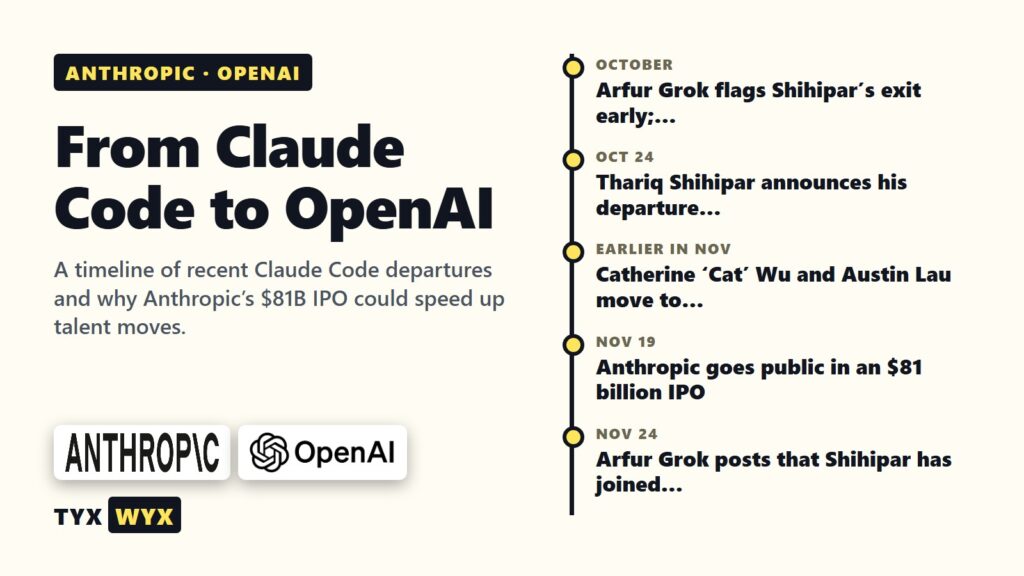
- Anthropic sold $81.34 billion of stock on Nasdaq at $83 a share, plus another $26 billion privately on the same day to seven chip and cloud companies.
- Each $83 share comes with about $17.58 in cash and $2.67 in trailing sales — and $68.15 in future compute bills the company has already signed.
- The scary $104 billion loss is mostly an accounting charge. The real question is whether revenue can grow fast enough to cover $900.9 billion in commitments.
What happened
On November 19, 2026, Anthropic started trading on Nasdaq under the ticker ANT. It sold 980 million shares at $83.00, raising $81.34 billion — the largest IPO on record. A day later the underwriters took their extra 147 million shares as well.
The more interesting number is on page 20 of the prospectus. On the same day, at the same price, Anthropic sold another $26 billion of stock privately to seven companies: Google ($10B), Nvidia ($10B), AMD ($2.5B), Broadcom ($1B), Micron ($1B), Microsoft ($1B) and TSMC ($500M).
Every name on that list sells AI chips or cloud computing. In plain English, the vendors waiting to get paid helped fund the party. Those private shares are non-voting, and they are not covered by the underwriters’ lock-up, although they are still restricted stock under securities law.
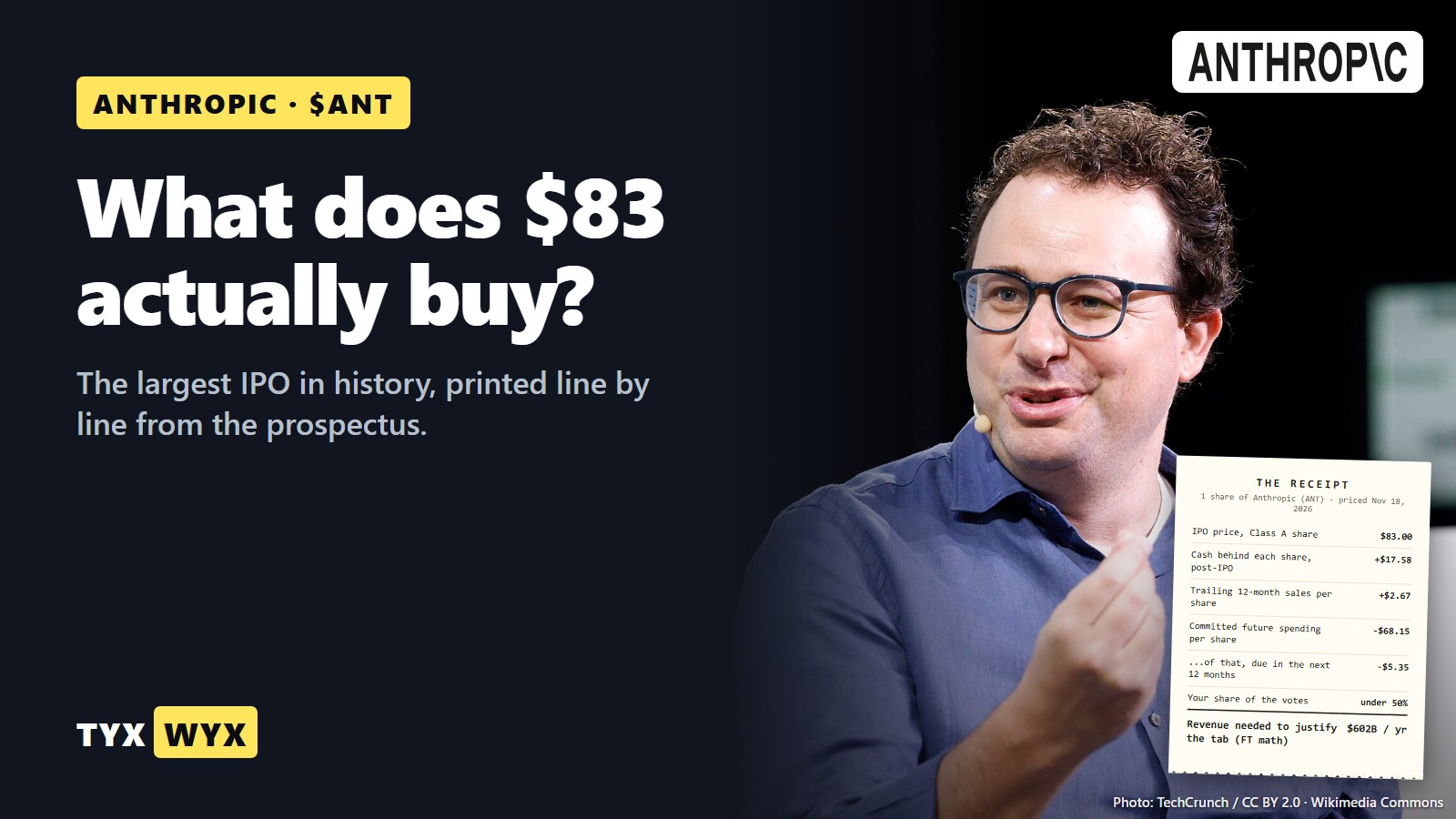
So when you pay $83 for one share, what does your receipt actually buy? We printed it line by line.
THE RECEIPT
1 share of Anthropic (ANT) · priced Nov 18, 2026
| IPO price, Class A share | $83.00 |
| Cash behind each share, post-IPO | +$17.58 |
| Trailing 12-month sales per share | +$2.67 |
| Committed future spending per share | -$68.15 |
| …of that, due in the next 12 months | -$5.35 |
| Your share of the votes | under 50% |
| Revenue needed to justify the tab (FT math) | $602B / yr |
Per-share figures are our division of the prospectus numbers by 13.22 billion shares outstanding after the offering.
The good half: the $104 billion loss that mostly isn’t cash
If you only read headlines, you saw a terrifying figure: a $104 billion net loss in the first nine months of 2026. Flip to Note 2 of the summary financials, and $94.3 billion of it is an accounting charge. Anthropic’s convertible notes had to be repriced higher on paper because the company’s own valuation went up.
It is like your house doubling in value while your accountant books a loss, because an option you once gave a friend just got more expensive to settle. The more investors wanted in, the uglier the bottom line looked.
Strip that out and the core business looks very different:
- Revenue: $41 million (2023) → $386 million (2024) → $4.59 billion (2025) → $33.24 billion in the first nine months of 2026.
- No single customer is more than 10% of revenue. 11,900 customers pay over $100,000 a year; 1,900 pay over $1 million.
- Cash from operations turned positive: +$6.6 billion for the nine months.
- Cash and short-term investments after the offering: about $232 billion.
There is a wrinkle on page 143. Anthropic posted a GAAP operating profit of $974 million in the second quarter, then slipped back to a $567 million operating loss in the third, after paying for expensive short-term compute and booking non-cash donation matching.
Divide the post-IPO cash and trailing sales by the share count and your $83 starts with $17.58 in cash and $2.67 in annual sales. Clean — until you turn the receipt over.
The bar tab: $68.15 a share, already signed
Turn to page 144. Anthropic has signed $900.9 billion in purchase commitments and leases, almost all of it for compute and infrastructure. About half ($451.6 billion) comes due before the end of 2030, and $70.7 billion is due in the next twelve months. That is more than 15 times everything the company sold in 2025.
And here the filing says the quiet part itself. On page 147, Anthropic writes that certain of its cloud providers “are also strategic investors in us, are our customers, and offer AI models and services that compete with ours.” The prospectus also describes a five-year equipment lease worth about $125.2 billion, and names the partner: Broadcom — one of the seven names from page 20.
When the same company is your investor and your landlord, outside buyers have to ask how much of that demand is truly independent.
Divide the commitments by the share count and every $83 share carries $68.15 in committed future spending, including $5.35 due this year. On page 40 the company warns:
“Our ability to meet the substantial and growing financial obligations of these requirements to secure compute depends on our ability to generate significant revenue growth.”Anthropic 424B4, Risk Factors
One line later: “our revenue is primarily consumption-based, and much of it is not subject to long-term contractual commitments.” The rent is locked in for decades. The customers pay by the drink.
The $602 billion math
How big does Anthropic have to get for that tab to pencil out? On November 19 the Financial Times’ Unhedged column ran the numbers. Assume investors want a 20% return on roughly a trillion dollars of commitments. At a 17% tax rate and a generous 40% operating margin, the company needs about $602 billion in annual revenue.
For scale, that is more than Apple or Alphabet sells in a year, and roughly seventeen times Anthropic’s trailing sales. The column’s question, in short: where is all that revenue supposed to come from?
Where you stand in line
Start on the cover page. Public buyers get Class A stock with one vote per share. The founders’ entity holds a single Class F share that carries 50.1% of the total voting power and no economic rights. A separate trust share elects a majority of the board. Nasdaq calls this a “controlled company.” Even Amazon (14.6%) and Google (13.4%) hold non-voting stock.
Then look at who can sell first. Most insider shares are locked up for 180 days, and up to 365 days for co-founders and large holders. But non-founder employees were allowed to sell up to 10% of their locked-up shares from the first day of trading. Nothing hidden about that — it is disclosed. It just tells you who had the first exit.
What it means for your wallet
In its first two sessions ANT opened far above $83, then traded down to $83.05 on November 20 — five cents above the IPO price — before closing at $88.91. It never broke the offering price, but anyone who bought at the opening bell was down about 20% by the next day’s close.
You don’t need to own ANT to feel this. Nvidia wired $10 billion into the private placement and had its own crisis the same week. The chip giants that anchor most index funds are also the ones financing the newest listing. If AI revenue arrives late, the same loop that lifted everyone’s sales runs in reverse.
Neither half of the receipt is fake. There is a real business with real customers, and there is $900.9 billion in bills signed before the revenue exists. Whether $83 turns out cheap or expensive depends on one race: do paying customers arrive faster than the bills?
What we still don’t know
- How much of the $900.9 billion is owed to each partner. The prospectus gives the total and the Broadcom lease; a full counterparty breakdown is not in the summary.
- How much insider stock actually gets sold when the 180-day lock-up ends in May 2027.