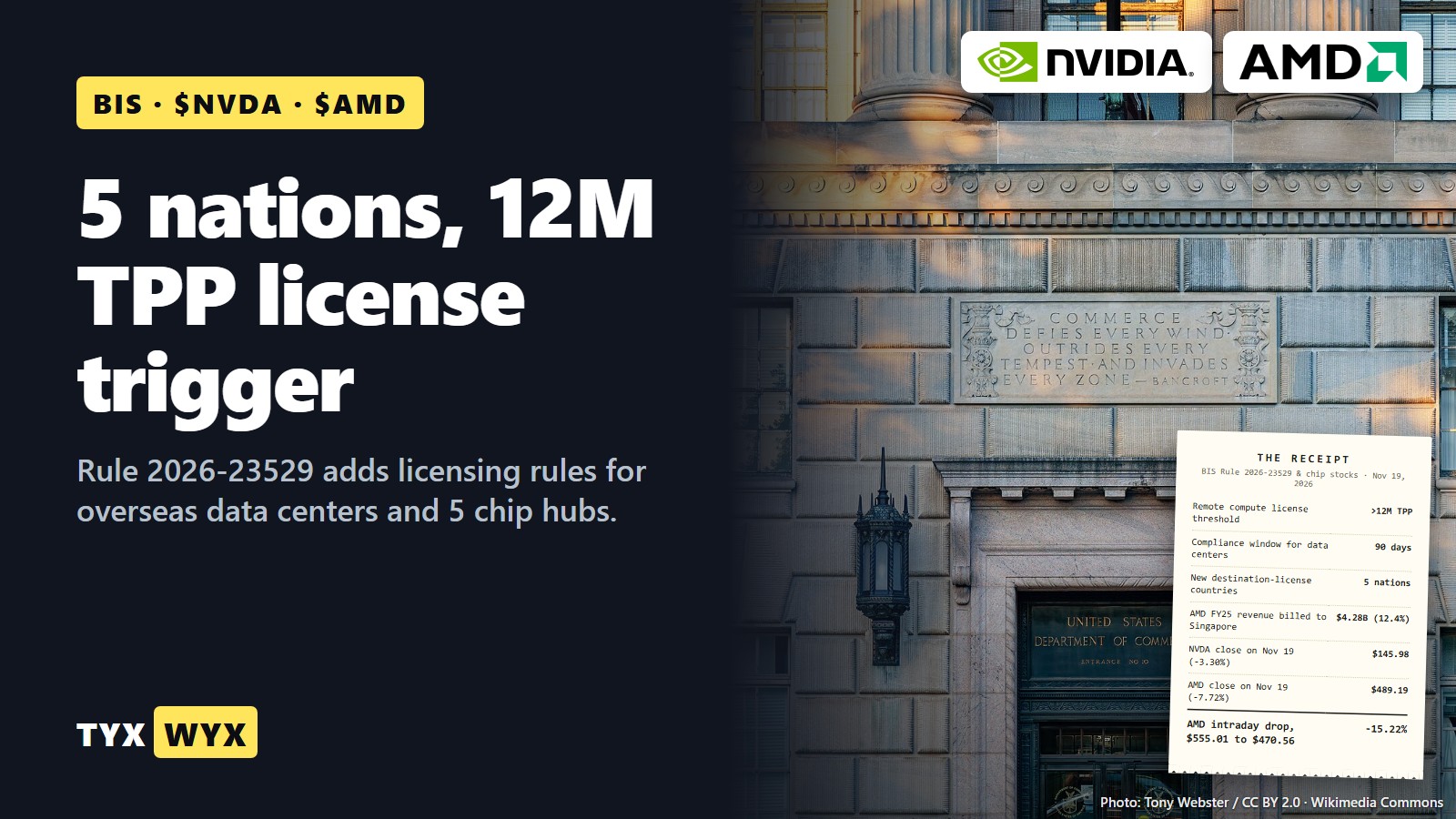
- On November 19, the Commerce Department’s Bureau of Industry and Security enforced Interim Final Rule 2026-23529, requiring licenses for overseas data centers providing over 12,000,000 aggregate TPP of compute to Macau or Country Group D:5 firms.
- The rule also requires licenses to ship advanced semiconductors to Indonesia, Malaysia, Singapore, Thailand, and Brazil (exempting U.S.-headquartered end users that meet reporting rules).
- On the morning the rule took effect, Hunterbrook Media highlighted that AMD billed $4.28 billion (12.4% of FY25 revenue) to Singapore; AMD fell 7.72% to $489.19 and Nvidia slipped 3.30% to $145.98.
What happened
On Thursday, November 19, 2026, the U.S. Department of Commerce’s Bureau of Industry and Security (BIS) published and enforced Interim Final Rule 2026-23529 (91 FR 74970), tightening export controls on how advanced artificial intelligence chips are shipped to third countries and accessed remotely over the cloud.
Rather than an outright ban, the 30-page rule establishes two major new license requirements reviewed on a case-by-case basis. First, under new section 744.24(a)(1), a BIS license is required to export, reexport, or transfer advanced Super Intelligence (SI) semiconductors (such as items under ECCNs 3A090 and 4A090) when there is knowledge that an overseas data center — or digitally linked data centers — will provide more than 12,000,000 aggregate Total Processing Performance (TPP) to or for companies headquartered in Macau or Country Group D:5 (which includes China).
Second, under section 742.6(a)(6)(iii)(A)(1), BIS added a destination-based license requirement for advanced semiconductors sent to five countries cited for higher diversion risk: Indonesia, Malaysia, Singapore, Thailand, and Brazil. The rule also requires data centers, foreign foundries, and chip exporters to perform “robust due diligence on their customers, including any direct or indirect ownership or control by persons in Country Group D:5 or Macau,” while formally rescinding the never-enforced January 2025 AI Diffusion Rule.
On November 19, Nvidia shares slipped 3.30% from $150.96 to $145.98, while rival AMD fell 7.72% from $530.14 to close at $489.19 after trading as high as $555.01 and as low as $470.56 during the session.
THE RECEIPT
BIS Rule 2026-23529 & chip stocks · Nov 19, 2026
| Remote compute license threshold | >12M TPP |
| Compliance window for data centers | 90 days |
| New destination-license countries | 5 nations |
| AMD FY25 revenue billed to Singapore | $4.28B (12.4%) |
| NVDA close on Nov 19 (-3.30%) | $145.98 |
| AMD close on Nov 19 (-7.72%) | $489.19 |
| AMD intraday drop, $555.01 to $470.56 | -15.22% |
AMD’s -15.22% peak-to-trough intraday drop on November 19 is our calculation from the daily price table’s $555.01 high to its $470.56 low.
12,000,000 TPP, 90 days, and who is exempt
Two days earlier, Nvidia had stated in its November 17 earnings outlook that its $130.0 billion fourth-quarter forecast assumed zero Data Center compute revenue from China. Rule 2026-23529 reaches beyond direct shipments to China by regulating third-country facilities where Chinese companies rent computing power remotely:
“Through this rule, BIS is imposing restrictions that will undermine those entities’ ability to access significant volumes of advanced SI semiconductors remotely, including through connected cloud computing.”Bureau of Industry and Security, Federal Register Doc. 2026-23529, Nov 19, 2026
Think of it like regulating a heavy-duty industrial printing press: previously, you needed a government permit to crate up the press and ship it to a restricted buyer, whereas now a print shop in a third country also needs a permit if it lets that same buyer log in over the internet to run large print jobs remotely.
The Federal Register text includes three critical operational clauses that shape the actual revenue impact:
- A 90-day transition window: Overseas data centers already providing significant compute volumes to Country Group D:5 or Macau customers before November 19 have 90 days from the effective date to obtain a BIS license or face future export restrictions.
- U.S. parent exception in the five countries: The new license requirement for Indonesia, Malaysia, Singapore, Thailand, and Brazil does not apply when the ultimate consignee or end user is headquartered in the United States (or has a U.S.-headquartered ultimate parent), provided new section 743.10 reporting rules are met.
- Commercial recommender carve-out: The remote-access license requirement does not apply when compute is used exclusively for “commercial recommender systems, such as those used by online retailers or social media companies” that do not generate novel text, image, audio, video, or code.
Why AMD swung 15.22% intraday as Hunterbrook pointed to Singapore
On the exact morning Rule 2026-23529 took effect — November 19 at 10:27 a.m. EST — investigative outlet Hunterbrook Media published a report titled “AMD Has Its Own China Problem,” disclosing that its affiliated fund, Hunterbrook Capital, was short AMD stock. Hunterbrook explicitly connected the new regulation to AMD’s regional billing footprint:
“A separate newly released interim final rule, which takes effect today, will require licenses for advanced chips shipped to Singapore and four other countries. AMD billed $4.28 billion to customers in Singapore alone in fiscal 2025, over 10% of its sales.”Hunterbrook Media, Nov 19, 2026
According to Hunterbrook’s review of corporate filings, AMD billed $4.28 billion, or 12.4% of its fiscal 2025 revenue, to Singapore (up from $2.23 billion two years earlier), and billed $7.75 billion, or 22.4% of revenue, to China and Hong Kong, compared with Nvidia’s 9.1% revenue share attributed to customers headquartered there. Hunterbrook also reported that Chinese server maker IEIT Systems — placed on the BIS Entity List in March 2025 — incorporated at least six newer versions of AMD startup firmware (BIOS) through October 19, 2026, that three non-blacklisted server vendors tied to IEIT (Maginfra in China, Kaytus in Singapore, and Aivres in California) offered 99.94% identical firmware, that customs records showed 209 ocean shipments (over 2,000 metric tons of server parts) arriving at Aivres from China since IEIT’s blacklisting, and that AMD reported $67 million in 2025 licensing income traced to blacklisted Chinese chip ventures (Hygon).
By our math on the daily stock price table, AMD shares fell 15.22% from their November 19 intraday peak of $555.01 to their intraday low of $470.56 before clawing back about a fifth of that intraday drop to close at $489.19 (-7.72%). In the same report, Carnegie Endowment senior fellow Sam Winter-Levy called the new BIS rule a potential “turning point” in U.S. export policy.
The other side
A license requirement is not an automatic embargo. As former Commerce undersecretary William Reinsch told Hunterbrook, “The fact that you have to get a license does not mean automatically that the license will be denied,” noting that BIS keeps license approvals confidential and that AMD could hold valid licenses. Hunterbrook itself wrote that the records it found “don’t establish on their own a violation of export laws,” and noted that AMD did not answer its questions after asking for more time. Meanwhile, Rule 2026-23529 explicitly exempts shipments to U.S.-headquartered companies operating in Singapore, Malaysia, Indonesia, Thailand, and Brazil, leaving American hyperscalers’ own overseas branches outside the new five-country license requirement.
What it means for your wallet
For investors holding Nvidia, AMD, or broad semiconductor and Nasdaq-100 ETFs, Rule 2026-23529 shifts the key geographical line item in annual reports from China to Southeast Asia and Brazil. The day after the rule took effect, on November 20, both chipmakers fell further as multiple sector headlines overlapped — Nvidia dropped 14.01% to $125.53 and AMD slid 13.25% to $424.39 — before rebounding on November 23 to $165.05 (+31.48%) and $453.46 (+6.85%), respectively.
Because U.S.-headquartered cloud buyers are exempt from the five-country license rule while local non-U.S. buyers must apply for case-by-case BIS licenses, the financial impact on chipmakers will depend on how much of their Singapore and Malaysian billing goes to U.S. cloud subsidiaries versus foreign data center operators.
What we still don’t know
- How many license applications BIS will approve or deny on a case-by-case basis during the 90-day transition window for existing overseas data centers.
- What share of AMD’s $4.28 billion in fiscal 2025 Singapore billings involved advanced AI accelerators destined for non-U.S. buyers versus exempt U.S.-headquartered companies or standard processors.
- Whether AMD or any distributor held a BIS license covering the startup firmware updates incorporated by IEIT Systems after March 2025, as neither AMD nor BIS responded to Hunterbrook’s questions before publication.