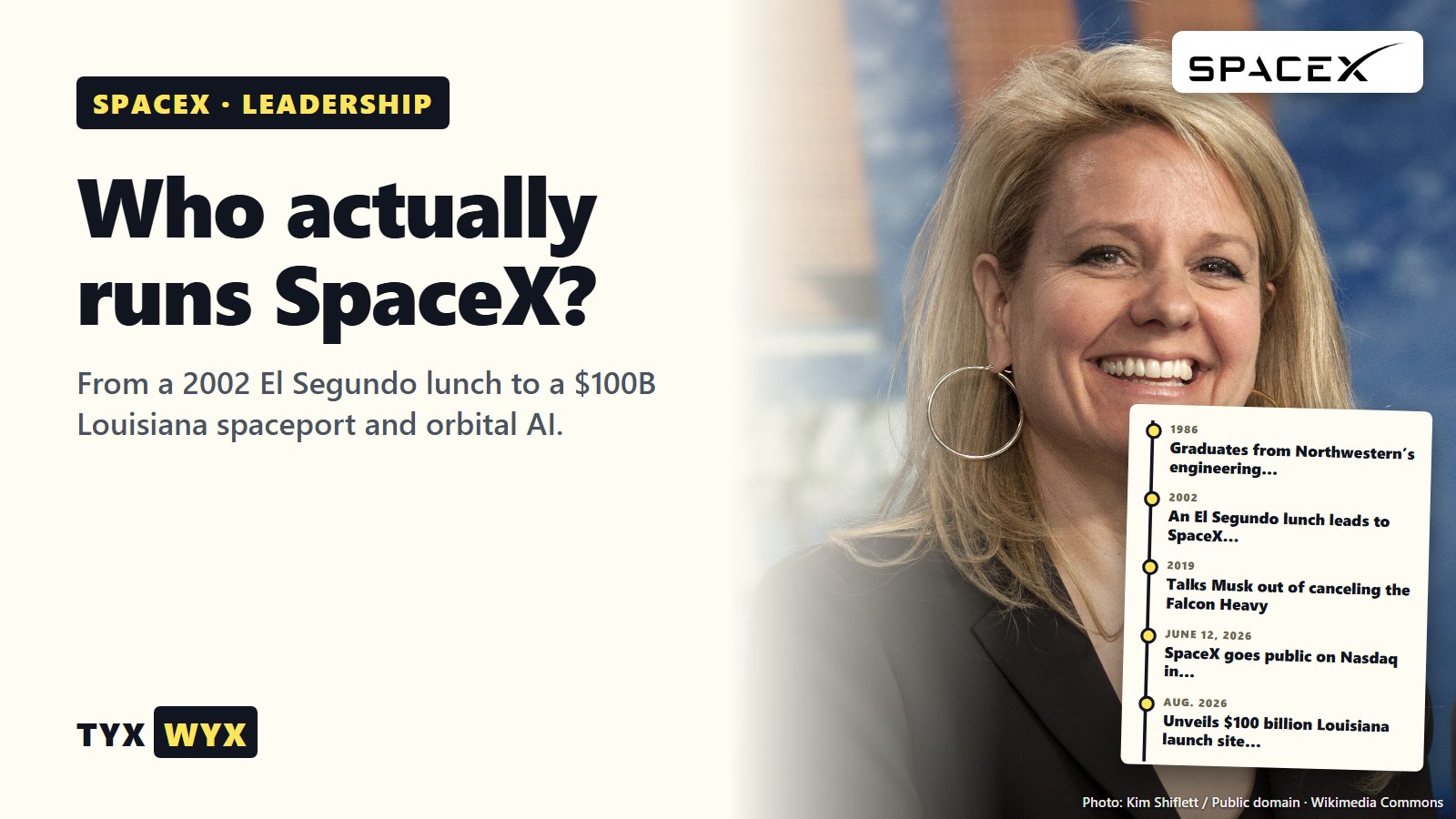
- Gwynne Shotwell, SpaceX’s president and employee No. 7, holds 12.6 million shares worth some $2 billion after the company’s June 12, 2026 Nasdaq IPO.
- Starlink and terrestrial data centers leased to AI rivals generate billions in cash, but SpaceX more than tripled nine-month 2026 capex to $48.1 billion to chase Elon Musk’s orbital AI data center plan.
- With outside researchers estimating a 1-gigawatt orbital data center costs $51.1 billion over five years versus $15.9 billion on earth, investors face one test: can Shotwell make orbital compute pay?
What happened
Anyone who bought SpaceX stock after its June 12, 2026 Nasdaq debut — before Anthropic, the largest IPO of all time — bet on Elon Musk, who serves as CEO, chairman, and chief technology officer and controls around 40% of the shares, Fortune reported. Yet as Fortune’s profile details, shareholders are equally betting on 63-year-old president Gwynne Shotwell, employee No. 7, whose 12.6 million shares were worth some $2 billion after the listing.
For 24 years, the division of labor has stayed clear. As Shotwell said in a recent interview cited by Fortune: “He focuses on the future…on strategy and deep dives on the technical [side]. I focus on things that are helpful to customers today to earn money.” Tom Mueller, SpaceX’s first employee and developer of the Merlin engine before retiring in 2020, put it even more plainly in interviews cited by Fortune:
“I built the rockets, but Gwynne built the company.”Tom Mueller, SpaceX Employee No. 1, cited by Fortune
THE TIMELINE
Gwynne Shotwell & SpaceX · 1986–2026, via Fortune
- Graduates from Northwestern’s engineering school 3 of 36Shotwell graduates from Northwestern’s McCormick School of Engineering as one of three women in a class of 36, later spending 10 years at Aerospace Corp. and 4 years at rocket builder Microcosm Inc.
- An El Segundo lunch leads to SpaceX employee No. 7 Employee #7After lunch at an Austrian restaurant in El Segundo, a former colleague brings the 38-year-old Shotwell to meet Elon Musk. She tells Musk he needs a “business developer” and joins SpaceX within days.
- Fourth Falcon 1 launch reaches orbit and wins NASA deal $1.6BAfter three failed flights, Falcon 1 reaches orbit carrying dummy payload RatSat while Shotwell watches from a Glasgow hotel. The flight lands a $1.6 billion NASA cargo contract for the International Space Station.
- Accepts Musk’s offer to become president of SpaceXAt the close of 2008, the NASA deal prompts Musk to offer Shotwell the presidency. After her first instinct to say no — which she later calls “a nanosecond of stupidity” — she accepts.
- Debuts the 21-story Falcon 9 using nine Merlin engines $1B savedSpaceX introduces its workhorse Falcon 9, avoiding what Shotwell claims would have been $1 billion for an all-new engine by packing nine Falcon 1 Merlin engines into the booster.
- Delivers a $50 million fixed-price Air Force launch $50MEven after Musk sues the U.S. Air Force over rival contracts, Shotwell keeps government business flowing and completes an experimental military satellite launch for a $50 million fixed price.
- Talks Musk out of canceling the Falcon HeavyWhen Musk impulsively decides to shutter the Falcon Heavy, Shotwell speeds to his cubicle, reminds him SpaceX needs the vehicle to fulfill a major military contract, and gets him to reverse the cancellation.
- SpaceX goes public on Nasdaq in record-setting IPO $2B stakeSpaceX lists on Nasdaq in what was, pre-Anthropic, the biggest IPO of all time. Shotwell’s 12.6 million shares are worth some $2 billion, while Musk controls around 40% of the stock.
- Unveils $100 billion Louisiana launch site for orbital AI $100BAs nine-month 2026 capex more than triples to $48.1 billion, Shotwell unveils a $100 billion Louisiana spaceport to launch Starmind orbital AI data centers.
Dates, quotes, and financial figures are taken from Shawn Tully’s November 24, 2026 Fortune profile of Gwynne Shotwell.
The cash engines she built — and the $48.1 billion capex bill she now has to fund
To understand why investors watch Shotwell, look at how SpaceX’s three businesses actually make and spend money, according to financial figures and analyst reports cited by Fortune:
- Space and Connectivity (Starlink): SpaceX flew 165 orbital missions last year — 85% of the U.S. total and half the world total — and operates over 11,000 Starlink satellites, three-quarters of all broadband satellites in orbit. In the 12 months through Q3 2026, Starlink subscribers nearly doubled to 13.6 million and connectivity revenues jumped 57%. MoffettNathanson analyst Julie Zhu forecasts Space and Starlink will generate $86 billion in revenue and $51 billion in EBITDA (a 60% margin) by 2030. By contrast, Starlink Mobile brought in just $632 million last year and in October struck a reported $8 billion deal for cellular spectrum licenses.
- Terrestrial AI Data Centers (Super Intelligence): Inherited from xAI, the 200-acre Memphis campus includes Colossus 1 (built in 120 days in 2024) and Colossus 2. After filling the sites with scarce Nvidia GPUs, Musk and Shotwell began leasing capacity in May 2026 to Google, Anthropic, Reflection AI, and a fourth undisclosed major player — generating $3.4 billion a month in revenue on 90-day cancellable terms. By our math, that monthly run rate equals $40.8 billion a year if racks stay full, and Zhu predicts terrestrial campuses will reach $102 billion in revenue by 2031, or 40% of SpaceX’s total.
- Orbital AI Data Centers (Starmind): Musk has forecast a $1 trillion revenue run rate by 2030 built largely on putting data centers in orbit. To chase it, SpaceX more than tripled its capital expenditures to $48.1 billion in the first nine months of 2026, and in August Shotwell unveiled a $100 billion Louisiana launch site.
Think of SpaceX like a landlord using the steady rent from a packed apartment building on Main Street to construct an off-grid hotel on a mountaintop where every brick has to be flown in by helicopter. Shotwell also acts as the public counterweight to Musk’s boldest forecasts: when Musk predicted Starlink would grow to 100,000 satellites in five years, Shotwell pegged the fleet at 12,000 to 15,000 more powerful V3 satellites, Fortune reported.
The other side: $51.1 billion in orbit vs. $15.9 billion on earth
At the All-In Summit in mid-September and on CNBC in June, Shotwell argued that orbital compute skips earthly permit delays, power bottlenecks, and land that jumps from $3,000 to $180,000 an acre, declaring: “The real estate in space is infinite. And it’s free.” She even moved the target for launching AI satellites into low-earth orbit up to next year from the pre-IPO target of 2028, Fortune reported.
Independent analysts and aerospace researchers cited by Fortune see brutal arithmetic on the other side. Andrew McCalip, head of research at Varda Space Industries, estimates that running a 1-gigawatt facility in orbit over five years would cost $51.1 billion, compared with $15.9 billion for an equivalent facility on earth — more than a three-to-one cost gap. Without air or water in a vacuum, a 100-megawatt orbital cluster requires roughly 700 satellites carrying 1,200-square-foot radiators, degrades under radiation over an estimated five-year lifespan with no repair crews, and currently costs about $2,700 per kilogram to launch (which Musk and Shotwell pledge to cut below $200, and eventually under $100).
Aswath Damodaran, a professor at NYU’s Stern School of Business, called the spending numbers “mind-blowingly large” and told Fortune his biggest fear for SpaceX is that “it overspends on orbital AI.” Morgan Stanley analyst Adam Jonas predicts SpaceX will not see significant sales from orbital AI until at least 2032, projecting the company will burn cash through 2030 and require $390 billion in debt financing through that date.
What it means for your wallet
Because SpaceX was the largest IPO on record prior to Anthropic’s listing, it sits inside major institutional and growth portfolios alongside its chip supplier Nvidia — which Fortune noted is developing space-hardened chips for SpaceX while SpaceX’s Terafab joint venture with Intel and Tesla works on custom orbital semiconductors. As long as Starlink and the Memphis Colossus campuses throw off cash, Shotwell’s operational discipline gives SpaceX a massive buffer.
The risk for shareholders, as Morgan Stanley and other banks cited by Fortune point out, is the gap between today’s record capex and post-2032 orbital revenue: if orbital AI stalls and Musk refuses to dial back spending, Starlink’s profits will be subsidizing up to $390 billion in debt and decades-high capital outlays.
What we still don’t know
- Whether SpaceX can drive launch costs down from roughly $2,700 per kilogram to under $200 per kilogram via Starship and the $100 billion Louisiana spaceport fast enough to narrow the 3-to-1 cost gap with terrestrial data centers.
- Whether Google, Anthropic, Reflection AI, and the fourth undisclosed tenant will keep renewing their $3.4 billion-a-month terrestrial leases once their 90-day cancellation windows roll over.
- Whether Shotwell can persuade Musk to scale back orbital AI capital expenditures if the five-year satellite lifespan and radiation-degradation hurdles prove unprofitable before 2030.