- Jensen Huang’s return as Nvidia CEO sparked Wall Street’s best day since April 2025 on November 23, 2026, lifting the S&P 500 by roughly $3 trillion before TSMC added $158 billion in Taipei on Tuesday.
- Even after that surge, the S&P 500 sits roughly $5 trillion below its October 6 record of $70 trillion, with SPY still down 7.3% and QQQ down 14.3% from their October 6 closes.
- With 10 giant companies making up 40% of the S&P 500, can a founder’s return answer whether trillions in AI spending will actually pay off?
What happened
On Monday, November 23, 2026, Wall Street staged its best single-day rally since April 2025 after Nvidia’s board unanimously reinstated Jensen Huang as chief executive, 11 days after his resignation, Fortune reported. Nvidia shares closed at $165.05, up 31.48% from Friday’s close of $125.53 (Fortune noted the stock jumped 33% at its peak), pulling the S&P 500 up about 5% (SPY +4.71% to $722.29), the Nasdaq up 6.5% (QQQ +7.00% to $651.03), and the Dow up 3%.
Zoom out six weeks, however, and the math is much soberer. According to Fortune, when the S&P 500 hit its record high on October 6, 2026, the companies in the index were worth roughly $70 trillion. Over the next six weeks, an AI-led selloff erased more than 11% of that value — roughly $8 trillion — pushing the S&P 500, Nasdaq, and Dow into correction territory by Friday, November 20.
Monday’s bounce won back roughly $3 trillion of those losses, leaving the S&P 500 still about $5 trillion below its October 6 peak, Fortune reported. President Donald Trump told CNBC on Monday that he “convinced” Nvidia’s board to bring Huang back, saying, “If I didn’t get involved, you’d probably have a very sad Nvidia for a long time to come,” while White House communications director Steven Cheung confirmed to outlets that Trump was “totally involved.”
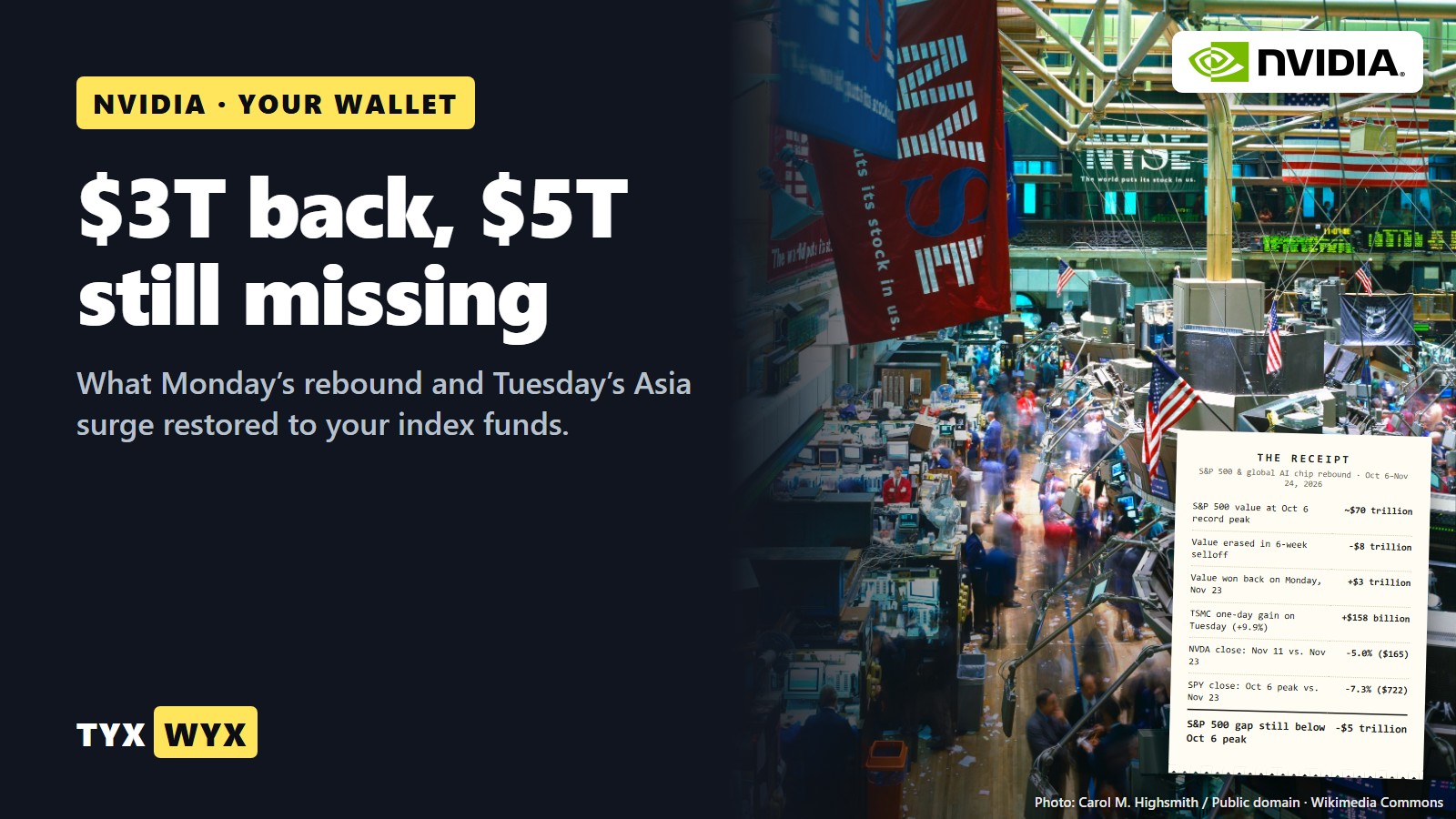
THE RECEIPT
S&P 500 & global AI chip rebound · Oct 6–Nov 24, 2026
| S&P 500 value at Oct 6 record peak | ~$70 trillion |
| Value erased in 6-week selloff | -$8 trillion |
| Value won back on Monday, Nov 23 | +$3 trillion |
| TSMC one-day gain on Tuesday (+9.9%) | +$158 billion |
| NVDA close: Nov 11 vs. Nov 23 | -5.0% ($165) |
| SPY close: Oct 6 peak vs. Nov 23 | -7.3% ($722) |
| S&P 500 gap still below Oct 6 peak | -$5 trillion |
Trillion-dollar market figures and TSMC gains are as reported by Fortune on Nov 23–24, 2026. ETF and NVDA percentage gaps are our math from closing prices ($165.05 divided by $173.73 for NVDA; $722.29 divided by $779.09 for SPY).
From Wall Street to Taipei: the $158 billion Tuesday wave
On Tuesday, November 24, the relief rally crossed the Pacific into Asia’s AI hardware supply chain, Fortune reported. Taiwan Semiconductor Manufacturing Co. (TSMC), which manufactures Nvidia’s chips, surged 9.9% — hitting Taiwan’s daily trading limit — and added 5.2 trillion New Taiwan dollars ($158 billion) to its market value in a single session.
Across the region, major benchmarks and chip suppliers jumped in tandem, according to Fortune:
- Taiwan: The benchmark TAIEX climbed 9% on Tuesday, rebounding after a brutal 17.5% drop last week — its worst weekly slide since 1991, which had prompted regulators to ban short selling over the weekend. Server assemblers Foxconn and Wistron rose almost 10%.
- South Korea: The KOSPI surged 6.2%, led by high-bandwidth memory leader SK Hynix (+6.7%) and Samsung Electronics (+6.6%).
- Japan: Coming back from a three-day weekend, the Nikkei 225 rose 3.9%, while memory maker Kioxia surged 10.0% and chip-testing equipment maker Advantest jumped 12.5%.
- The holdout: Hong Kong’s Hang Seng Index fell 0.6%, which Pepperstone head of research Chris Weston told Fortune showed Chinese tech stocks still struggling to find support.
Why 10 companies steer 40% of your S&P 500 index fund
Celebrating a $3 trillion rebound after an $8 trillion slide is like tumbling eight steps down a staircase and bounding back up three steps in a single leap: your heart is racing and the momentum feels thrilling, but you are still standing five steps below the floor where you started.
Why did one CEO’s 11-day absence rattle retirement accounts worldwide? Because the stock market has never been more concentrated in a single trade. According to Fortune, the top 10 largest U.S. companies now make up 40% of the S&P 500, and eight of those ten are tech companies. Globally, the United States now accounts for three-quarters of the total value of stocks across developed markets worldwide, Apollo chief economist Torsten Slok wrote in a Monday note cited by Fortune.
Even after Nvidia’s first-ever $100-billion-plus revenue quarter ($115.8 billion), last week’s downdraft battered every corner of the AI trade: Fortune noted that Micron plunged nearly 24% for the week, AMD and Broadcom fell by double digits, data center operators CoreWeave and Nebius slid on post-midterm regulatory worries, and newly public Anthropic slipped from $88.91 on Friday to $87.64 on Monday (-1.43%). James St. Aubin, chief investment officer of Ocean Park Asset Management, summed up the dilemma to Fortune:
“The AI story was already facing pressure before the Jensen story broke. Jensen’s return doesn’t answer the big questions investors were grappling with regarding the ROI on the AI build-out.”James St. Aubin, CIO of Ocean Park Asset Management, to Fortune
The other side
Bulls argue that removing leadership uncertainty at the world’s most important chipmaker changes the fundamental calculus. eToro market analyst Sam North told the Guardian, as cited by Fortune, that while Monday’s rebound highlights the AI trade’s dependence on one man, Nvidia “restoring its founder to the helm gives investors a powerful reason to reassess last week’s selloff.” Similarly, Saxo Bank chief investment strategist Charu Chanana told Fortune on Tuesday that the relief rally — amplified by short covering — could extend over the next few sessions in semiconductor-heavy markets like Taiwan and South Korea where earnings visibility improved with Huang’s return.
What it means for your wallet
By our math from daily closing prices, if you had $10,000 sitting in an S&P 500 ETF (SPY) on November 11 — the day Nvidia’s board accepted Huang’s resignation — it dropped to $9,079 by Friday, November 20, and recovered to $9,506 on Monday. In the tech-heavy Nasdaq-100 ETF (QQQ), that same $10,000 fell to $8,813 on Friday and bounced to $9,430 on Monday. In Nvidia stock itself, $10,000 plunged to $7,226 before rebounding to $9,500 — still 5.0% below its November 11 close of $173.73.
Measured from the October 6 market peak, SPY is still down 7.3% ($722.29 vs. $779.09) and QQQ is down 14.3% ($651.03 vs. $759.66). As Saxo Bank’s Chanana warned in Fortune, once the immediate relief fades, markets will become more selective as focus returns to AI spending returns, earnings delivery, and the Federal Reserve’s policy outlook.
What we still don’t know
- Whether corporate software and cloud customers will generate enough return on investment (ROI) to justify the hundreds of billions spent on AI data centers.
- How incoming House Oversight Committee chair Rep. Robert Garcia and other lawmakers will pursue corporate governance and national security questions around Nvidia and the Entity List additions.
- How long Taiwan’s weekend market stabilization measures, including its short-selling ban, will stay in place after Tuesday’s 9% TAIEX rebound.