- Social Security benefits will rise 3.6% in January 2027 — the largest cost-of-living adjustment in four years, lifting the average retired worker’s check to about $2,170 a month.
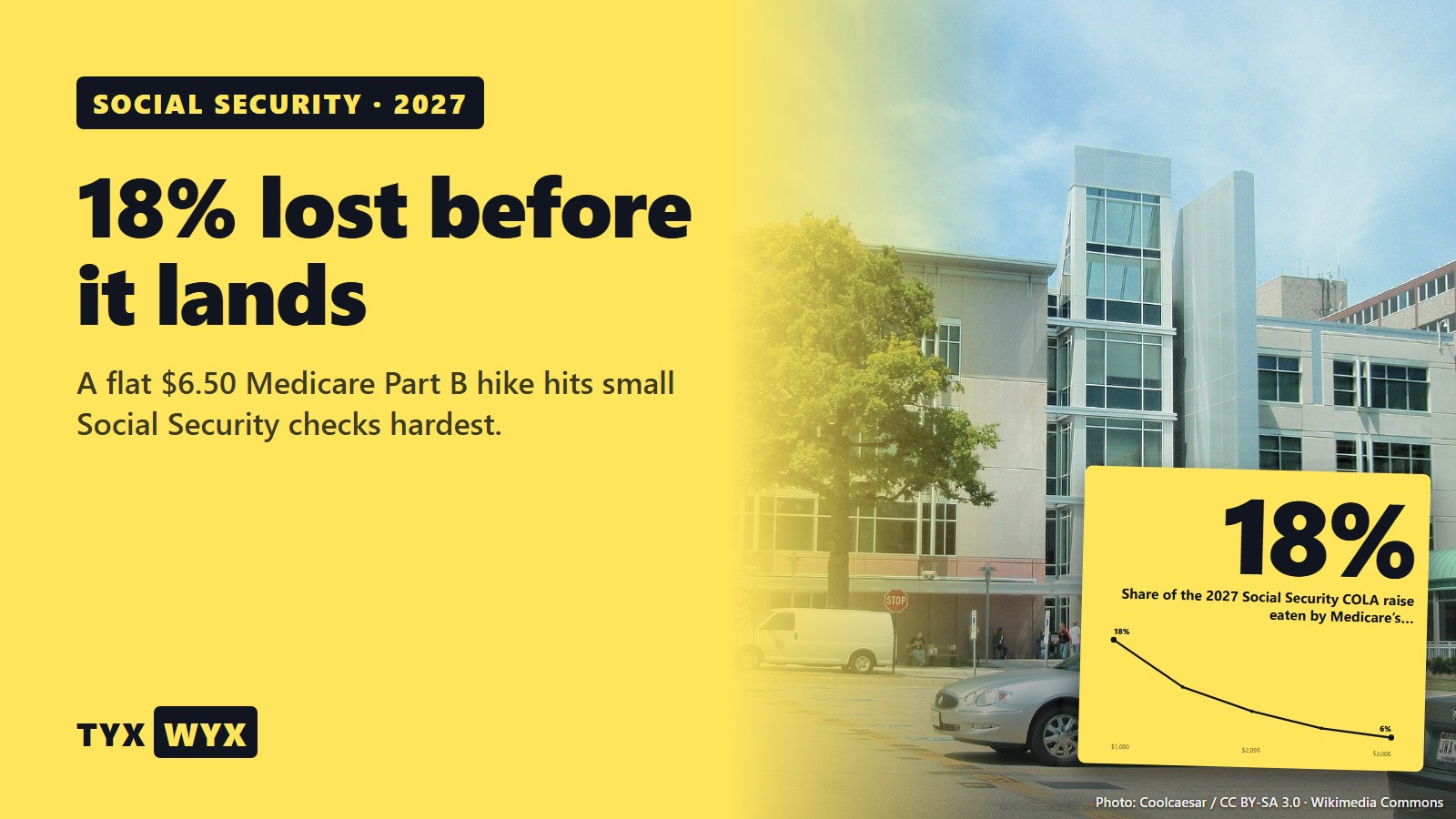
- The standard Medicare Part B premium rises $6.50 to $209.40 a month and is deducted first, taking 18% of the raise on a $1,000 check compared with just 6% on a $3,000 check.
- With September 2026 annual inflation at 3.7% and the trust fund projected to pay only 78% of scheduled benefits by late 2032, the new Congress convening in January has roughly six years to act.
What happened
In January 2027, Social Security recipients will receive a 3.6% cost-of-living adjustment (COLA), their biggest raise in four years, lifting the average retired worker’s monthly benefit to about $2,170, according to the Social Security Administration’s 2027 COLA announcement, cited by Fortune. Yet for most retirees, the headline percentage is not the money that actually lands in their bank account.
On November 17, the Centers for Medicare & Medicaid Services announced that the standard Medicare Part B premium will climb by $6.50 to $209.40 a month starting in January, Fortune reported. Because Part B premiums are deducted straight from Social Security checks before payment, Medicare takes its slice first.
ONE NUMBER
Share of the 2027 Social Security COLA raise eaten by Medicare’s Part B hike on a $1,000 monthly check
Percentage of the 3.6% Social Security COLA raise absorbed by the flat $6.50 monthly Medicare Part B premium increase across monthly benefit levels, as reported by Fortune.
How a flat $6.50 fee scales from $1,000 to $3,000 checks
Think of the Medicare increase like a flat cover charge at a neighborhood diner: a $6.50 fee barely registers on a $108 steak dinner tab, but it takes nearly a fifth of a $36 breakfast. Because the standard Part B increase is the same dollar amount for everyone, the smaller the monthly benefit, the larger the share of the raise it swallows. Fortune broke down the net math across five monthly check sizes:
- $1,000 a month: The 3.6% COLA adds $36, but after the $6.50 Part B hike only $29.50 remains — an 18% haircut on the raise.
- $1,500 a month: The raise adds $54 and leaves a net gain of $47.50, sending 12% of the increase to Medicare.
- $2,095 a month (the 2026 average): The COLA adds about $75 and leaves roughly $69, with Medicare claiming about 9% of the increase.
- $2,500 a month: The check gains $90 and keeps $83.50, losing 7% of the raise.
- $3,000 a month: The raise is $108, the net gain is $101.50, and the premium takes 6%.
By our math, that $6.50 monthly deduction takes $78 a year off the top of a retiree’s increase before a single grocery bill is paid. Higher-income enrollees pay income-based surcharges above the standard premium, while states cover Part B for about one in five enrollees with low incomes and savings, Fortune reported.
The other side
By recent standards, 2027’s Medicare bite is comparatively mild, Fortune noted. The 3.2% Part B premium increase is smaller than the COLA for the first time since 2023; in 2026, the Part B premium jumped 9.7% against a 2.8% COLA. Still, David Herbert, director of economics and economic freedom and a senior research fellow at the American Institute for Economic Research, told The Hill, as cited by Fortune:
“It’s meant to make sure that Social Security recipients are receiving the same amount of spending power as they did in the past. It’s not actually going to make them wealthier or have an easier time buying things that they weren’t already going to buy.”David Herbert, AIER, to The Hill (cited by Fortune)
What it means for your wallet
Even before Medicare’s deduction, the 3.6% adjustment lags recent price increases. In an AARP survey conducted before the announcement and cited by Fortune, 80% of recipients said a projected 3.5% COLA would not keep up with rising costs. The Bureau of Labor Statistics reported 3.7% annual inflation for September 2026, after inflation hit 3.3% in March and peaked at 4.2% in May, Fortune reported.
A larger structural deadline sits right behind the 2027 check. The 2026 Trustees Report found that starting in the fourth quarter of 2032, the Old-Age and Survivors Insurance Trust Fund will be able to pay only 78% of scheduled benefits, according to Fortune. Only about 2.6 workers paid in per beneficiary in 2025 — down from 41.9 in 1945 and projected to reach 1.9 by 2075 — prompting Herbert to warn that workers a decade or two from retirement should not count on receiving full scheduled benefits.
What we still don’t know
- How the new Congress convening in January 2027 will address the OASI Trust Fund shortfall before the fourth quarter of 2032, when — per the projection Fortune cites — the fund could pay only 78% of scheduled benefits.
- Whether inflation between late 2026 and January 2027 will widen the gap beyond September’s 3.7% annual rate before the higher checks arrive.