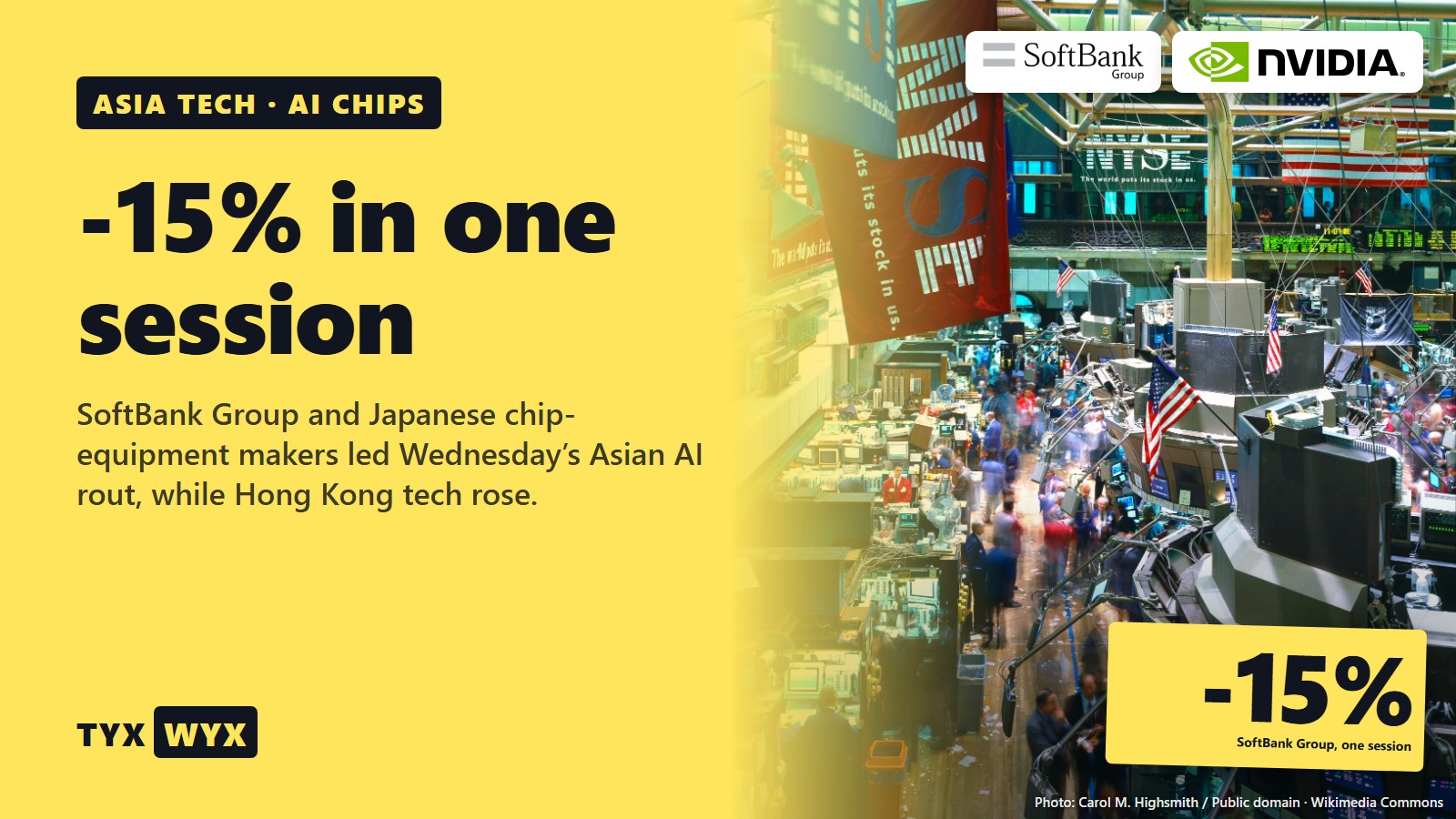
- SoftBank Group fell 15% on Wednesday as Asian technology stocks tumbled following an overnight U.S. tech pullback, CNBC reported.
- Japanese semiconductor equipment makers Advantest (-13%), Tokyo Electron (-12.82%), and Lasertec (-11.23%) led chip losses alongside South Korea’s Samsung Electronics and SK Hynix (more than -8% each), while Hong Kong-listed Chinese tech stocks gained.
- Futurum Group analyst Rolf Bulk told CNBC the sell-off reflects doubts about AI spending sustainability beyond 2027, warning that wafer fabrication equipment spending could drop materially if AI demand slows from 2028 onward.
What happened
Technology-focused investor SoftBank Group shed 15% on Wednesday as renewed concerns over the artificial intelligence trade rippled from Wall Street across Asian markets, CNBC reported. The drop followed an overnight decline in U.S. technology stocks, where the Nasdaq Composite gave back some of the sharp gains from the previous session that had been fueled by Jensen Huang’s return as Nvidia CEO.
Japanese semiconductor stocks tied to the global AI supply chain took some of the steepest losses. Advantest, a supplier of chip-testing equipment to Nvidia, plunged 13%, while Tokyo Electron, which supplies chipmaking equipment to Nvidia’s manufacturing partner TSMC, slumped 12.82%. Semiconductor inspection equipment maker Lasertec lost 11.23%, Disco Corporation fell 9.41%, and Renesas Electronics lost 9%.
ONE NUMBER
SoftBank Group, one session
SoftBank Group’s Wednesday drop in Asian trading, as reported by CNBC. The five Japanese semiconductor and equipment makers cited in the report fell an average of 11.09% (55.46% divided by 5) in the same session.
Why chip-equipment makers took a harder hit than Hong Kong tech
Heavy selling also hit South Korea and Taiwan, CNBC reported. South Korean memory giants Samsung Electronics and SK Hynix — key suppliers of high-bandwidth memory chips used in AI accelerators — plunged more than 8%, and LG Innotek shed 5%. In Taiwan, TSMC tumbled 7%, Hon Hai Precision Industry plunged 8.6%, and electronic components maker Foxconn Technology shed 4.93%. By our math, the five Japanese chip and equipment makers cited by CNBC lost an average of 11.09% on Wednesday.
Rolf Bulk, an analyst at The Futurum Group, told CNBC that the renewed sell-off largely reflects lingering concerns over the sustainability of AI spending beyond 2027, with Huang’s return doing little to fundamentally alter the outlook.
“There are still concerns on the sustainability of AI demand, ability of the sector to finance the build-out, and questions around power supply.”Rolf Bulk, analyst at The Futurum Group, via CNBC
Think of chip-equipment makers like the tool shops selling picks and shovels during a gold rush: as soon as miners worry about affording the dig in 2028, tool orders are the first thing questioned. Bulk noted that Japanese chip equipment makers are particularly vulnerable to a slowdown in AI infrastructure spending due to the highly cyclical nature of their business, warning that spending on wafer fabrication equipment could decline materially if AI demand slows from 2028 onward.
The other side
Chinese technology stocks listed in Hong Kong bucked the broader regional sell-off, CNBC reported. Xiaomi jumped 4.6%, Kuaishou gained 2.8%, Alibaba added 0.7%, Tencent was marginally higher, and Meituan and Baidu rose 0.31% and 0.16% respectively.
Even within the semiconductor sell-off, Bulk told CNBC that South Korean memory chipmakers could be relatively insulated due to supply shortages. While the memory industry is also cyclical, Bulk expects shortages to intensify over the next two years, making a return to equilibrium between supply and demand in 2028 unlikely.
What it means for your wallet
As CNBC reported, tech stocks have seen heightened volatility for months amid concerns over capital expenditure, skepticism over return on investments, and circular AI financing. For investors holding Asian tech or semiconductor funds, Wednesday showed how quickly sentiment swings can hit cyclical equipment suppliers even when near-term memory shortages remain tight.
What we still don’t know
- Whether AI demand will slow from 2028 onward and trigger the material decline in wafer fabrication equipment spending that Bulk warned about.
- Whether intensifying memory shortages over the next two years will cushion Samsung Electronics and SK Hynix from broader AI capital-spending jitters.