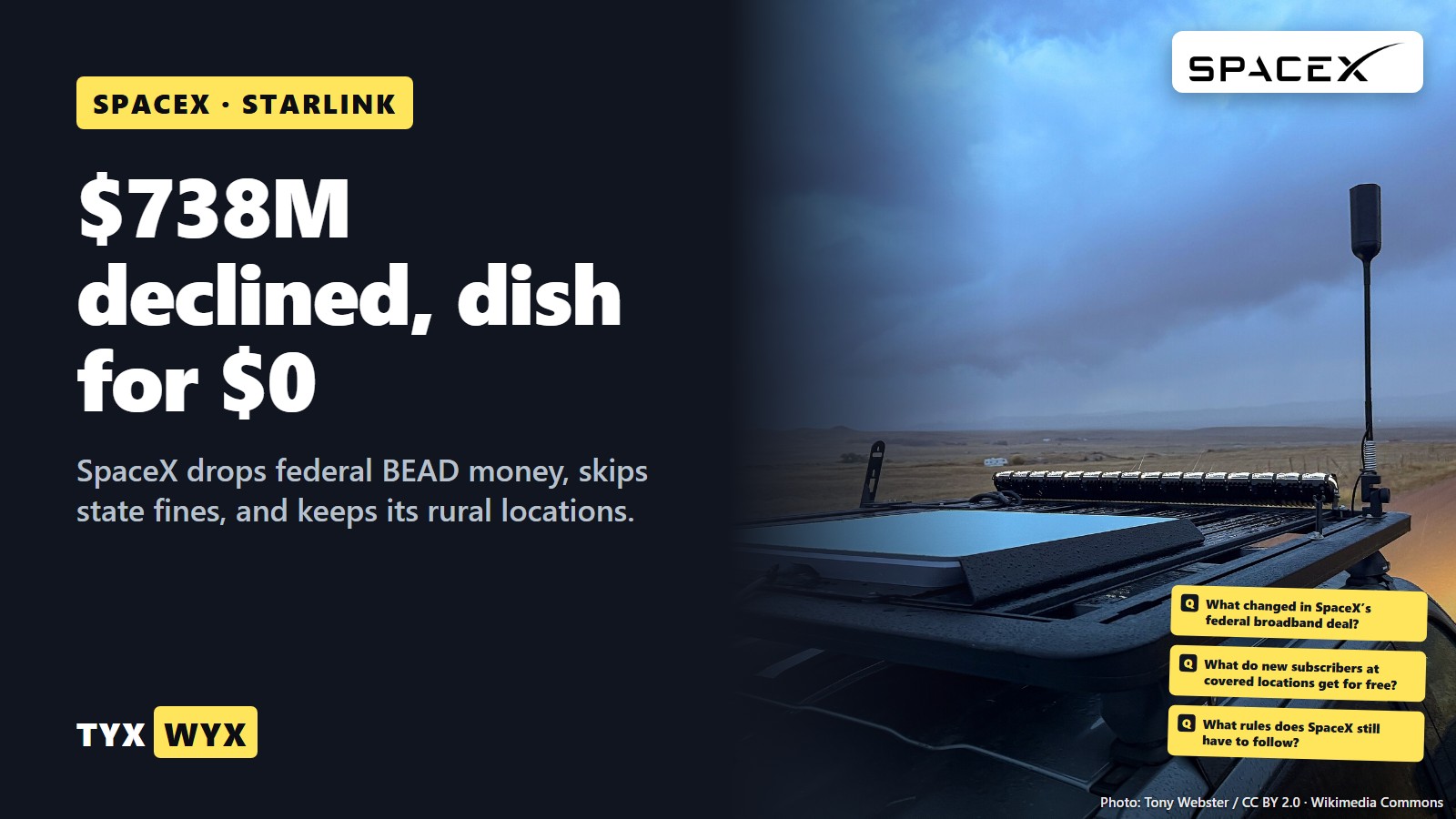
- SpaceX is walking away from roughly $738 million in federal Broadband Equity, Access, and Deployment (BEAD) subsidies while still committing to serve every rural location Starlink won.
- New subscribers at covered locations will receive a Starlink dish and router at no cost plus a low-cost service plan option, though the monthly subscription itself is not waived.
- State broadband offices must now either sign a new federal model agreement with no default penalties or rebid SpaceX’s locations under their already approved cost plans.
What happened
SpaceX is walking away from roughly $738 million in federal broadband subsidies under the U.S. Broadband Equity, Access, and Deployment (BEAD) program while still committing to connect the rural homes and businesses Starlink won, Teslarati and Drive Tesla Canada reported. The National Telecommunications and Information Administration (NTIA) said SpaceX will serve every location awarded to it at no cost to the program, and a senior NTIA official told Broadband Breakfast that SpaceX is ready to sign the new model agreement after running into contract disputes over financial reports and default penalties.
“I am pleased this new agreement has the potential to save taxpayers hundreds of millions of dollars while getting more Americans connected faster,”Arielle Roth, NTIA Administrator
State broadband offices now have two options: sign the model agreement or rebid the SpaceX locations at a cost in line with their already approved plans.
SIX QUESTIONS
SpaceX, Starlink, and the NTIA model agreement · BEAD broadband program
What changed in SpaceX’s federal broadband deal?
A senior official at the National Telecommunications and Information Administration (NTIA) told Broadband Breakfast that SpaceX approached the agency after struggling with differing contract terms across all 50 states, Teslarati and Drive Tesla Canada reported. On Monday, NTIA posted a model agreement allowing a low Earth orbit satellite provider to turn down BEAD money and still serve its awarded locations. Some states had already signed contracts with SpaceX, but the official said those agreements are no longer on the table, and two state officials told Broadband Breakfast the directive caught states by surprise.
What do new subscribers at covered locations get for free?
Under NTIA’s new model agreement, new subscribers at covered locations will receive the Starlink dish and router at no cost, Teslarati reported. SpaceX must also offer a low-cost service plan. However, the monthly subscription itself is not waived.
What rules does SpaceX still have to follow?
NTIA Administrator Arielle Roth said in the report that SpaceX agreed to meet the program’s speed and testing rules at every location it was awarded, without using BEAD money. SpaceX must still meet BEAD’s minimum speeds of 100 Mbps down and 20 Mbps up, pass performance testing, and file a report every six months.
What oversight and penalties were dropped?
The deal drops BEAD’s financial audit, procurement, and usual financial reporting provisions, Teslarati and Drive Tesla Canada reported. States also cannot levy penalties if SpaceX falls short. Their only remedy is to return those locations to the program for a new award.
Why is walking away from the money still a win for SpaceX?
Starlink’s role in BEAD expanded after NTIA’s 2025 “Benefit of the Bargain” overhaul dropped the program’s preference for fiber and opened awards to low Earth orbit satellite providers, Teslarati reported. Holding its BEAD locations with a $0 award keeps other federal broadband money from flowing to competitors in those rural areas, according to the NTIA official. It is like a contractor offering to pave a town’s road for free so the city does not pay a rival crew to work the same street.
Why are there two subsidy figures — $738 million and $636 million?
The senior NTIA official put the forgone amount at roughly $738 million, while Telecompetitor, citing administration officials, reported a lower figure of about $636 million. By our math, that is a $102 million gap between the two estimates. For scale, Teslarati reported that Arizona awarded SpaceX $17.1 million to cover 10,749 locations, while Virginia awarded $3.3 million for 5,579. Elon Musk reshared Sawyer Merritt’s summary of the NTIA terms on X, adding a single word: “Starlink.”
What we still don’t know
- Whether the total forgone subsidy is closer to the senior NTIA official’s roughly $738 million figure or the about $636 million reported by Telecompetitor.
- How many state broadband offices will sign NTIA’s model agreement rather than rebid the SpaceX locations under their original approved plans.
- What monthly rate SpaceX will charge under the required low-cost service plan, since the monthly subscription itself is not waived.