- Tesla began rolling out FSD v15 to early testers on November 21, 2026, and Elon Musk’s posts on X revealed that its new Reality View uses the last half-accelerator left on AI4’s second chip.
- Musk said AI4 now costs twice as much due to memory and storage price hikes, prompting Tesla to cut the mid-cycle AI4.5 computer’s RAM from 32GB to 24GB and direct future AI5 chips to Optimus robots instead of cars.
- If FSD v15 uses both chips on the AI4 board just to drive and render visuals, how does the computer handle a single-chip failure when nobody is in the driver’s seat?
What happened
Over the weekend of November 21–22, 2026, Tesla began rolling out Full Self-Driving (FSD) v15 to early testers, and Elon Musk spent two days on X explaining how the software fits onto the AI4 computer installed in millions of customer vehicles, Electrek reported on November 23.
The headline visual feature in v15 is Tesla Reality View, a live rendering of the car’s surroundings with floating chevrons in the sky for upcoming turns. On X, Musk initially called it “real-time AI video generation (no gaming engine!) using just half of one AI4 TRIP accelerator.”
In follow-up posts reported by Electrek, however, Musk explained why it used half an accelerator: after moving a decoder into SRAM, “we only have half a TRIP out of three on SoC B, for this reality visualizer, so spent the compute as best we could.” He also confirmed two major hardware shifts for current and future Tesla buyers: the mid-cycle AI4.5 computer had its RAM trimmed from 32GB to 24GB, and the next-generation AI5 chip is headed to Optimus robots rather than passenger cars.
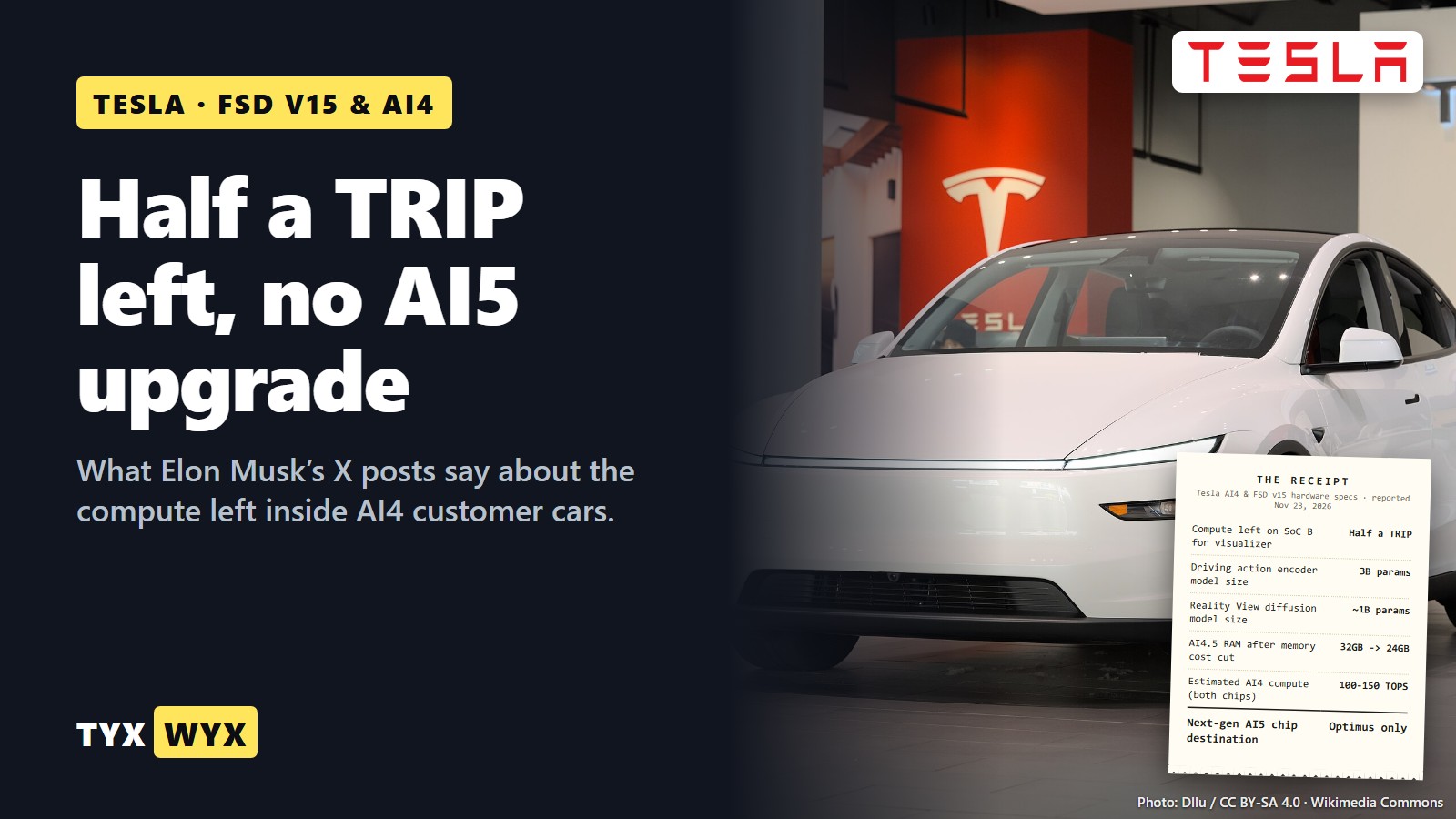
THE RECEIPT
Tesla AI4 & FSD v15 hardware specs · reported Nov 23, 2026
| Compute left on SoC B for visualizer | Half a TRIP |
| Driving action encoder model size | 3B params |
| Reality View diffusion model size | ~1B params |
| AI4.5 RAM after memory cost cut | 32GB -> 24GB |
| Estimated AI4 compute (both chips) | 100-150 TOPS |
| Next-gen AI5 chip destination | Optimus only |
All hardware figures come from Elon Musk’s X posts and Electrek’s technical comparison, as reported by Electrek on Nov 23, 2026.
What Musk wrote on X vs. how Electrek reads the numbers
Because Musk shared a flood of technical details across separate X replies, it helps to separate his exact words from Electrek editor Fred Lambert’s technical breakdown.
What Musk wrote on X (as quoted by Electrek):
- On the models: Reality View is a roughly 1-billion-parameter diffusion model running off vision encoder features “that are plugged into the 3B encoder model that produces the driving actions.” Its latency is “a bit high due to compute constraints,” and Tesla’s TRIP neural accelerator “basically only handles 8-bit int and has to run softmax in emulation mode in 28 steps.”
- On AI4 and AI4.5 memory costs: AI4 “costs twice as much now due to memory and storage price hikes.” While Musk announced an “AI4 Plus” with 32GB of RAM per chip on Tesla’s Q1 2026 earnings call, he wrote this weekend that “AI4.5 is a relatively small performance improvement that is mostly due to needing to upgrade RAM to LPDDR5X,” adding hours later: “RAM is super expensive, so we reduced AI4.5 from 32GB to 24GB. That will be fine. It’s hard to use 32GB anyway, given memory bandwidth constraints.”
- On AI5 and AI6: Asked on Sunday whether a Hardware 3 (HW3) owner should wait for AI5 before upgrading, Musk replied: “It’s going to Optimus. Cars will remain at AI4. That’s enough to solve superhuman driving.” He called AI5 “a gigantic improvement. Roughly 12X more compute” and “roughly an order of magnitude hardware performance improvement, all things considered.”
How Electrek interprets those disclosures:
Electrek points out that half a TRIP accelerator wasn’t a casual flex — it was all the compute left over. Tesla silicon engineer Dilreet Raju wrote that co-designing the v15 vision encoder “to squeeze out the last few percents of MFU from AI4” (model FLOPs utilization, or how much theoretical compute the model actually uses) was the hardest work of his life, a post Musk answered with a target emoji. Furthermore, while Tesla talked up a 10x jump in FSD model size for over a year, a 3B action encoder is nowhere near a 10x leap. And with Samsung’s Texas fab not reaching AI5 volume production until the second half of 2027 — nearly two years behind Musk’s original schedule — that silicon is going to robots and data centers, leaving AI4 cars with no hardware escape hatch.
The two-chip safety question Tesla hasn’t answered
Packing FSD v15 onto AI4 is like stuffing a suitcase until you have to sit on the lid just to zip the last half-pocket shut — only to realize you packed your backup emergency bag inside the main luggage. If the zipper bursts on the highway, there is no spare bag left.
As Electrek notes, when Tesla unveiled its FSD computer in 2019, the core safety pitch was redundancy: two identical, independent system-on-chips (SoC A and SoC B) on one board, each with its own power and memory, so one chip could seamlessly take over if the other failed. In an unsupervised Level 4 vehicle with nobody in the driver’s seat, a crashing chip cannot simply beep and hand the wheel back to a human.
Yet Musk’s own breakdown shows SoC B actively running the decoder and the Reality View diffusion model rather than sitting as a redundant mirror of SoC A — matching what Tesla hackers like greentheonly have reported since the HW3 era. According to Electrek, Tesla has never explained how much of AI4 is reserved for failover, or whether a single SoC can bring a car to a safe stop on its own.
By contrast, Electrek notes that Waymo has answered that question publicly: Waymo says both of its onboard computing systems run full workloads in parallel so a secondary computer can bring the vehicle to a safe stop if the primary fails, backed by redundant braking, steering, and power. Waymo’s new custom chip is rated at more than 1,000 TOPS, whereas Electrek estimates Tesla’s AI4 at roughly 100 to 150 TOPS across both chips combined.
The other side
Musk maintains that passenger cars do not need AI5 hardware because AI4 is already sufficient. As he told an owner on X on Sunday, “Cars will remain at AI4. That’s enough to solve superhuman driving.” When Tesla started rolling out FSD v15 on Saturday, the company claimed “25x better handling of safety critical cases,” and Musk wrote hours before the rollout that v15 “goes to wide release next month.”
What it means for your wallet
If you own a Tesla or are shopping for one, Musk’s weekend posts directly affect what your vehicle’s hardware can and cannot become. First, if you drive an older HW3 car and paid for Full Self-Driving, Musk’s confirmation that cars will remain on AI4 removes the idea that Tesla was waiting for AI5 to perform HW3 retrofits, as Electrek pointed out.
Second, if you own an AI4 vehicle or buy a new model with the downsized 24GB AI4.5 board, your car’s shot at true unsupervised self-driving rides entirely on software optimization within today’s compute ceiling — because no AI5 car retrofit is coming down the line.
What we still don’t know
- How Tesla’s AI4 board handles hardware failover if one of its two SoCs fails while both chips are splitting the FSD v15 workload.
- What baseline Tesla used to calculate its claim of “25x better handling of safety critical cases,” or how many miles v15 drives between critical human interventions.
- When Tesla will address hardware upgrade plans for existing HW3 owners now that Musk has said cars will stay at AI4.