- On November 19, U.S. President Donald J. Trump, Russian President Vladimir Putin, and Chinese State Chairman Xi Jinping met in Shenzhen and issued a five-paragraph joint declaration.
- The three leaders stated that their countries plan to increase the production and supply of refined petroleum products for the benefit of all nations and reaffirmed stable energy flows.
- The 222-word White House text contains zero barrel targets, timelines, or sanctions details, covering UN reform, International Criminal Court jurisdiction, and nuclear risk dialogue.
What happened
On Thursday, November 19, 2026, the White House published a joint statement titled “U.S.-Russia-China Heads of State Declaration toward Peace,” documenting a trilateral meeting in Shenzhen, China, between U.S. President Donald J. Trump, Russian President Vladimir Putin, and Chinese State Chairman Xi Jinping.
In the opening paragraph of the release, the U.S. and Russian heads of state expressed appreciation to China for hosting what the text called a “historic trilateral Summit.” The three leaders stated that they held an in-depth exchange of views on the international situation and “committed to maintaining strategic stability and international security.”
Across five concise paragraphs, the declaration laid out joint positions on four geopolitical issues — United Nations reform, the International Criminal Court, official immunities, and nuclear risk reduction — alongside one unexpected economic pledge on global fuel supplies.
In its third paragraph, the declaration stated that the United States, Russia, and China plan to expand the production and supply of refined petroleum products. Around the summit, posts on X claimed oil fell below $82.
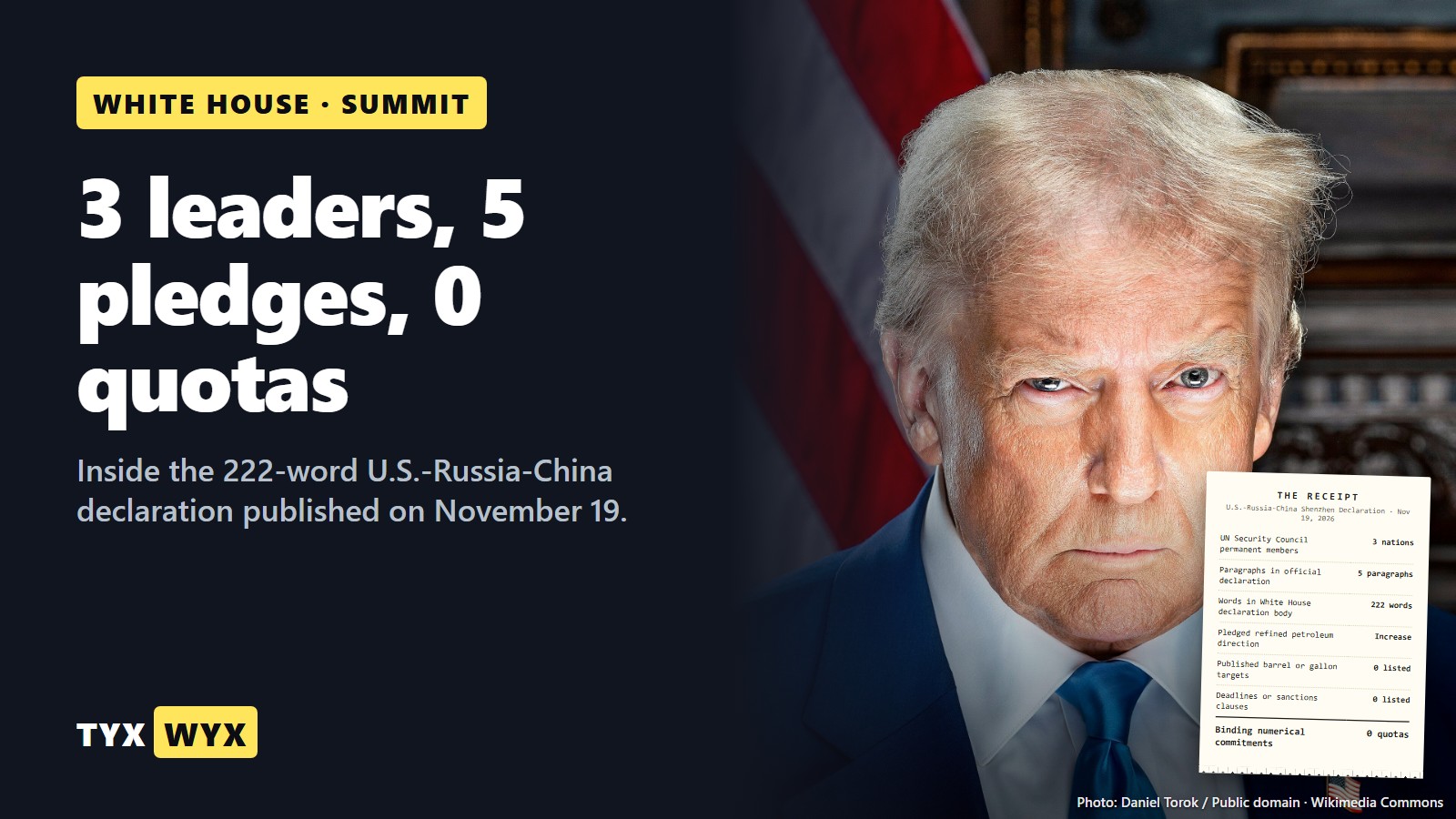
THE RECEIPT
U.S.-Russia-China Shenzhen Declaration · Nov 19, 2026
| UN Security Council permanent members | 3 nations |
| Paragraphs in official declaration | 5 paragraphs |
| Words in White House declaration body | 222 words |
| Pledged refined petroleum direction | Increase |
| Published barrel or gallon targets | 0 listed |
| Deadlines or sanctions clauses | 0 listed |
| Binding numerical commitments | 0 quotas |
The 5-paragraph and 222-word counts are our direct tally of the official declaration body published by the White House on November 19, 2026.
5 paragraphs, 222 words, and the exact text on refined petroleum
By our math, the entire body of the official White House declaration runs just five paragraphs and 222 words. Every word of the energy commitment fits inside two sentences in the third paragraph:
“The three countries plan to increase the production and supply of refined petroleum products for the benefit of all nations. They reaffirmed the importance of stable energy flows.”The White House, U.S.-Russia-China Heads of State Declaration toward Peace, Nov 19, 2026
Notice the specific phrase chosen by the three governments: refined petroleum products — processed fuels rather than raw unrefined crude — paired with a general statement reaffirming “stable energy flows.”
The other four paragraphs of the Shenzhen text focus on diplomatic and legal power across three permanent members of the United Nations Security Council:
- United Nations reform: In paragraph two, the three countries “committed to reform the UN so that the UN can respond more effectively to global challenges and conform to its fundamental mission of international peace and security.”
- State immunities and the ICC: In paragraph four, the leaders stated that “the principle of state consent and respect for immunities of State officials are of paramount importance, and concurred that the International Criminal Court and other similar bodies must not abuse their jurisdiction.”
- Nuclear risk dialogue: In the final paragraph, the three heads of state “reaffirmed that a nuclear war cannot be won and must never be fought” and stated that their countries “will conduct a dialogue on reducing nuclear risks and preventing the proliferation of nuclear weapons.”
What has zero numbers in the White House text?
Read the 222-word declaration from top to bottom and the most important takeaway for markets is what is absent: the document contains zero numerical targets, zero dates, and zero enforcement mechanisms.
In the refined petroleum paragraph, the three governments do not specify how many barrels or gallons of refined products will be added, which country will supply what share, or when the planned production increase will begin. Nor does the text mention existing trade restrictions, tariffs, or energy sanctions on any of the three nations.
It is like three competing neighborhood property owners signing a one-page handshake memo promising to “increase the supply of hot water for all tenants” without writing down which building will turn up its boiler, what temperature the water will reach, or who pays the utility bill.
The other side
While the Shenzhen statement omits concrete quotas and implementation schedules, supporters of high-level diplomacy can point to the breadth of the document itself: having the sitting heads of state of the United States, Russia, and China jointly put in writing that “a nuclear war cannot be won and must never be fought,” commit to a dialogue on reducing nuclear risks and preventing proliferation, and pledge “stable energy flows” establishes an official trilateral baseline that did not exist before November 19.
What it means for your wallet
For everyday investors holding broad index funds or energy exposure in a retirement account, the Shenzhen declaration is a reminder to separate headline summitry from binding policy documents. A joint statement saying three countries “plan to increase the production and supply of refined petroleum products” signals diplomatic intent to favor fuller fuel supply and lower energy bottlenecks.
However, because the White House text includes no production schedules, refinery capital commitments, or changes to export rules, any lasting financial effect on energy markets or inflation depends entirely on whether follow-up regulatory actions actually put physical barrels onto the market.
What we still don’t know
- What specific volume of refined petroleum products the United States, Russia, and China plan to add, and over what timeframe.
- Whether implementing the refined petroleum pledge will involve any changes to U.S. energy export policies or sanctions affecting Russian petroleum products.
- When the three countries will hold their announced dialogue on reducing nuclear risks and what specific United Nations reforms they intend to propose.