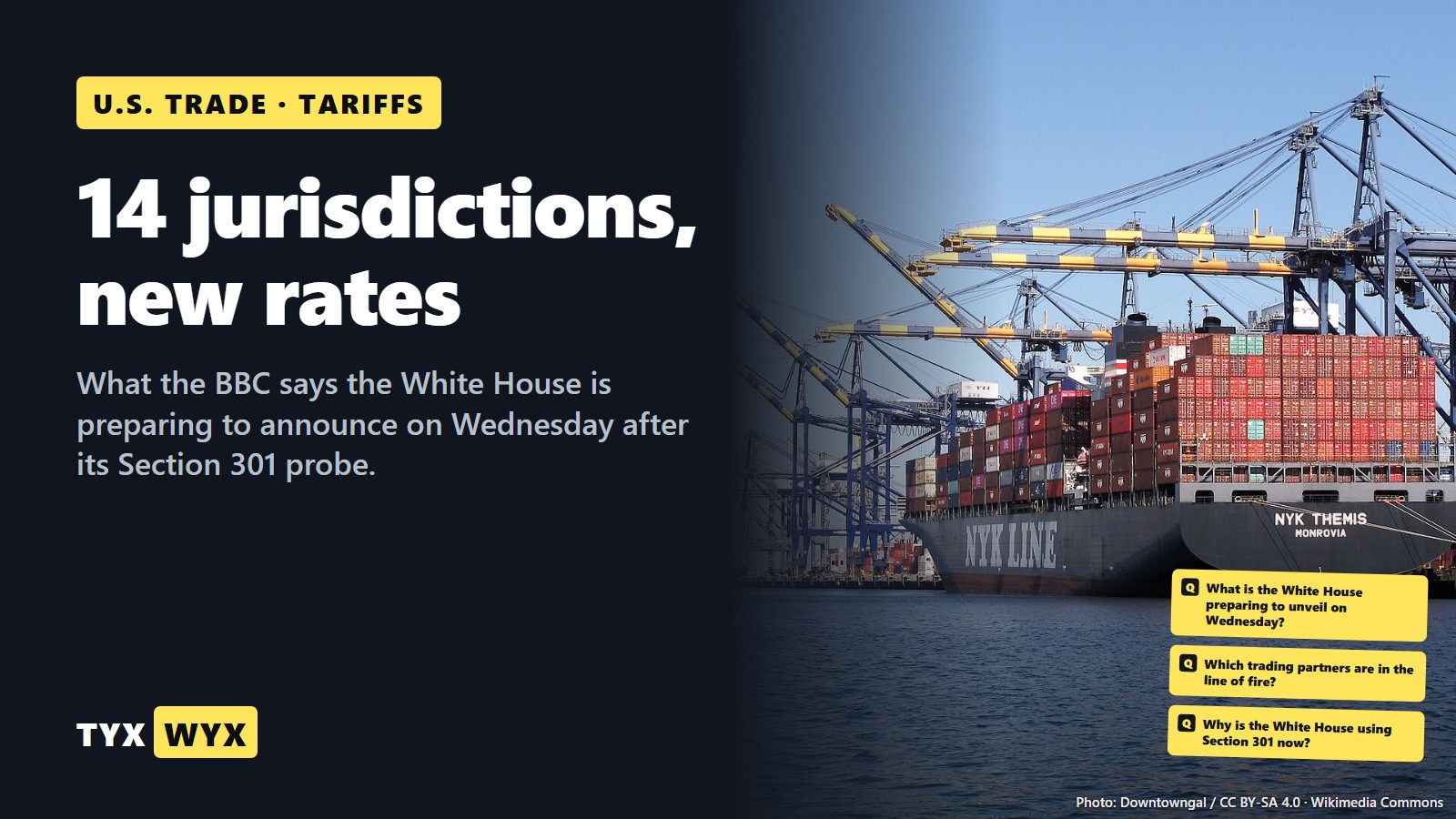
- The U.S. is preparing to announce plans for new tariffs on Wednesday targeting at least 14 jurisdictions, including China, the European Union, and Japan, the BBC reported.
- The plan follows a White House Section 301 investigation launched in March after the U.S. Supreme Court ruled President Donald Trump’s April 2025 Liberation Day tariffs illegal.
- Each country will face different import tax rates based on prior deals with Trump, though the exact rates and the remaining 11+ targeted jurisdictions have not yet been disclosed.
What happened
The United States is preparing to announce plans for new tariffs on several countries on Wednesday, the BBC reported, citing what the broadcaster understands of the White House rollout. The new import taxes would hit at least 14 jurisdictions, with China, the European Union, and Japan among the major trading partners affected.
The move comes out of a White House Section 301 investigation launched in March, after the U.S. Supreme Court ruled that President Donald Trump’s April 2025 Liberation Day tariffs were illegal. Think of it like a landlord whose building-wide rent hike was thrown out in court coming back months later with individualized lease increases for each tenant: under the new plan, countries will face different import tax rates depending on the deals they previously struck with Trump.
FIVE QUESTIONS
White House Section 301 tariff plan · BBC report, Nov 25, 2026
What is the White House preparing to unveil on Wednesday?
The U.S. is preparing to announce plans for new import taxes on several countries on Wednesday, the BBC reported. Rather than a single uniform levy, countries will face different import tax rates under the new tariffs depending on the deals they have previously struck with President Donald Trump.
Which trading partners are in the line of fire?
According to the BBC, the new import taxes would hit many of America’s biggest trading partners across at least 14 jurisdictions. The report specifically named three of them: China, the European Union, and Japan. By our math, that leaves at least 11 affected jurisdictions still unnamed ahead of Wednesday’s announcement.
Why is the White House using Section 301 now?
Shortly after returning to the White House, Trump unveiled sweeping Liberation Day tariffs on global trading partners in April 2025, which the U.S. Supreme Court later ruled illegal. In response, the White House launched its so-called Section 301 investigation in March. When the earlier tariffs were struck down, U.S. Trade Representative Jamieson Greer argued that overproduction abroad was displacing American manufacturing and deterring investment.
How does this intersect with the U.S.-China critical minerals dispute?
The BBC noted that the announcement is likely to raise tensions between the world’s two biggest economies. Despite last week’s meeting between Trump and President Xi Jinping, an interim agreement is set to expire on January 10, and ahead of the Shenzhen summit Washington accused Beijing of falling short on its October 2025 South Korea commitments, “particularly as they relate to agricultural purchases, rare earths, and other critical minerals.” Earlier on Tuesday, however, China extended the suspension of an export ban on critical minerals — including gallium, germanium, and antimony — until January 27, halting a ban that would otherwise have come into force on Friday.
What could the new tariffs mean for your wallet?
The BBC reported no specific tariff percentages or product price estimates ahead of Wednesday’s roll-out. Trump has made tariffs a signature policy of his presidency and argues they will boost American manufacturing and create jobs, while critics argue the administration’s tariff policy has put up prices for American consumers and damaged the global economy.
What we still don’t know
- Which additional countries or trading blocs make up the remaining at least 11 jurisdictions beyond China, the European Union, and Japan.
- What specific import tax rates each jurisdiction will face, which goods are covered, and when the new tariffs take effect.
- Whether Washington and Beijing will reach a longer-term deal before their interim agreement expires on January 10 and China’s critical-mineral export ban suspension runs out on January 27.