- A federal jury in Brooklyn convicted Huawei and three subsidiaries on 10 out of 12 criminal counts on Tuesday, including bank fraud, sanctions violations, and conspiracy to steal trade secrets, while acquitting the company of racketeering conspiracy.
- Prosecutors cited billions of dollars in Iran-related bank transactions alongside intellectual property cases involving Cisco router source code and T-Mobile’s touchscreen-testing robot.
- Huawei faces potential fines, forfeiture, and restitution at sentencing on September 14, 2027, and says it will take legal action to challenge the remaining convictions.
What happened
On Tuesday, November 24, 2026, a federal jury in Brooklyn, New York found Chinese technology and telecommunications giant Huawei and three of its subsidiaries guilty on 10 out of 12 criminal counts, CNBC and the BBC reported. The convictions include bank and wire fraud, conspiracy to commit money laundering, conspiracy to violate U.S. sanctions, and conspiracy to steal trade secrets.
At the same time, jurors acquitted Huawei of the overarching racketeering conspiracy charge, which required finding that the firm acted like a criminal enterprise. The split verdict is like a referee throwing out a lifetime ban for running a rigged league while still handing down ten separate penalties for breaking the rules on the field. Sentencing is scheduled for September 14, 2027, when Huawei faces potential fines, forfeiture, and restitution.
THE TIMELINE
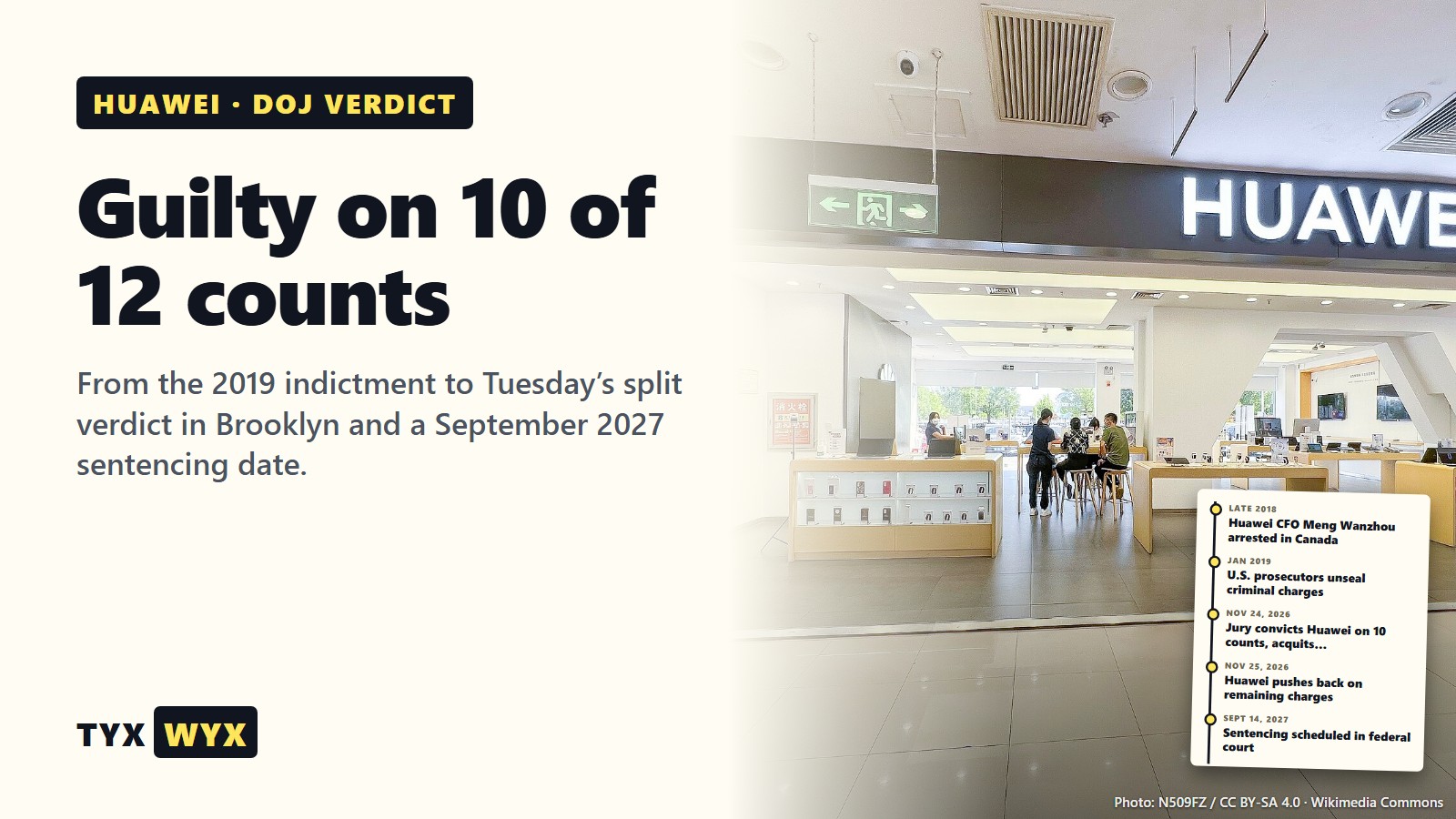
U.S. criminal case against Huawei · Late 2018 to Sept. 14, 2027
- Huawei CFO Meng Wanzhou arrested in CanadaSenior executive and chief financial officer Meng Wanzhou, also known as Cathy Meng, is arrested in Canada.
- U.S. prosecutors unseal criminal charges 12 countsA month after Meng’s arrest, federal prosecutors publicly disclose criminal charges against Huawei in the United States.
- Meng returns to China under deferred prosecution deal 3 yearsAfter being held for three years in Canada, Meng enters into a deferred prosecution agreement with U.S. prosecutors and returns to China.
- Closing arguments at Brooklyn federal courtDefense lawyer Brian Heberlig and assistant U.S. attorney Meredith Arfa deliver closing arguments to jurors in Brooklyn.
- Jury convicts Huawei on 10 counts, acquits on racketeering 10 of 12Jurors find Huawei and three subsidiaries guilty of trade-secret theft conspiracy, bank and wire fraud, money-laundering conspiracy, and sanctions violations, but not guilty of racketeering conspiracy.
- Huawei pushes back on remaining chargesIn a Wednesday statement, Huawei welcomes the racketeering acquittal and says the remaining charges lack legal or factual merit.
- Sentencing scheduled in federal courtHuawei and its subsidiaries face potential fines, forfeiture, and restitution at sentencing, after which defense lawyers expect to appeal.
Chronology compiled from CNBC and BBC reports published Nov. 24–25, 2026, citing the U.S. Department of Justice and Brooklyn federal court proceedings.
Iran dollar clearing, Cisco code, and a T-Mobile robot part in a backpack
U.S. prosecutors first publicly disclosed the criminal charges in January 2019, a month after Huawei chief financial officer Meng Wanzhou was arrested in Canada in late 2018. Meng returned to China in September 2021 after entering into a deferred prosecution agreement, while the corporate indictment moved to trial in Brooklyn. By our math, jurors convicted Huawei on 83.3% of the 12 counts nearly eight years after the charges were first unveiled.
According to the Justice Department, as reported by CNBC, Huawei misrepresented its activities in Iran to banks in order to secure billions of dollars and retain access to U.S. dollar-clearing services, and supplied surveillance cameras that enabled Iranian authorities to monitor protests. Prosecutors also detailed intellectual property theft involving Cisco and T-Mobile: Huawei copied source code used in Cisco routers — with engineers spelling Cisco’s name backward to conceal the theft — and employees sent photographs and technical details of T-Mobile’s touchscreen-testing robot to China, with one employee removing a component from T-Mobile’s laboratory in a backpack.
“No person or company is above the law.”U.S. Attorney General Todd Blanche, Justice Department statement via CNBC
In the Justice Department statement reported by CNBC, Assistant Attorney General Tysen A. Duva of the Criminal Division added: “For over two decades, Huawei built its global empire on a foundation of fraud, theft, and deception.”
The other side
In a statement issued Wednesday, Huawei welcomed its acquittal on the racketeering charge — saying it “confirms that these allegations lack factual basis” — while pushing back on the rest of the verdict: “We believe the government’s remaining charges are equally without legal or factual merit.” As CNBC and the BBC reported, Huawei added that the five trade-secret disputes cited by prosecutors had previously been resolved as civil matters, and pledged to “take all necessary legal actions to defend our rights and interests.”
Defense attorney Brian Heberlig argued that Huawei expanded to 170 countries and more than 200,000 staff through hard work and innovation, telling the BBC that the RICO count alleging a corporate policy of committing crime was “a significant overreach, and the jury soundly rejected it.” Heberlig said there will be “significant advocacy” for the lowest possible sentence before an expected appeal.
What it means for your wallet
Neither CNBC nor the BBC reported immediate market moves or new commercial sanctions tied to Tuesday’s verdict. Huawei stated that it remains focused on maintaining uninterrupted business operations and investing in research and development as it prepares for sentencing in September 2027 and a subsequent appeal.
What we still don’t know
- How much Huawei and its three convicted subsidiaries will be ordered to pay in fines, forfeiture, and restitution at sentencing on September 14, 2027.
- Which specific Huawei subsidiaries were convicted alongside the parent firm, and how an appeal after sentencing might affect the 10 guilty verdicts.