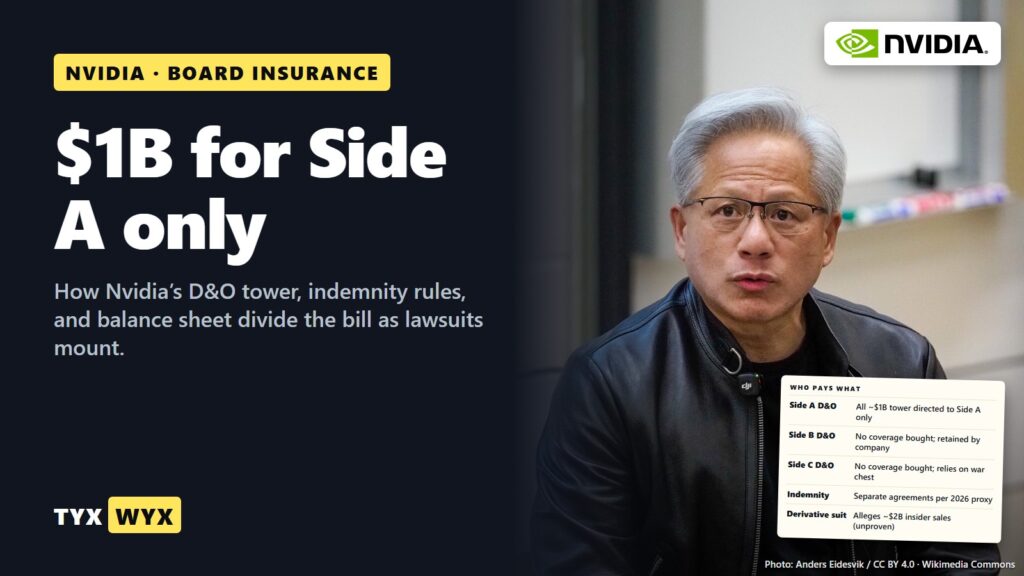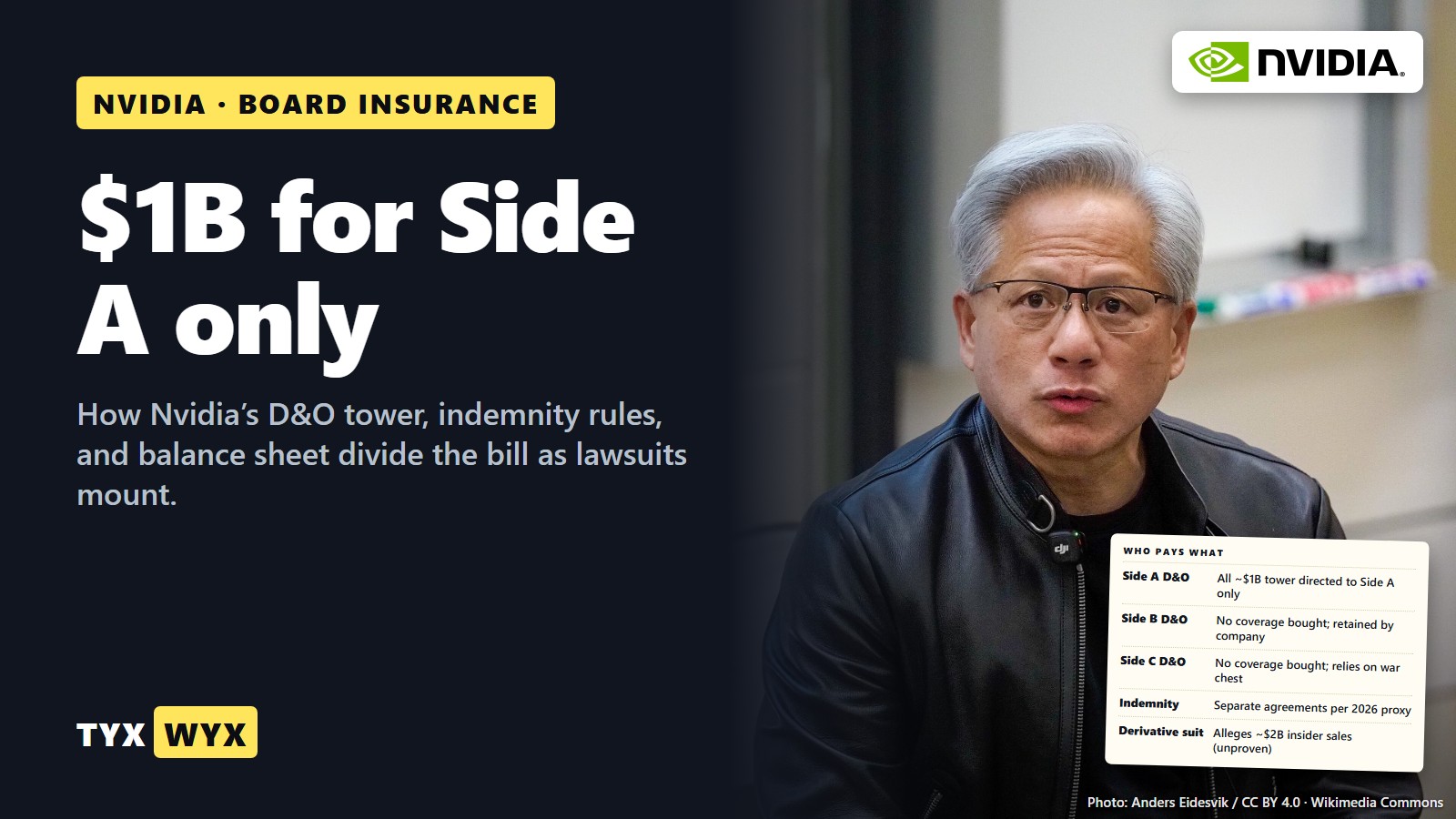
Nvidia built an approximately $1 billion directors-and-officers (D&O) insurance tower, but directed all of that coverage to Side A only, a risk advisor with direct knowledge of the coverage told CNBC’s Contessa Brewer on November 25, 2026. Side A protects directors and officers personally when Nvidia cannot indemnify them, while leaving no Side B or Side C insurance for the company itself — meaning Nvidia covers company-side legal bills from its own balance sheet.
Last verified against the source documents: Nov 26, 2026WHO PAYS WHAT
Nvidia’s D&O insurance, indemnity rules, and active cases · CNBC, Nov 25, 2026
| Piece | What it covers | Nvidia’s setup (CNBC) |
|---|---|---|
| Side A D&O | Directors/officers when company can’t | All ~$1B tower directed to Side A only |
| Side B D&O | Company costs/settlements for directors | No coverage bought; retained by company |
| Side C D&O | Company when named in securities suits | No coverage bought; relies on war chest |
| Indemnity | Costs/liabilities when law permits | Separate agreements per 2026 proxy |
| Derivative suit | Nov 11 suit on Nvidia’s behalf vs board | Alleges ~$2B insider sales (unproven) |
| Class action | Nov 9 suit vs Nvidia and Jensen Huang | Covers Oct 9, 2025–Nov 8, 2026 buyers |
| CA AG & board | Rob Bonta probe and Nov 8 board probe | Outside counsel hired Nov 10; ongoing |
Source: CNBC report by Contessa Brewer (Nov 25, 2026) and Nvidia’s 2026 proxy as cited by CNBC. Lawsuit claims are allegations, not findings.
Why is this question coming up now?
Even though Jensen Huang is back as CEO of Nvidia after President Donald Trump urged the board to rehire him, investigations into the company, its executive leadership, and its board continue as outside criticism mounts, CNBC’s Contessa Brewer reported on Wednesday, November 25. Nvidia announced an independent investigation on Sunday, November 8, and independent directors retained outside counsel two days later. Huang resigned as CEO and a director on Wednesday, November 11, and the board appointed CFO Colette Kress interim CEO before Huang later resumed leadership, according to CNBC.
Two lawsuits and a state probe are underway. A securities class action filed Monday, November 9, names Nvidia and Huang, seeking damages for investors who bought Nvidia shares between October 9, 2025, and November 8, 2026, alleging the company and Huang misled investors, CNBC reported. A separate shareholder derivative complaint filed Wednesday, November 11 — brought on Nvidia’s behalf against Huang, directors, and other officers — alleges they failed to oversee risks and made misleading statements, and alleges some defendants sold roughly $2 billion in Nvidia stock while holding material nonpublic information. As CNBC emphasized, those remain allegations, not findings. Meanwhile, California Attorney General Rob Bonta is investigating whether Nvidia misrepresented information to investors.
“There is classic corporate securities law on the books in California that prevents investors and the public from being misled by companies.”California Attorney General Rob Bonta, on CNBC’s Squawk on the Street, Nov 24, 2026
Betsy Atkins, an author and longtime public-company director, said “Clearly they caved to external pressure,” adding that “The board failed” when it initially allowed Huang’s removal and that “The board’s role is to think of all stakeholders,” CNBC reported. At the same time, Atkins argued that allegations are not conclusions and that boards should weigh governance concerns against the value a founder brings to a company’s innovation.
“Will companies’ hyper-accelerated innovation speed be the same without them? I don’t think so.”Betsy Atkins, author of Don’t Waste a Board Seat: A Decision-Maker’s Guide to Choosing Directors Who Create Value, via CNBC
What does buying only Side A coverage mean?
According to the risk advisor with direct knowledge of Nvidia’s coverage, the company built an approximately $1 billion D&O tower — policies from different companies that combine to cover one massive risk, CNBC reported. The advisor said Nvidia “loves insurance” and added, “They buy insurance as if they have no balance sheet.” An industry expert with 25 years working in financial insurance told CNBC that a billion-dollar tower essentially meant Nvidia “bought the market,” purchasing all the coverage it could get.
Yet directing all of that coverage to Side A only means the insurance protects directors and officers personally when the company cannot indemnify them, while skipping Side B (which covers the company for legal defense costs or settlements on behalf of directors and officers) and Side C (which protects the company when it is named as a defendant in a securities claim), according to CNBC. Buying only Side A is like paying the house’s repair bills out of your own savings while buying a big policy that protects the people inside when those savings can’t be used for them.
Whether that choice protected the board at the company’s expense is debated. An insurance CEO told CNBC that a billion-dollar policy is a lot of coverage, but called a Side A-only allocation a surprising move because it results in imbalanced coverage protecting only directors. By contrast, a D&O insurance expert told CNBC that the structure is not automatically a governance failure and is common among companies with the capital to manage corporate risk internally, calling it “a capital-allocation decision” when Side B and Side C premiums are considered too expensive. The risk advisor said Nvidia believed it had “the war chest” to protect itself against a securities class action, telling CNBC: “For a company with Nvidia’s resources, retaining the company-side risk can make financial sense,” while calling Side A D&O “imperative to corporate governance.”
When does D&O insurance actually start paying?
Separate from its insurance, Nvidia’s 2026 proxy says the company has indemnity agreements with its directors and officers that provide for the company to cover certain costs and liabilities when the law permits, CNBC reported. Where D&O coverage applies, defense costs can start right after a lawsuit is filed. Michel Léonard, chief economist at the Insurance Information Institute, told CNBC — describing standard policy mechanics rather than Nvidia’s specific policy — that “Insurance is already at work,” adding:
“Once the suit is filed, D&O starts paying defense costs, long before anyone proves anything.”Michel Léonard, chief economist at the Insurance Information Institute, to CNBC
Still, CNBC noted important limits: a claim has to meet the policy’s terms, defense costs can reduce the remaining limits, and a drop in Nvidia’s market value by itself does not establish an insurable loss. Plaintiffs would need to prove legally recoverable damages, and the policy would respond only to covered losses, according to CNBC.
What we still don’t know
- Nvidia’s response to questions about whether the board protected itself at the company’s expense, as CNBC received no response from the company.
- Which insurers underwrite Nvidia’s approximately $1 billion D&O tower, or the exact policy terms and limits remaining after defense costs.
- How the November 9 securities class action, the November 11 shareholder derivative complaint, the California Attorney General’s investigation, and the board’s ongoing independent investigation will be resolved.
This ledger maps each layer of legal protection and active legal action reported by CNBC’s Contessa Brewer on November 25, 2026. Policy details come from a risk advisor with direct knowledge of Nvidia’s coverage, insurance industry experts, and Nvidia’s 2026 proxy statement as cited by CNBC.
Questions people ask
What is Side A D&O insurance?
Side A directors-and-officers insurance protects directors and officers personally when the company cannot indemnify them, according to CNBC. Side B covers the company for legal defense costs or settlements on behalf of directors and officers, and Side C protects the company when it is named as a defendant in a suit such as a securities claim.
Who pays if Nvidia’s directors are sued?
Nvidia’s 2026 proxy says the company has indemnity agreements to cover certain costs and liabilities for directors and officers when the law permits, CNBC reported. When the company cannot indemnify them, an approximately $1 billion Side A-only D&O tower protects directors and officers personally, while company-side risk is retained by Nvidia.
What is the Nvidia shareholder derivative lawsuit?
Filed on November 11, 2026, the shareholder derivative complaint is brought on Nvidia’s behalf against Jensen Huang, directors, and other officers, according to CNBC. It alleges they failed to oversee risks, made misleading statements, and that some defendants sold roughly $2 billion in Nvidia stock while holding material nonpublic information — claims that remain allegations, not findings.
What is the Nvidia securities class action period?
The separate securities class action, filed on November 9, 2026, names Nvidia and Huang as defendants, CNBC reported. It seeks damages for investors who bought Nvidia shares between October 9, 2025, and November 8, 2026, alleging the company and Huang misled investors.