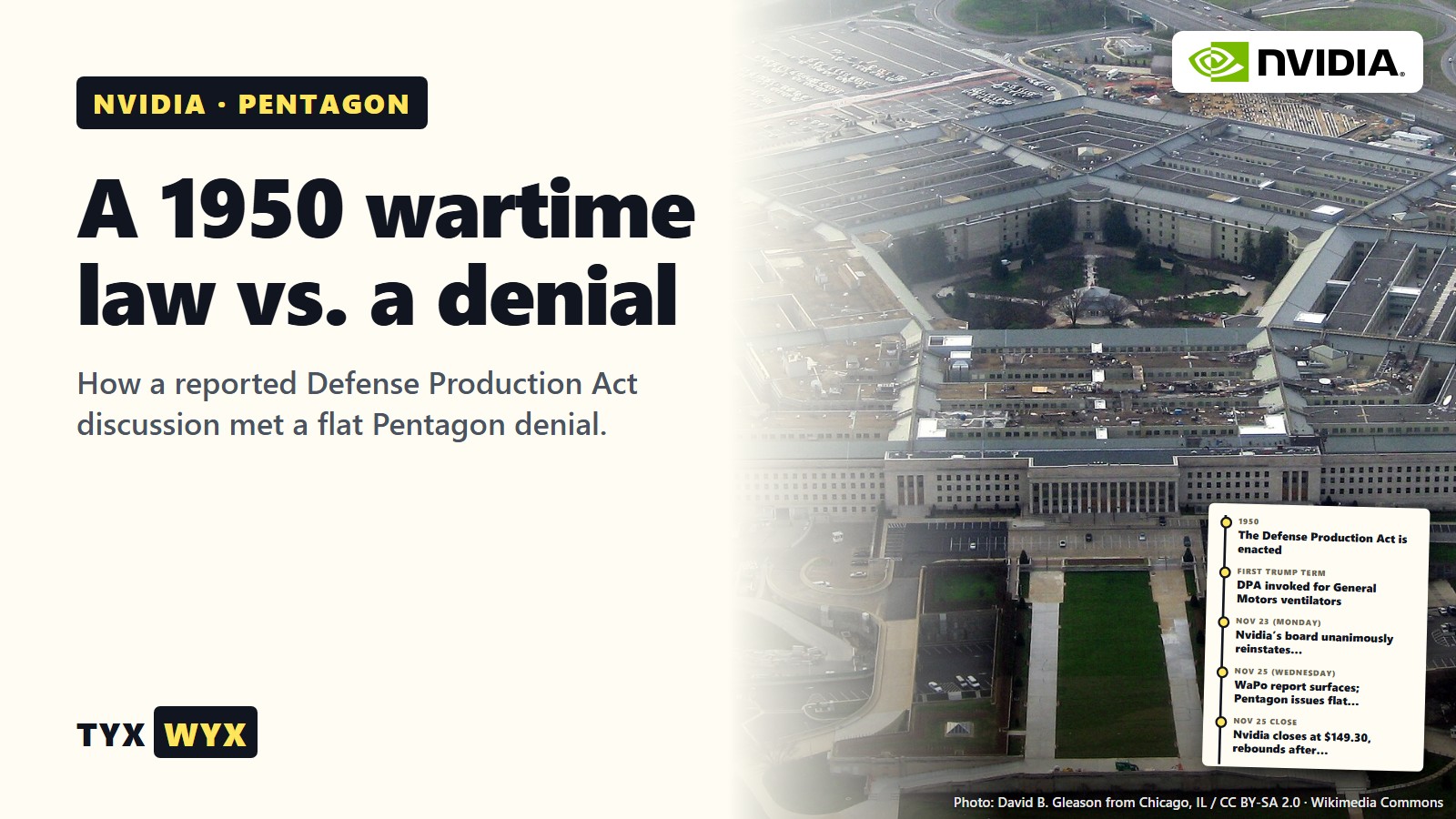
- Senior Pentagon officials, including Defense Secretary Pete Hegseth and Deputy Secretary Steve Feinberg, discussed using the Defense Production Act to influence Nvidia’s board over the weekend, the Washington Post reported on Wednesday, according to Benzinga.
- A Department of War official told Benzinga the described conversations never happened and no such proposal was made.
- Nvidia shares closed Wednesday down 3.91% at $149.30 before gaining 1.32% to $151.27 after hours, according to Benzinga Pro.
What happened
Senior Pentagon officials — including Defense Secretary Pete Hegseth and Deputy Secretary Steve Feinberg — discussed invoking the Defense Production Act over the weekend to influence Nvidia Corp.’s board into reinstating CEO Jensen Huang, the Washington Post reported on Wednesday, citing people familiar with the matter, according to Benzinga. The Pentagon rejected the account in an emailed statement.
Nvidia’s board unanimously voted Monday, November 23, to restore Huang, who had stepped down earlier this month, following input from senior U.S. government officials, Benzinga reported. According to the report, the administration viewed Nvidia’s role in the artificial intelligence race against China and Huang’s ability to stabilize the company as reasons for his return, and President Donald Trump reportedly asked Vice President JD Vance to help broker the reinstatement as leadership uncertainty weighed on financial markets.
THE TIMELINE
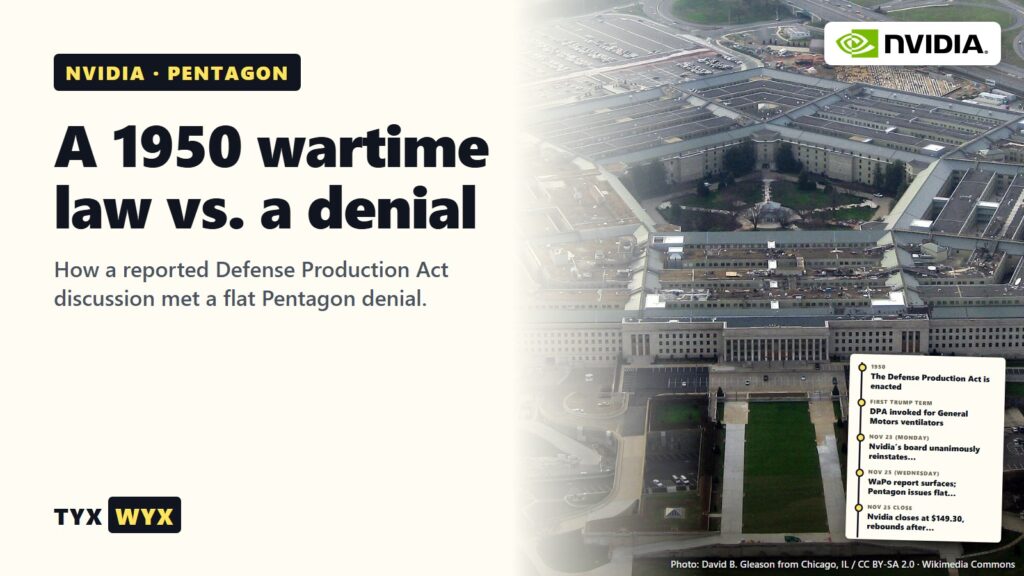
Defense Production Act & Nvidia · 1950 to Nov 25, 2026
- The Defense Production Act is enactedThe law gives the president broad authority to prioritize domestic production for national defense, though it does not explicitly authorize the government to appoint or reinstate corporate executives, according to Benzinga.
- DPA invoked for General Motors ventilatorsDuring the COVID-19 pandemic, the first Trump administration used the law to push General Motors into manufacturing ventilators, Benzinga reported.
- Reported Pentagon discussion on Nvidia’s boardSenior Pentagon officials, including Defense Secretary Pete Hegseth and Deputy Secretary Steve Feinberg, discussed using the DPA to influence Nvidia’s board over the weekend, the Washington Post reported Wednesday, citing people familiar with the matter, according to Benzinga.
- Nvidia’s board unanimously reinstates Jensen HuangThe board voted unanimously Monday to bring back Huang, who stepped down earlier in November, following input from senior U.S. government officials, according to Benzinga.
- WaPo report surfaces; Pentagon issues flat denialA Department of War official told Benzinga in an emailed statement that the conversations never happened and no proposal was made. The White House and Nvidia did not immediately respond to requests for comment.
- Nvidia closes at $149.30, rebounds after hours -3.91%Nvidia shares fell 3.91% on Wednesday to close at $149.30, then gained 1.32% to $151.27 in after-hours trading, according to Benzinga Pro.
Dates and figures from Benzinga’s Nov 25–26, 2026 report citing The Washington Post and Benzinga Pro.
Can a 1950 factory law pick a CEO?
Enacted in 1950, the Defense Production Act gives the president broad authority to prioritize domestic production for national defense, and the first Trump administration used it during the COVID-19 pandemic to push General Motors to manufacture ventilators, according to Benzinga. However, as Benzinga noted, the law does not explicitly authorize the government to appoint or reinstate corporate executives.
Using a wartime factory statute to seat a chief executive would be like trying to use a building’s emergency fire hose to unlock the front office door — the tool exists for national emergencies, not corporate governance.
The other side
The Pentagon flatly denied that any such discussion took place, while outside technology investors had publicly floated the idea earlier, according to Benzinga. Earlier, technology investors Balaji Srinivasan and Shervin Pishevar had advocated using the Defense Production Act to protect Nvidia’s strategic importance, Benzinga reported.
“The conversations described between DOW senior leaders never happened and no such proposal was made by the Secretary, Deputy Secretary, or Under Secretary.”Department of War official, emailed statement to Benzinga
What it means for your wallet
For Nvidia shareholders and index fund investors, this story separates into what is confirmed and what is disputed. Two facts are on the record: Nvidia’s board unanimously voted Monday to reinstate Huang after input from senior U.S. government officials, and a Department of War official denied in an emailed statement that its top leaders discussed or proposed using the Defense Production Act.
At the same time, it remains unclear what was actually communicated to Nvidia or whether the reported DPA arguments ever reached Trump and Vance, according to Benzinga. Beyond the boardroom, Benzinga noted that uncertainty surrounding Nvidia’s chip exports to China remains unresolved.
What we still don’t know
- What specific input senior U.S. government officials communicated to Nvidia’s board before Monday’s unanimous vote.
- Whether the reported Defense Production Act arguments ever reached President Trump or Vice President JD Vance.
- How the White House and Nvidia view the report, as neither immediately responded to Benzinga’s request for comment.