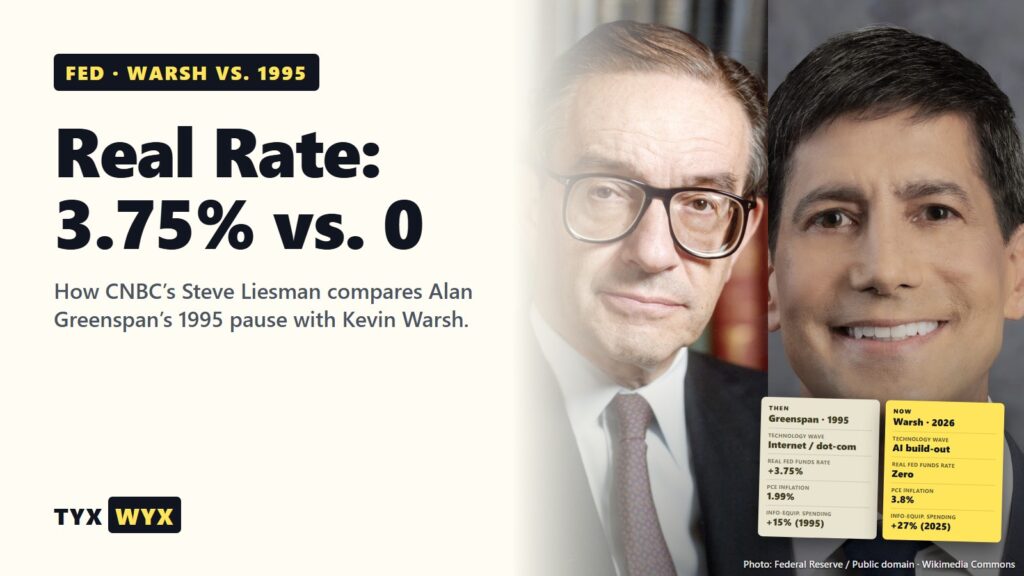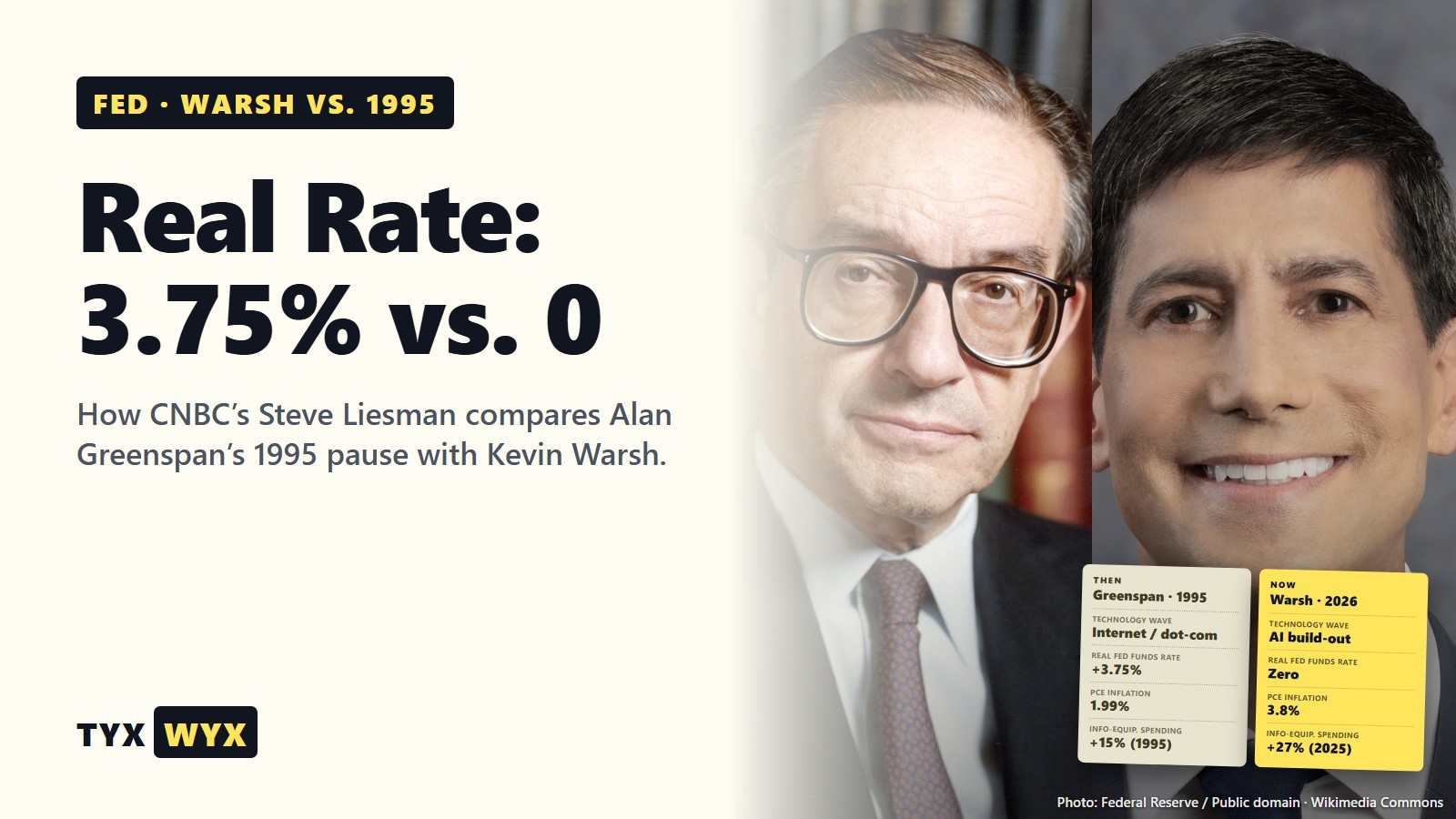
Both Alan Greenspan in 1995 and Federal Reserve Chairman Kevin Warsh in 2026 sit in the middle of a major technology investment boom — the internet then and the artificial intelligence build-out now, CNBC’s Steve Liesman wrote on Wednesday, Nov. 25. The sharpest numerical contrast, by Liesman’s numbers, is the inflation-adjusted federal funds rate: a positive 3.75% in 1995 versus zero today, alongside PCE inflation of 1.99% then versus 3.8% now.
THEN & NOW
Steve Liesman’s comparison in CNBC · Nov. 25, 2026
| Greenspan · 1995 | Warsh · 2026 | |
|---|---|---|
| Technology wave | Internet / dot-com | AI build-out |
| Real fed funds rate | +3.75% | Zero |
| PCE inflation | 1.99% | 3.8% |
| Info-equip. spending | +15% (1995) | +27% (2025) |
| 1-quarter annualized | +18% (Q2 1995) | +60% (Q3) |
| Deficit, share of GDP | 2.2% | 6.2% |
| Target rate after | 3 cuts, Jul '95–Jan '96 | Not known yet |
Comparison figures: CNBC’s Steve Liesman, Nov. 25, 2026. Target-rate moves: Federal Reserve series DFEDTAR via FRED.
Where it rhymes
In a column published Wednesday, Nov. 25, CNBC’s Steve Liesman examined a question raised during a discussion on CNBC’s Halftime Report: why Federal Reserve Chairman Kevin Warsh cannot hold the line on interest rates during the artificial intelligence build-out the way Alan Greenspan — whom Liesman described as Warsh’s icon — did at the start of the dot-com era.
In 1995 and 1996, as Liesman wrote, Greenspan leaned against the inflation hawks on his committee and, in Liesman’s words, held the line on interest rates amid strong growth, because he believed in the productivity promise of the internet revolution. Today, the parallel hope is that Warsh could follow a similar course and hold rates steady during the artificial intelligence build-out until those productivity gains arrive.
Where it doesn’t
By Liesman’s numbers, the economic backdrop facing Warsh differs sharply from the one Greenspan faced in 1995, leading Liesman to write that “the Fed looks like it has to hike” to get anywhere close to where the Fed stood in Greenspan’s time. First, the real, or inflation-adjusted, federal funds rate was a positive 3.75% in 1995, meaning policy was already leaning against the dot-com boom when Greenspan decided not to tighten further. Today, by Liesman’s numbers, the real federal funds rate stands at zero, which Liesman wrote could be viewed as fueling the boom. Comparing a zero real rate with a 3.75% real rate is like comparing a truck rolling downhill in neutral with one descending while the driver already has a foot on the brake.
Second, inflation measured by the personal consumption expenditures price index was 1.99% in 1995 — right near the 2% mark even though there was no formal 2% target then — whereas government data published Wednesday, Nov. 25 put PCE inflation at 3.8%, CNBC’s Steve Liesman wrote. Third, the scale of capital investment is much larger: by Liesman’s numbers, spending on information processing equipment rose 15% year over year in 1995 compared with 27% in 2025, and grew at a 60% annualized rate in the third quarter according to Wednesday’s data versus 18% in the second quarter of 1995.
Fourth, government deficit spending is more stimulative now, with the deficit at 6.2% of GDP today compared with 2.2% in 1995, by Liesman’s numbers. Alongside those four gaps, Liesman pointed to higher oil prices, higher tariffs, and recent tax cuts and accelerated depreciation on investments as additional forces for the Fed to lean against.
What happened next in 1995 and 1996
“Holding the line” did not mean the rate sat still. By our math from the Federal Reserve’s own target-rate series (DFEDTAR on FRED), the federal funds target reached 6.00% on Feb. 1, 1995, and was then cut three times: to 5.75% on July 6, 1995, to 5.50% on Dec. 19, 1995, and to 5.25% on Jan. 31, 1996. That is 0.75 percentage point below the early-1995 peak.
The next move after that was a hike, to 5.50%, on March 25, 1997. In other words, Greenspan’s Fed stopped raising rates in early 1995 and eased into the internet build-out, instead of tightening against it.
What comes next now
In a separate report published Tuesday, Nov. 24 on the Conference Board’s monthly consumer confidence survey, CNBC’s Jeff Cox reported that the Federal Reserve is expected to raise its benchmark interest rate by a quarter percentage point when it meets again in two weeks. That report noted that inflation has run above the central bank’s 2% target for some 5½ years, CNBC reported.
What this comparison can’t tell you
- This side-by-side reflects one columnist’s analysis in CNBC on Nov. 25, not an official Federal Reserve projection or policy statement.
- A single historical episode from 1995 and 1996 is not a rule for how monetary policy or technology booms behave three decades later.
- As CNBC’s Steve Liesman wrote, heavy capital spending on artificial intelligence could still bring higher productivity and lower inflation down the road, even if the upfront build-out adds inflationary pressure right now.
- Neither historical comparisons nor market expectations tell us what Warsh and the Federal Reserve will actually decide at upcoming meetings.
- CNBC — Liesman: Why Greenspan could bet on productivity — and Warsh needs to hike (Nov 25, 2026)
- CNBC — Consumer confidence shoots up after Democrats’ midterm victories — though inflation worries persist (Nov 24, 2026)
- FRED — Federal Funds Target Rate (DFEDTAR), Board of Governors of the Federal Reserve System