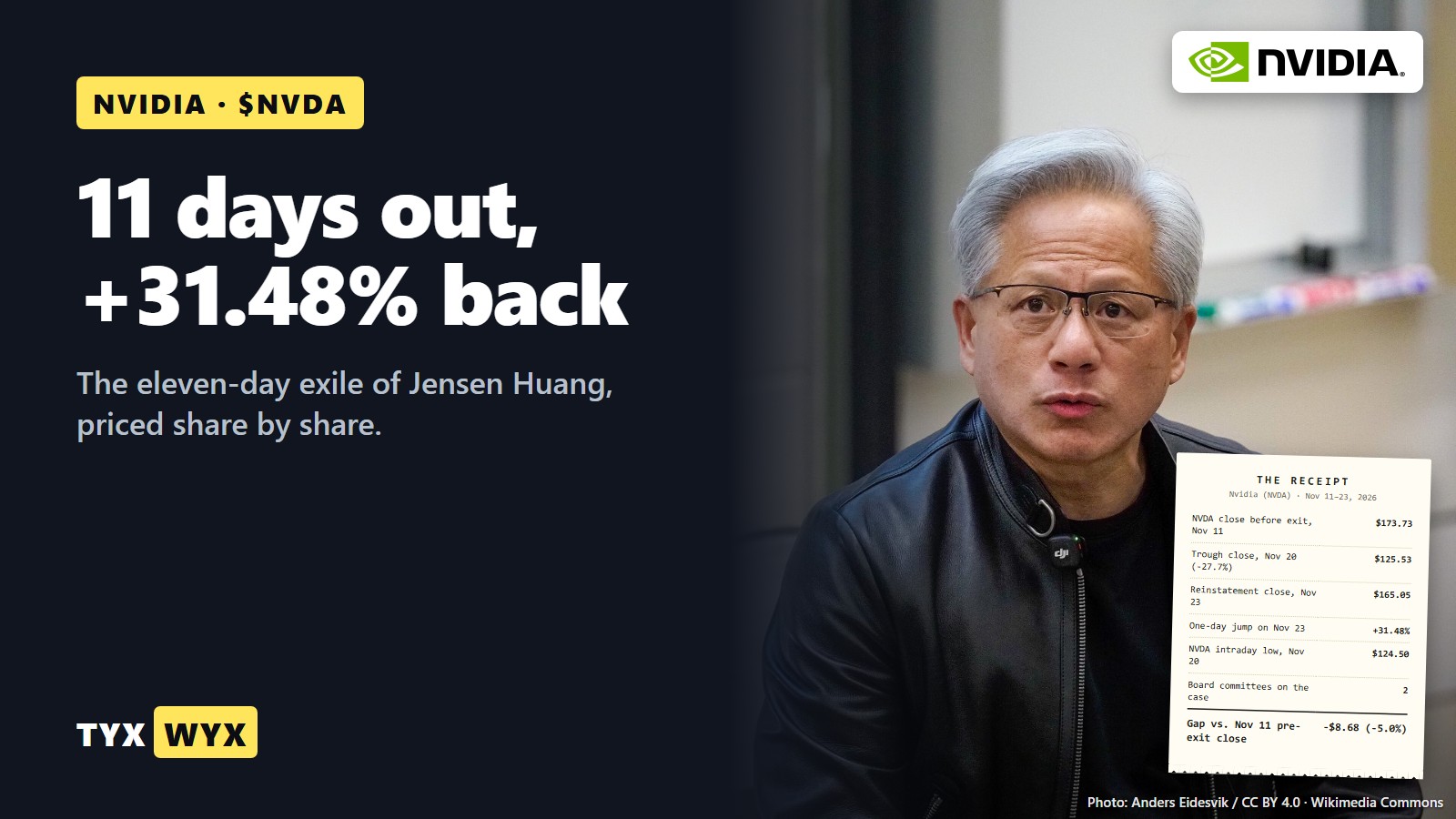
- Nvidia’s board unanimously reinstated Jensen Huang as president, CEO, and director on November 22, exactly 11 days after accepting his resignation.
- Shares sank 27.7% from $173.73 on November 11 to $125.53 on November 20, then surged 31.48% to $165.05 on November 23 — still $8.68 a share short of whole.
- Huang is back in his chair, but the board’s independent investigation into foreign intelligence targeting and federal inquiries remain wide open.
What happened
Eleven days without Jensen Huang cost Nvidia shareholders more than a quarter of their stock price, and bringing him back returned most of it in a single session. According to a Form 8-K — an official filing companies send the Securities and Exchange Commission for major events — and the press release attached to it, Nvidia’s board voted unanimously to reinstate Huang on Sunday, November 22, 2026.
The crisis began on November 11, when the board accepted Huang’s immediate resignation as president, chief executive officer, and director. When Nvidia disclosed the exit on November 12, it named Chief Financial Officer Colette Kress, 59, as interim CEO and made 33-year board veteran Harvey C. Jones its first-ever board chair.
That first filing offered no explanation for why the co-founder of the world’s most valuable chipmaker suddenly walked out. It stated only that “Jensen’s contributions to NVIDIA are profound” and that directors were searching for a permanent replacement. Over the next seven trading days, the stock tumbled from $173.73 to $125.53.
On Monday, November 23, Nvidia reversed course and announced Huang’s immediate return. Kress went back to her full-time CFO post, Jones kept the board chair, and 783 million shares changed hands as the stock vaulted 31.48% to close at $165.05.
THE RECEIPT
Nvidia (NVDA) · Nov 11–23, 2026
| NVDA close before exit, Nov 11 | $173.73 |
| Trough close, Nov 20 (-27.7%) | $125.53 |
| Reinstatement close, Nov 23 | $165.05 |
| One-day jump on Nov 23 | +31.48% |
| NVDA intraday low, Nov 20 | $124.50 |
| Board committees on the case | 2 |
| Gap vs. Nov 11 pre-exit close | -$8.68 (-5.0%) |
Drawdown (-27.7%) is ($125.53 – $173.73) ÷ $173.73; remaining gap (-5.0%, or -$8.68) is ($165.05 – $173.73) ÷ $173.73 from daily closing prices.
The 11-day tab: down 27.7%, up 31.48%, and still $8.68 short
If you only watched Monday’s headlines, a 31.48% rally after a 27.7% slide sounds like shareholders came out ahead. Percentage math does not work that way. Think of a $100 winter coat marked down 28% to $72, then marked back up 31%: the new price tag reads $94, not $103.
By our math on the daily closing table, Nvidia lost $48.20 per share between November 11 ($173.73) and the November 20 trough ($125.53). That was a 27.7% drop. Even at Friday’s intraday low of $124.50, sellers were pricing in a permanent leadership vacuum at the center of the AI boom.
Monday’s 31.48% surge added $39.52 per share back to the stock, lifting it to $165.05 after touching $171.50 intraday. TechCrunch reported that the shares opened about 30% higher that morning.
Put the two halves of the trip together and long-term holders are still down $8.68 a share, or 5.0%, from where Nvidia stood on November 11. The round trip repaired the panic, not the entire bill.
A petition, a president, and the strings attached to Huang’s chair
What made a board that had already hired a search firm reverse itself in eleven days? TechCrunch reported that on the third-quarter earnings call, chair Harvey C. Jones said the board did not intend to reinstate Huang, and that Nvidia had retained executive search firm Heidrick & Struggles to find a permanent replacement. At the same time, a long list of tech executives — including Elon Musk, Epic Games CEO Tim Sweeney, Travis Kalanick, Replit CEO Amjad Masad and Y Combinator CEO Garry Tan — signed a petition pushing for his return; TechCrunch reported it drew about 200,000 signatories.
Washington moved too. TechCrunch reported that President Donald Trump repeatedly voiced support for Huang and lobbied for the reinstatement; after the announcement, Trump wrote on Truth Social that the board “made the correct and proper decision to return” him. Nvidia’s official press release did not mention Trump by name, choosing careful language instead:
“In the process of reaching its decision, the Board received input from senior levels of the United States government, and based on that input, the Board is confident that Mr. Huang’s reinstatement poses no national security risk.”NVIDIA Form 8-K Exhibit 99.1, Nov 23, 2026
Still, Huang did not return to the same governance structure he left on November 11. In the same press release, the board listed three things that stay in place after his reinstatement:
- An independent directors’ committee formed to investigate reporting that Huang was the target of a foreign intelligence effort will proceed to conclusion.
- The board recently formed a National Security and Export Control Committee made up solely of independent directors.
- Nvidia is searching for a new Chief Compliance Officer and pledged to keep cooperating with government inquiries.
Huang struck a contrite note in the filing: “I take this responsibility with the greatest humility and renewed commitment.”
The other side
Critics point out that the underlying questions did not vanish over the weekend. Nvidia’s own press release says the independent committee’s investigation “will proceed to conclusion” — which means the board brought Huang back before its own inquiry was finished. Lawmakers in both parties noticed. Republican Senator John Cornyn wrote: “No national security risk? Based on what?” Democratic Representative Raja Krishnamoorthi wrote that “neither the government nor Nvidia’s own board has completed its investigation.” TechCrunch reported that Huang is scheduled to appear publicly before the Senate next week. Investors now carry the risk of whatever those inquiries turn up.
What it means for your wallet
Because Nvidia carries one of the largest weightings in both the S&P 500 and the Nasdaq 100, you felt this eleven-day swing even if you only hold broad index funds or a standard 401(k). On Monday the Nasdaq-100 ETF rose 7.00% and the S&P 500 ETF rose 4.71%, after falling 10.51% and 8.56% the week before.
For direct shareholders, the episode proved how big Nvidia’s key-man discount — the value a company loses when one irreplaceable leader walks out — really is. The market took more than a quarter off the share price in his absence, while the new board committees show that his autonomy inside the boardroom now comes with guardrails.
What we still don’t know
- Whether the board’s independent investigation into foreign intelligence targeting will ever be published for shareholders, or when it will conclude.
- Which senior U.S. government officials gave input to the board, and what they told it.
- Whether the U.S. government requested any private commitments on domestic investment or export controls in exchange for its input to the board.