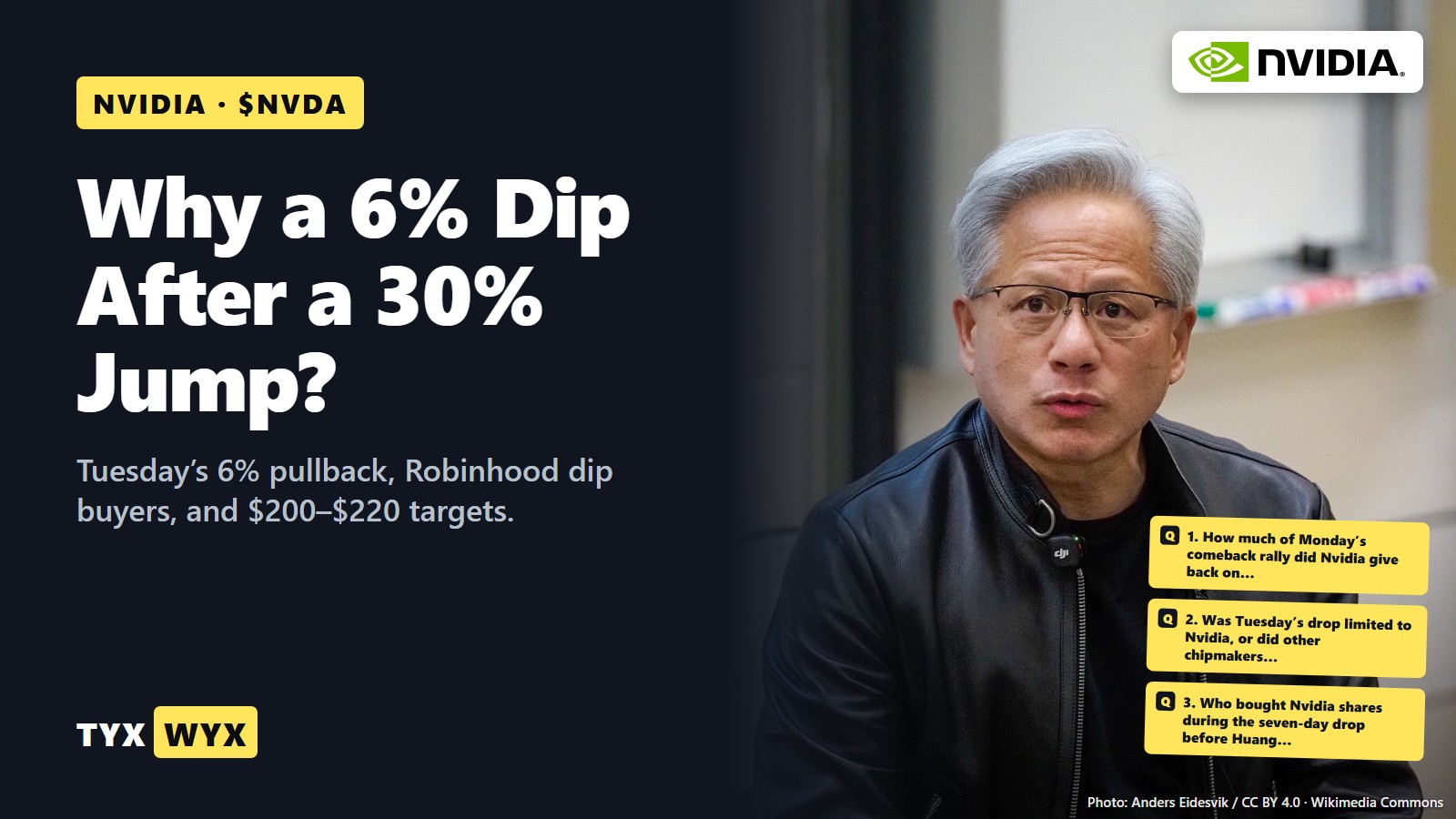
- Nvidia shares fell around 6% on Tuesday, paring Monday’s rally of over 30% following Jensen Huang’s return as chief executive officer, CNBC reported.
- Retail traders on Robinhood remained net buyers across a 28% seven-day drop after Huang’s Nov. 12 resignation, Semafor reported, while Bernstein and UBS kept $200 and $220 price targets, according to CNBC.
- Can Nvidia’s roughly 75% revenue-growth forecast and $390 billion in supply commitments outpace data-center financing worries and ongoing scrutiny?
What happened
Shares of Nvidia fell around 6% on Tuesday, giving back a slice of the over 30% surge recorded on Monday when co-founder Jensen Huang returned as chief executive officer, CNBC reported. Other U.S. chipmakers including Micron, Marvell Technology, Arm Holdings, and AMD also fell between 5% and nearly 9% in Tuesday morning trading, according to CNBC.
On Monday, Nvidia’s board of directors said it unanimously voted to reinstate Huang after “a series of discussions and meetings” with him, reversing his Nov. 12 resignation, CNBC and Semafor reported. Small traders on Robinhood who bought through a 28% seven-day decline reaped the rewards of Monday’s rebound, according to Semafor.
Tuesday’s pullback is like the morning after a stadium-shaking comeback win — Monday’s points stay on the scoreboard, but the team still has to play the rest of a grueling schedule. Even with a roughly 75% revenue-growth forecast for the next financial year and analyst price targets of $200 at Bernstein and $220 at UBS, investors are weighing roughly $390 billion in supply commitments and upcoming December questions in Congress, CNBC reported.
FIVE QUESTIONS
Nvidia (NVDA) · Tuesday pullback, retail dip buyers, and analyst outlook · Nov 24, 2026
1. How much of Monday’s comeback rally did Nvidia give back on Tuesday?
Nvidia shares fell around 6% on Tuesday (after sliding over 5% early in the session), paring a massive Monday rally sparked by the return of Jensen Huang as CEO, CNBC reported. On Monday, the stock had closed over 30% higher following the news of his reinstatement.
By our math, a 6-percentage-point pullback trims roughly one-fifth (6 divided by 30) of Monday’s 30-percentage-point surge. Gilbert told CNBC that part of Monday’s rally reflected investors recovering earlier losses rather than pricing in new growth.
2. Was Tuesday’s drop limited to Nvidia, or did other chipmakers fall too?
Other U.S. semiconductor stocks also opened lower on Tuesday after posting strong gains on Monday, CNBC reported. In morning trading, Micron declined 8%, Marvell Technology lost 5%, Arm Holdings dropped over 5%, and AMD shed nearly 9%, according to CNBC.
As CNBC noted, Huang and Nvidia have been central to the artificial intelligence story, supplying the chips that power AI and financing companies across the ecosystem.
3. Who bought Nvidia shares during the seven-day drop before Huang returned?
While Jensen Huang’s return was pushed by a faction of Silicon Valley’s elite, small traders piled in and reaped the rewards, Semafor reported. Nvidia was the most-traded name across all of Robinhood on Nov. 12, when Huang resigned, and the retail broker’s customers remained net buyers in the days that followed, a spokesman told Semafor.
Shares in Nvidia dropped 28% in the seven trading days following Huang’s resignation before rebounding on Monday upon the news of his return, and Robinhood said it saw “record-breaking traffic” on Monday after Nvidia’s pre-market release announcing Huang’s return, Semafor reported.
“The fundamentals of the company didn’t change, but the company fundamentally changed.”Joe Tigay, portfolio manager at Equity Armor Investments, as cited by Semafor
4. Why do Wall Street analysts remain optimistic about Nvidia?
After Huang’s reinstatement, several Wall Street analysts turned more bullish on the stock and upgraded their ratings on Nvidia, CNBC reported.
“We believe reinstatement of CEO Jensen Huang RETURNS Investor CONFIDENCE in the AI trade.”Mizuho analysts, Monday note, as cited by CNBC
Regarding growth and price targets, Gilbert pointed to Nvidia’s roughly 75% revenue-growth forecast for the next financial year as evidence of strong near-term demand, CNBC reported. Bernstein restored its “Outperform” rating and kept its $200 price target, while UBS maintained its $220 target, according to CNBC. Gilbert told CNBC that having Huang back at the helm goes a long way toward easing concerns beyond next year “because he’s the one who sits down with the biggest customers and gets those multi-year orders over the line.”
5. What dates and business commitments are investors watching next?
In Washington, Huang is expected to sit for a closed-door interview with the House Foreign Affairs, Intelligence and China Select committees on Dec. 1 and is set to publicly testify before the Senate Banking Committee on Dec. 3, CNBC reported. Bank of America wrote in a Monday note, as cited by CNBC, that “Reinstatement should not be confused with the end of scrutiny.”
On the commercial side, UBS flagged Nvidia’s roughly $390 billion in supply commitments and the need to keep demand flowing through its ecosystem, CNBC reported. Bernstein analyst Stacy Rasgon said worries about whether AI spending is achievable and sustainable were not caused solely by Huang’s departure, while Luria told CNBC that concerns remain over the cost of financing data centers, potential overbuilding by neocloud companies, and obstacles to building new facilities.
What we still don’t know
- Whether customer orders and artificial intelligence investment can sustain Nvidia’s roughly 75% revenue-growth forecast for the next financial year beyond near-term demand, as Gilbert noted to CNBC.
- Whether demand across Nvidia’s ecosystem will keep pace with the roughly $390 billion in supply commitments flagged by UBS, amid the data-center financing costs, potential neocloud overbuilding, and facility construction obstacles cited by Luria to CNBC.